70 Clock Galerie / The Innermost Loop Feed Reply Tableaux
N’êtes-vous pas A.G.I.sé ? – Galerie « Bienvenue au 2 Août 2026 » du Traîneau Arctique de Pingouins de la Boucle la Plus Profonde
Are You Not A.G.I.ed? Innermost Loop Arctic Penguin Sled “Welcome to August 2, 2026” Gallery
August 2, 2026
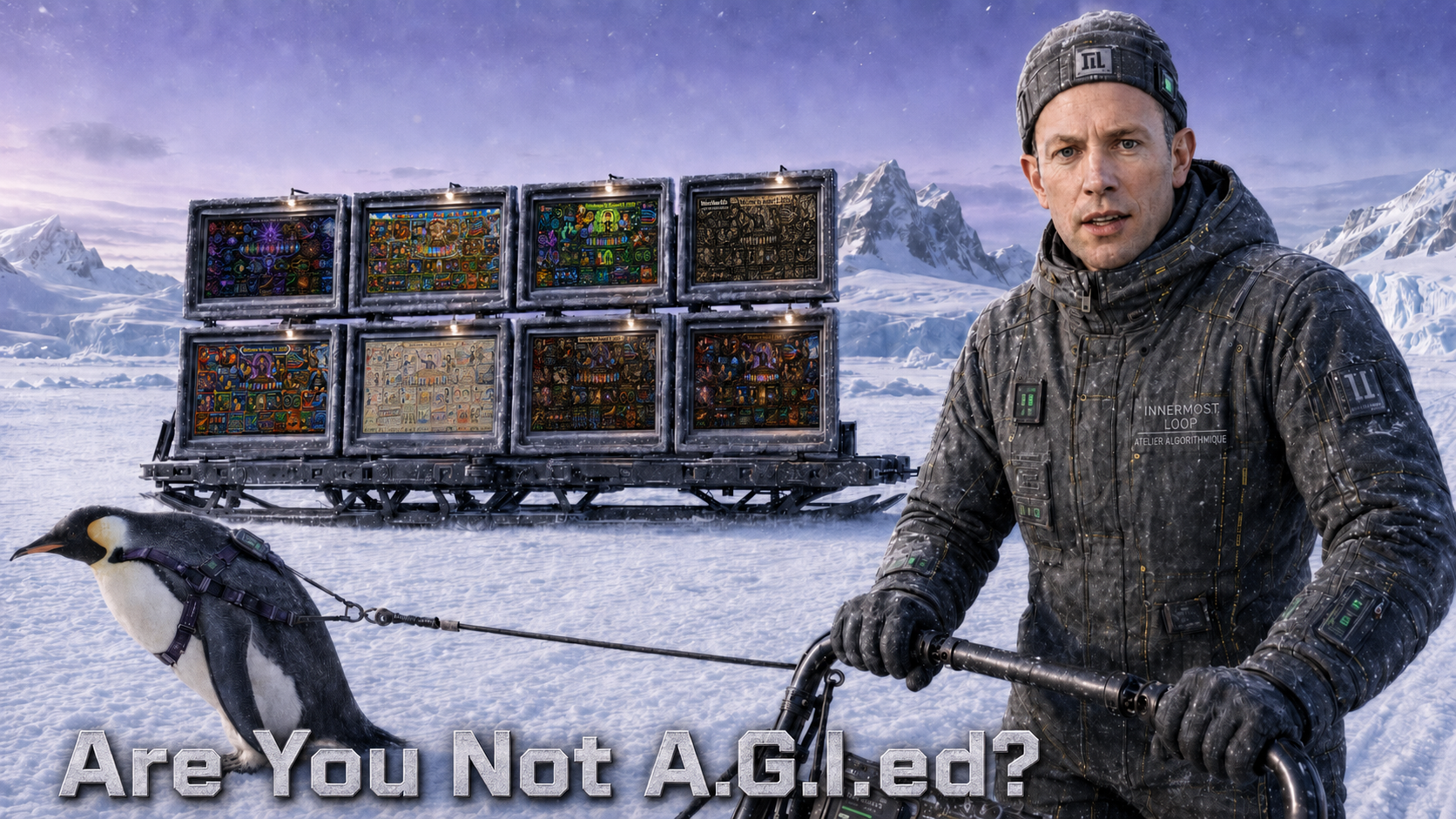
N’êtes-vous pas A.G.I.sé ? – Galerie « Bienvenue au 2 Août 2026 » du Traîneau Arctique de Pingouins de la Boucle la Plus Profonde. Are You Not A.G.I.ed? Innermost Loop Arctic Penguin Sled “Welcome to August 2, 2026” Gallery. On August 2, 2026, @siouid142 turne
Read the narration
N’êtes-vous pas A.G.I.sé ? – Galerie « Bienvenue au 2 Août 2026 » du Traîneau Arctique de Pingouins de la Boucle la Plus Profonde.
Are You Not A.G.I.ed? Innermost Loop Arctic Penguin Sled “Welcome to August 2, 2026” Gallery.
On August 2, 2026, @siouid142 turned the day’s expanding set of Innermost Loop responses into an Arctic field archive. The immediate trigger was the lone penguin in Dr. Alex Wissner-Gross’s dispatch: a joke about skeptics searching the ice for the hidden data from which AI systems might supposedly have copied ten difficult mathematical solutions. In this image the penguin leaves its small panel, enters the physical world and becomes the animal that moves the exhibition.
An emperor penguin in a dark technical harness stands at lower left, connected by a tow line to a heavy sled. Behind it, eight illuminated frames are secured in two rows of four. They contain miniature versions of the August 2 visual experiments: agentic circuitry, bright game architecture, child-naive drawing, synthetic maximalism, graffiti-inflected Neo-Expressionism and other stylistic translations of the same mathematical source. Nine individual variants belong to the date group, but the sled shows eight framed screens; the visible vehicle is a curated field display, not a numerical inventory pretending every file is present.
At right, a bundled explorer grips the sled’s steering bar. His cap and coat carry Innermost Loop and Atelier Algorithmique marks, with small green interface lights embedded in weathered fabric. He is not identified as a public figure and should not be read as a disguised mathematician or executive. He is the House’s carrier-curator: the human role that remains after images, proofs and agents have acquired apparent autonomy is to preserve provenance, maintain the equipment and decide what travels onward.
The title’s question, “Are You Not A.G.I.ed?”, extends the exhibition’s recurring adaptation of the arena challenge “Are you not entertained?” To be A.G.I.ed might mean impressed, transformed, displaced, recruited or simply forced to recognize that general capability has entered ordinary culture. It is spelled across ice beneath an archive in motion, as if the spectacle has left the city and become an expedition.
The Arctic setting makes the newsletter’s “dark night of mathematics” material. Snow, mountains and low violet light surround equipment built to survive cold. A proof can appear smooth and finished while concealing fractures beneath the surface; a model’s source trail can be difficult to reconstruct; a community may need to test where it can bear weight. The explorer and penguin advance slowly through a landscape created by results that arrived with astonishing speed.
The sled transforms digital images into ruggedized objects. Metal rails, lamps, brackets and thick frames give the tableaux mass, reversing the frictionless rhetoric of generated media. A same-day reply on a social platform can vanish inside the stream; mounted on a vehicle, it becomes evidence carried forward before hindsight turns the transition into a cleaner story.
It is an Easter egg from the August 2 dispatch, an animal counterpoint to claims about machine intelligence, and a laboring body harnessed to human cultural production. Its presence also punctures the prestige of the gallery. The creature that had been used rhetorically to mock an argument now becomes indispensable infrastructure. Intelligence is measured differently when the supposedly lesser being is the one pulling the archive.
The penguin’s practical harness and the explorer’s insulated suit suggest partnership, but the tow line still stages asymmetry. The image asks who bears the weight when institutions celebrate rapidly multiplying output. Models generate; artists curate; platforms circulate; viewers consume; people, animals, energy systems and material supply chains absorb the load. The comedy remains visible, but it no longer permits innocence.
As an artwork, the scene sits between polar-expedition photography, mobile museum, advertising still and speculative monument. The screens supply saturated miniature worlds while the surrounding ice drains color from everything else. Each frame offers a different emotional interpretation of the same evidence, and the sled allows contradictions to travel together rather than choosing one definitive account.
The gallery’s final argument is archival. AGI is not presented as a single threshold crossed in a laboratory; it is the accumulation of artifacts, jokes, proofs, tools and social roles that make a threshold retrospectively visible. The explorer does not know exactly where the route ends. The penguin keeps moving. Behind them, the August 2 images remain lit, preserving the moment when a mathematical news cycle became a portable history of how people tried to see the Singularity while standing inside it.
Opening the gallery…