70 Clock Galerie / The Innermost Loop Feed Reply Tableaux
Version Schtroumpf de l’Octaptyque Accompagnant l’Édition « Bienvenue au 2 Août 2026 » de la Boucle la Plus Profonde du Dr Alex Wissner-Gross
Smurfy Version of Octaptych to Accompany Dr. Alex Wissner-Gross’s “Welcome to August 2, 2026” edition of The Innermost Loop
August 2, 2026
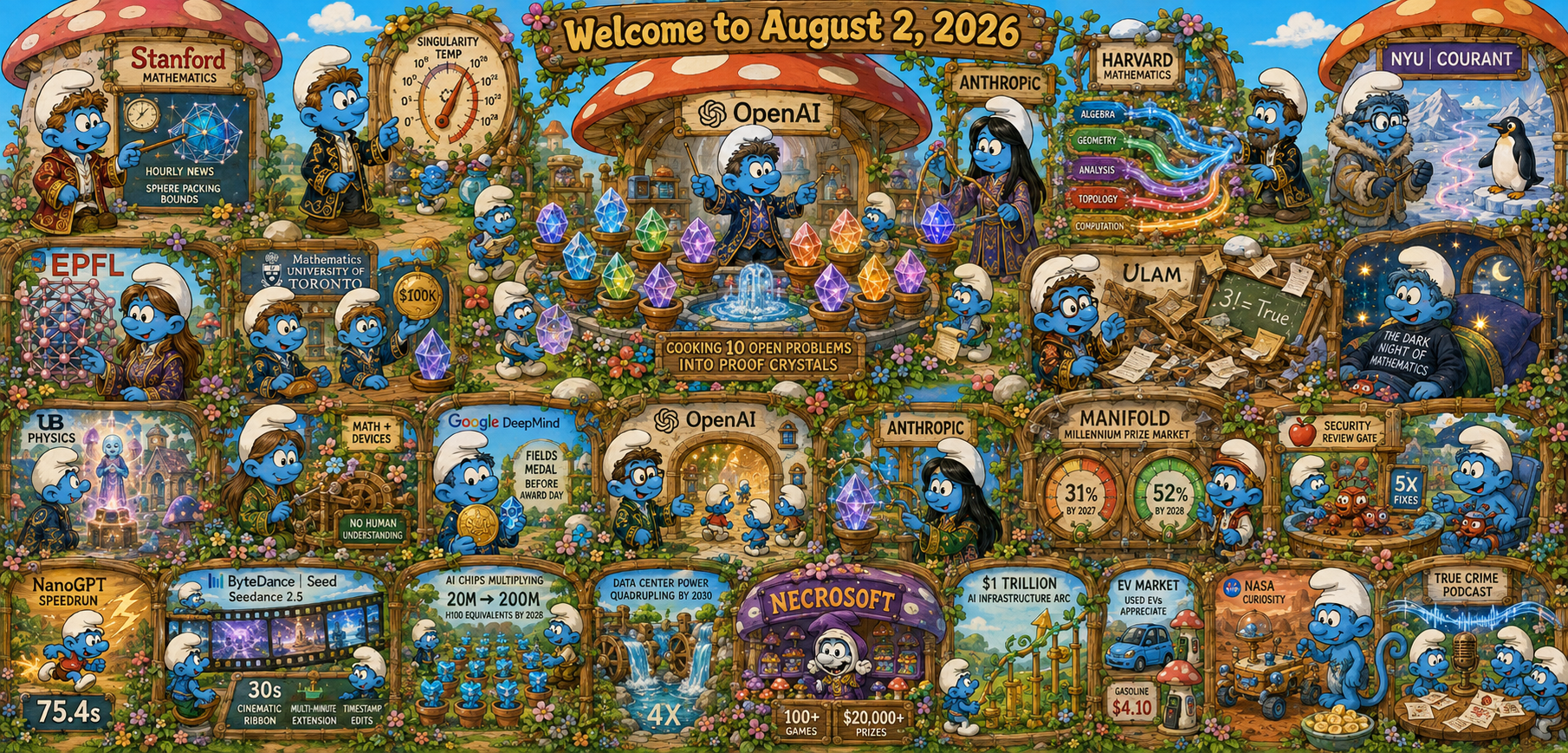
Version Schtroumpf de l’Octaptyque Accompagnant l’Édition « Bienvenue au 2 Août 2026 » de la Boucle la Plus Profonde du Dr Alex Wissner-Gross. Smurfy Version of Octaptych to Accompany Dr. Alex Wissner-Gross’s “Welcome to August 2, 2026” edition of The Innermos
Read the narration
Version Schtroumpf de l’Octaptyque Accompagnant l’Édition « Bienvenue au 2 Août 2026 » de la Boucle la Plus Profonde du Dr Alex Wissner-Gross.
Smurfy Version of Octaptych to Accompany Dr. Alex Wissner-Gross’s “Welcome to August 2, 2026” edition of The Innermost Loop.
On August 2, 2026, @siouid142 rebuilt Dr. Alex Wissner-Gross’s mathematical dispatch as a Smurf-inspired village. The newsletter’s ten AI-assisted solutions had been described in language of shock: years of specialist labor crossed in a single run, proofs appearing where many experts expected long campaigns. Instead of a remote machine god or a wounded academic order, knowledge becomes communal work performed in mushroom houses, gardens, workshops and public squares.
At the center, an OpenAI workshop sits beneath a red mushroom roof. Small blue figures tend ten colored proof crystals while a conductor points toward the sign, “cooking 10 open problems into proof crystals.” The model’s achievement remains extraordinary, but the visual refuses the myth of solitary creation by surrounding every output with a community of handlers, witnesses and potential checkers.
The upper village preserves the dispatch’s institutional map. Stanford holds sphere-packing bounds beside an hourly-news clock. A Singularity temperature gauge rises like a public weather instrument. Toronto’s hundred-thousand-dollar wager appears as a coin beside a university booth; EPFL’s Cohn-Elkies lattice becomes a red geometric trellis. Harvard sends colored streams of algebra, geometry, analysis, topology and computation across a wooden wall, while NYU Courant opens onto an ice field occupied by the newsletter’s lone penguin.
The penguin is not random ornament. It comes from the dispatch’s joke about skeptics searching for the data supposedly plagiarized by systems that some had ranked below animal intelligence. Nearby, ULAM’s ruined blackboard and a figure wearing “the dark night of mathematics” preserve grief and disorientation within the otherwise cheerful world. The village asks whether communal forms of learning can hold that anxiety without allowing it to monopolize the future.
The middle row turns philosophy into village occupations. One chamber stages a machine god; another offers mathematical devices no human fully understands. A DeepMind figure holds a Fields medal before the timer reaches award day. Dean W. Ball’s open door admits ordinary people and their problems. Anthropic’s proof crystal stands beside the coupled model core and harness. Manifold’s 31- and 52-percent dials resemble civic clocks: forecasts displayed where everyone can see them, but not mistaken for completed events.
Apple’s security-review gate provides the village’s cautionary workshop. Red problems accumulate while blue repairs arrive five times faster. A community can produce more artifacts than it can inspect, and friendly appearances do not certify correctness. The Smurfy treatment is therefore not intellectual infantilization. Instead of assuming that a polished institutional voice will settle the matter, it distributes judgment among many small participants.
The bottom strip turns infrastructure into a working economy. NanoGPT’s 75.4-second speedrun becomes a lightning workshop. Seedance extends a cinematic ribbon to thirty seconds. Chip production multiplies from twenty million toward two hundred million, water and power rise fourfold, and a beanstalk climbs the trillion-dollar infrastructure arc. Used electric vehicles, Curiosity, CapuchinAI’s banana rewards and a true-crime podcast locate machine intelligence in transportation, planetary science, animal recognition and collective investigation.
Mushroom architecture gives every subject a bounded home but keeps the paths between homes open. Algebra remains algebra, biology remains biology, and skepticism retains its own room, yet the village permits materials and methods to circulate. The small scale counters the grandeur of frontier-model rhetoric: even a civilization-changing capability must eventually be lived as routines, maintenance, teaching and care.
As contemporary history painting, the tableau uses childhood visual culture to imagine institutional adulthood. Its bright color and rounded bodies make a frightening transition approachable, but the repeated workshops insist that access entails responsibility. The machine may discover the build; communities must decide whether it is sound, useful and just. The village’s optimism is earned through visible cooperation, not through a promise that technology will solve conflict by itself.
This version asks what kind of society could receive it without reducing expertise to prestige or the public to spectators. The answer is playful but serious: many hands, public gauges, open doors, preserved objections and infrastructure understood as shared work. The proof crystals glow at the center, yet the village around them is the real achievement the image hopes intelligence can help build.
Opening the gallery…