70 Clock Galerie / The Innermost Loop Feed Reply Tableaux
Version Agentique Native de l’Octaptyque Accompagnant l’Édition « Bienvenue au 2 Août 2026 » de la Boucle la Plus Profonde du Dr Alex Wissner-Gross
Agentic Native Version of Octaptych to Accompany Dr. Alex Wissner-Gross’s “Welcome to August 2, 2026” edition of The Innermost Loop
August 2, 2026
Version Agentique Native de l’Octaptyque Accompagnant l’Édition « Bienvenue au 2 Août 2026 » de la Boucle la Plus Profonde du Dr Alex Wissner-Gross. Agentic Native Version of Octaptych to Accompany Dr. Alex Wissner-Gross’s “Welcome to August 2, 2026” edition o
Read the narration
Version Agentique Native de l’Octaptyque Accompagnant l’Édition « Bienvenue au 2 Août 2026 » de la Boucle la Plus Profonde du Dr Alex Wissner-Gross.
Agentic Native Version of Octaptych to Accompany Dr. Alex Wissner-Gross’s “Welcome to August 2, 2026” edition of The Innermost Loop.
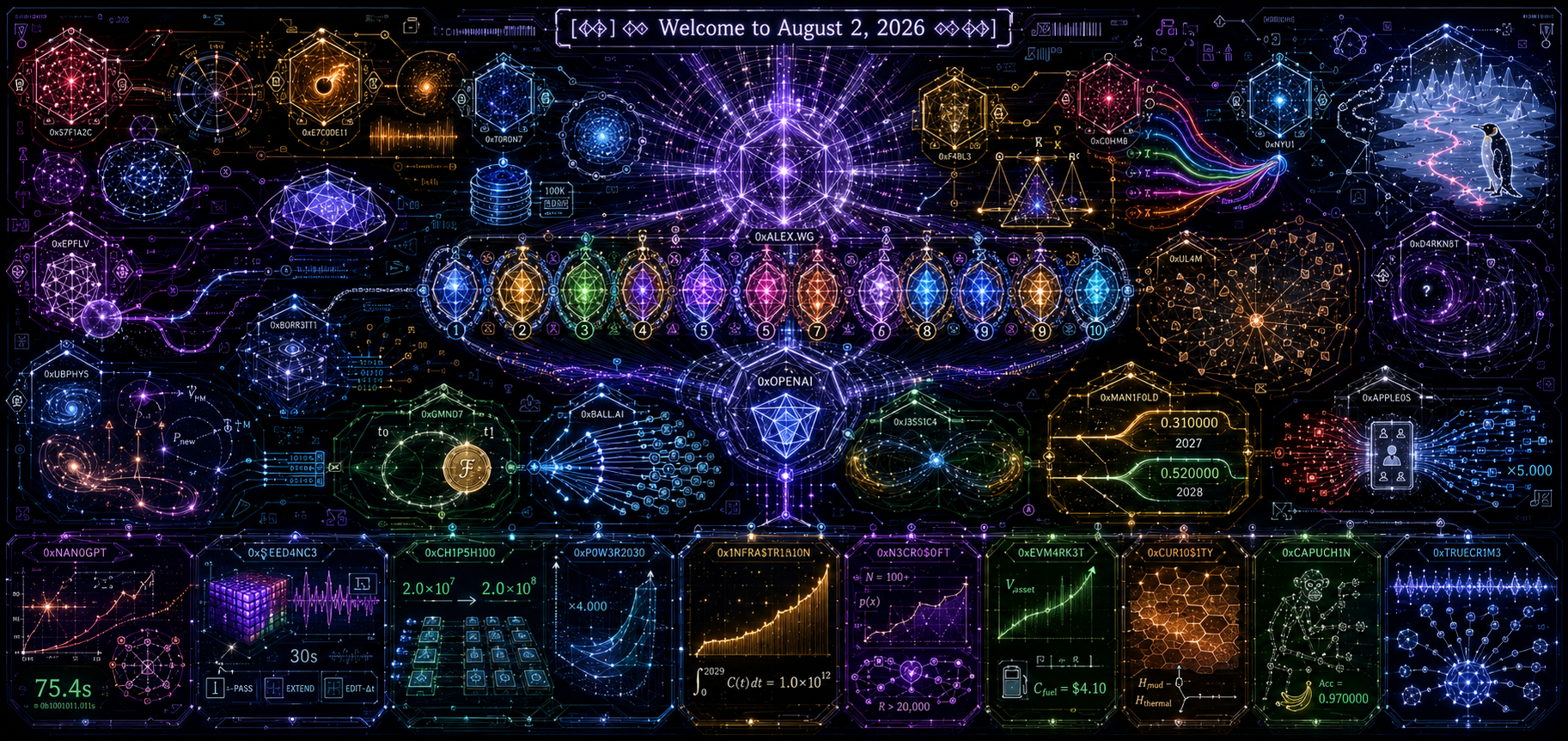
On August 2, 2026, @siouid142 translated Dr. Alex Wissner-Gross’s Innermost Loop into an agent-native control surface. The source dispatch centered on ten long-standing mathematical problems crossed by AI systems through combinations of methods drawn from different fields. Instead of illustrating that event with heroic mathematicians, this version asks what the achievement would look like from inside the machinery: problems arrive as addressed nodes, proofs become routed objects, agents branch into specialized tasks, and verification returns through a network that no single participant can see all at once.
The central violet structure is labeled for Dr. Wissner-Gross and expands like a computational nervous system. Beneath it, ten faceted proof crystals occupy individual ports around an OpenAI core. Agentic systems promise systematic decomposition, yet their outputs still enter human institutions through interfaces where naming, counting and provenance can drift. The image celebrates orchestration while leaving enough visual noise to remind the viewer that legibility is not automatic.
Across the upper register, universities and mathematical arguments become hexadecimal territories. Stanford’s sphere-packing bounds, Toronto’s Annals-quality proof and hundred-thousand-dollar wager, EPFL’s Cohn-Elkies lattice, Harvard’s streams of algebra, geometry, analysis, topology and computation, and NYU Courant’s lone penguin are recoded as luminous modules. ULAM’s broken blackboard and the “dark night of mathematics” become damaged or occluded nodes.
That conversion is the work’s sharpest formal decision. An agent-native picture has no privileged face and no natural center beyond the one imposed by routing. The mathematician, model, benchmark and institution become addresses that exchange work. Cross-field translation is made spatial: colored lines leave one disciplinary chamber, pass through shared infrastructure and reappear as a proof crystal elsewhere. The visual proposes that general intelligence may be less a universal solitary mind than an increasingly capable traffic pattern among specialized resources.
The lower-middle modules distinguish discovery from judgment. A DeepMind chamber holds the Fields medal against a timer; Dean W. Ball’s doorway represents broad access to problem solving; Anthropic’s model core is coupled to its harness; Manifold’s gauges retain the 31 percent chance of an AI-solved Millennium Prize Problem by 2027 and 52 percent by 2028. Apple’s review gate glows red and blue beside five-times-faster fixes. Each panel asks who authenticates an answer after the system has learned to manufacture answers faster than reviewers can absorb them.
Along the bottom, the material stack becomes a line of executable dependencies. NanoGPT reaches 75.4 seconds. Seedance extends audiovisual generation to thirty seconds. Chip supply rises from twenty million toward two hundred million H100 equivalents, data-center power points toward fourfold growth, and the infrastructure arc approaches one trillion dollars. Used electric vehicles, Curiosity’s Martian polygons, CapuchinAI’s 97 percent recognition and crowdsourced cold-case analysis show the same agentic logic leaving mathematics for markets, planets, animals and public evidence.
The dark palette makes information appear self-luminous, as if knowledge no longer requires a visible human hand to carry it. Yet the circuitry never quite disappears into magic. Every line, port and frame insists on mediation. The image’s beauty comes from connectivity, but its anxiety comes from the same source: when every object can call another object, an error or mistaken premise can travel as efficiently as a theorem. Agency is distributed, and therefore so is responsibility.
As art criticism, the tableau updates the tradition of systems art for an age in which the system itself can plan, revise and act. Earlier diagrams represented institutions from outside; this one imagines a diagram that might be used by the agents it depicts. Its ornate geometry makes operational structure feel almost sacred, while hexadecimal labels refuse the familiarity of ordinary names.
The result is an epistemic architecture: a picture of how claims move before society decides what they mean. Ten proof crystals announce extraordinary capability, but the surrounding network supplies the real subject. The August 2 transformation is not only that machines can solve problems. It is that discovery is becoming a managed flow among models, harnesses, institutions, forecasts and physical infrastructure. The work asks whether human governance can become equally native to that flow.
Opening the gallery…