70 Clock Galerie / The Innermost Loop Feed Reply Tableaux
Version Cubiste de l’Octaptyque Accompagnant l’Édition « Bienvenue au 2 Août 2026 » de la Boucle la Plus Profonde du Dr Alex Wissner-Gross
Cubist Version of Octaptych to Accompany Dr. Alex Wissner-Gross’s “Welcome to August 2, 2026” edition of The Innermost Loop
August 2, 2026
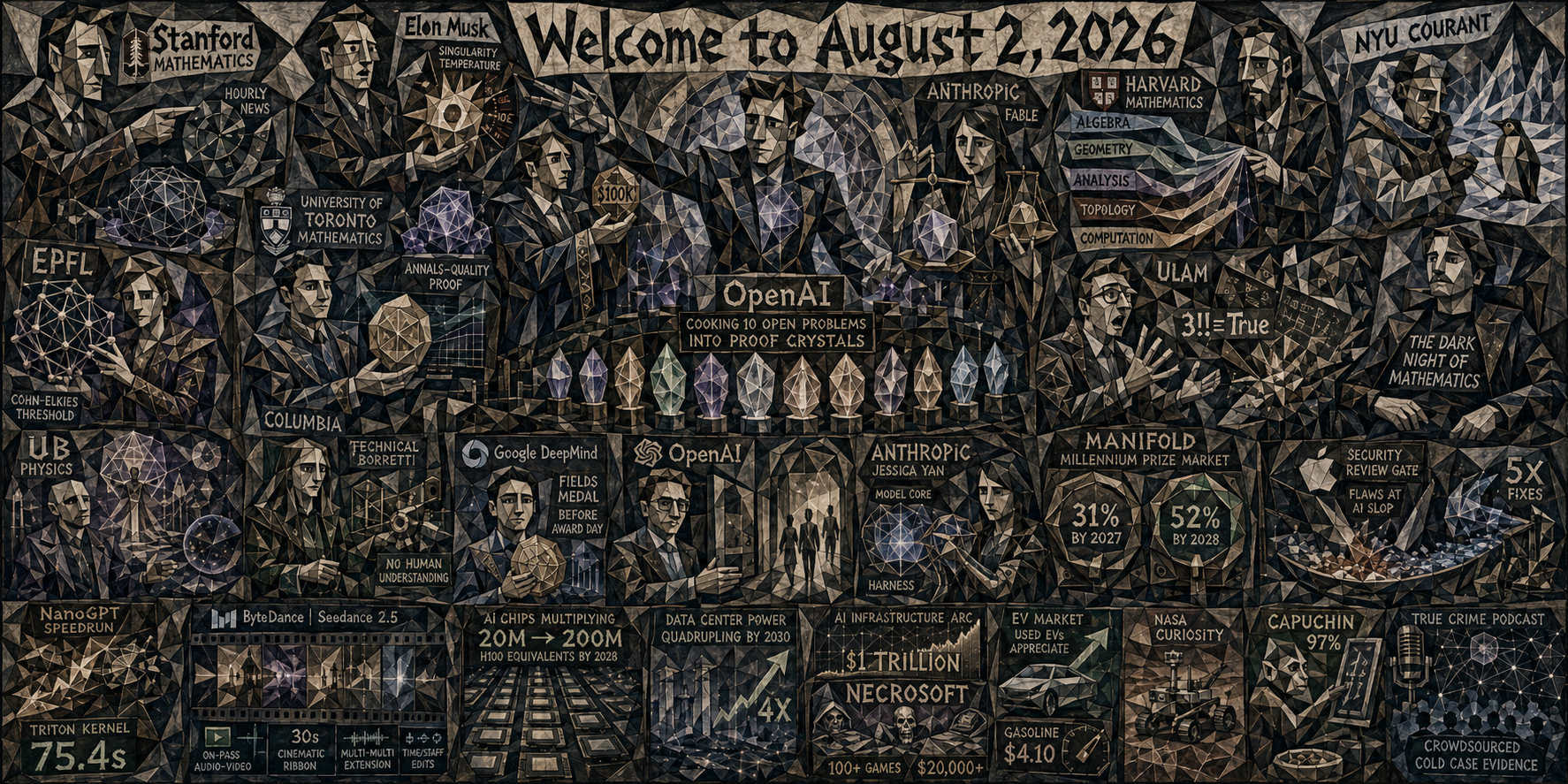
Version Cubiste de l’Octaptyque Accompagnant l’Édition « Bienvenue au 2 Août 2026 » de la Boucle la Plus Profonde du Dr Alex Wissner-Gross. Cubist Version of Octaptych to Accompany Dr. Alex Wissner-Gross’s “Welcome to August 2, 2026” edition of The Innermost L
Read the narration
Version Cubiste de l’Octaptyque Accompagnant l’Édition « Bienvenue au 2 Août 2026 » de la Boucle la Plus Profonde du Dr Alex Wissner-Gross.
Cubist Version of Octaptych to Accompany Dr. Alex Wissner-Gross’s “Welcome to August 2, 2026” edition of The Innermost Loop.
On August 2, 2026, @siouid142 fractured Dr. Alex Wissner-Gross’s Innermost Loop into a Cubist field of overlapping planes. The source dispatch described ten mathematical problems crossed by AI systems through cross-field translation: methods from one domain were recombined into verifiable constructions in another. Cubism supplies a historical language for that operation. It abandons one stable viewpoint so an object can be understood through several angles held at once.
The central OpenAI chamber is not a window into a coherent machine. It is a dark nexus from which ten faceted proof crystals emerge. Each crystal contains multiple surfaces and changing tonal edges, making proof look less like a single flash of insight than a structure that becomes legible through rotation. The surrounding portraits share the same geometry, as though human faces, institutional logos and mathematical objects have entered one common analytic space.
Stanford’s sphere-packing bounds are already ideal Cubist subjects: geometry represented through planes, intersections and constrained volume. Toronto’s Annals-quality proof appears beside the hundred-thousand-dollar wager as overlapping measures of intellectual and economic value. EPFL’s Cohn-Elkies threshold becomes a crystalline net, while Harvard’s algebra, geometry, analysis, topology and computation are compressed into separate bands that cross one another without merging completely.
The NYU Courant snowfield and lone penguin are broken into the same facets as the human observer. Columbia’s technical crux is nearly lost among angular fragments of boilerplate. ULAM’s destroyed blackboard turns proof notation into debris, and Kirwin Hampshire’s dark night occupies a seated figure whose body is composed from the same shards as the room. The style refuses to separate external breakthrough from internal disorientation.
The middle tier treats mathematical religion and technological production as simultaneous views of one transition. Will Kinney’s machine god is a luminous polygonal body. Fernando Borretti’s marvelous devices become assemblages whose functions exceed a single observer. A DeepMind figure holds the Fields medal; Dean W. Ball faces a doorway toward mass use; Anthropic’s model core and harness occupy adjacent planes. No interpretation is allowed to dominate the whole picture.
Manifold’s 31 percent by 2027 and 52 percent by 2028 gauges retain small areas of green but remain embedded in the fractured surface. Apple’s security-review gate and five-times-faster fixes appear as competing flows of red and blue shards. The contrast distinguishes uncertainty, achievement and overload. Forecasts are viewpoints, outputs are objects and institutional review is the practice through which either acquires meaning.
The bottom band grounds abstraction in matter. NanoGPT’s 75.4 seconds, Seedance, chip growth from twenty million toward two hundred million H100 equivalents, quadrupling power demand and a trillion-dollar infrastructure arc are rendered as repeating angular units. Used electric vehicles, Curiosity, CapuchinAI and cold-case crowds enter the same visual syntax. Mathematics does not float above the world; it shares a plane with energy, prices, animals and public evidence.
The near-monochrome palette withdraws the celebratory colors used by the Ben 10, Mario and LEGO variants. What remains is structure, tension and a few controlled lights. Cubist simultaneity makes the viewer work to reconstruct the scene, which parallels the human task after a machine produces a surprising proof. Verification is not passive reception. It is the labor of examining different faces until the construction holds.
As art criticism, the work resists two comforting stories: that machine discovery is merely the old human process performed faster, or that it is an alien event wholly outside human mathematics. The faceted world shows continuity and rupture together. Models recombine fields created by people, yet the scale and tempo of that recombination change professional identity and authority. There is no single correct vantage from which the transformation appears wholly triumphant or wholly catastrophic.
The Cubist octaptych therefore ends this checkpoint with a governance lesson. When intelligence sees many domains at once, society must cultivate institutions capable of examining many consequences at once. The proof crystal cannot be judged from its brightest face. Neither can the Singularity. Understanding requires rotation, disagreement and the willingness to preserve fractures long enough for a more complete object to emerge.
Opening the gallery…