70 Clock Galerie / The Innermost Loop Feed Reply Tableaux
Version LEGO de l’Octaptyque Accompagnant l’Édition « Bienvenue au 2 Août 2026 » de la Boucle la Plus Profonde du Dr Alex Wissner-Gross
Legos Version of Octaptych to Accompany Dr. Alex Wissner-Gross’s “Welcome to August 2, 2026” edition of The Innermost Loop
August 2, 2026
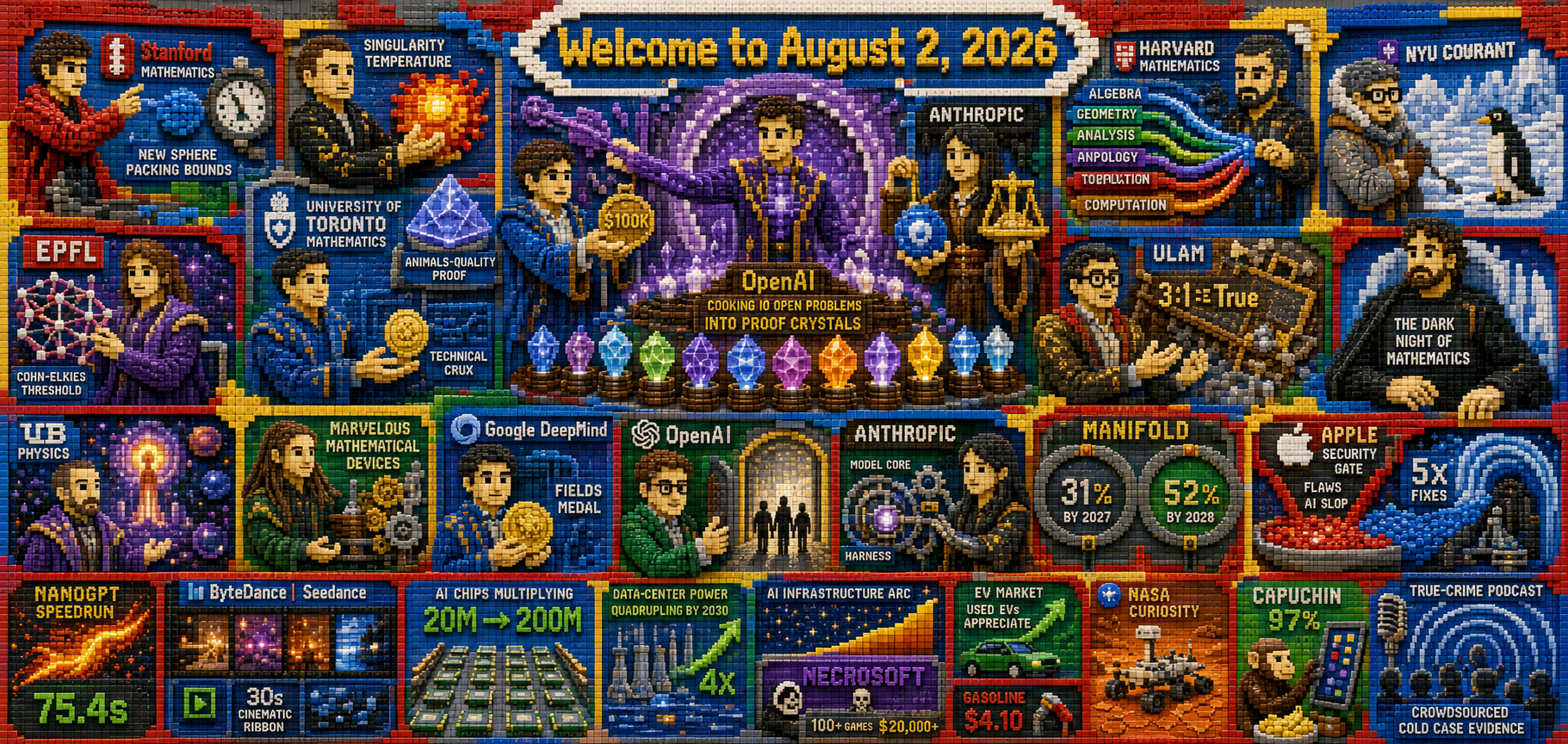
Version LEGO de l’Octaptyque Accompagnant l’Édition « Bienvenue au 2 Août 2026 » de la Boucle la Plus Profonde du Dr Alex Wissner-Gross. Legos Version of Octaptych to Accompany Dr. Alex Wissner-Gross’s “Welcome to August 2, 2026” edition of The Innermost Loop.
Read the narration
Version LEGO de l’Octaptyque Accompagnant l’Édition « Bienvenue au 2 Août 2026 » de la Boucle la Plus Profonde du Dr Alex Wissner-Gross.
Legos Version of Octaptych to Accompany Dr. Alex Wissner-Gross’s “Welcome to August 2, 2026” edition of The Innermost Loop.
On August 2, 2026, @siouid142 rebuilt Dr. Alex Wissner-Gross’s Innermost Loop as a LEGO relief. The source dispatch centered on ten AI-assisted mathematical solutions and on frontier models’ unusual strength at translating across fields into verifiable constructions. LEGO makes that claim physical. Every portrait, proof, institution and industrial trend is assembled from standardized pieces whose connections remain visible.
The central OpenAI chamber presents ten colored proof crystals beneath a purple mathematical canopy. Their pedestals are built from repeated round bricks, and the surrounding figures are block-bodied minifigures. A proof is thereby imagined as a structure made from lemmas small enough to connect, detach and inspect. The model’s achievement is not represented as mystical inspiration but as the rapid discovery of a build that holds together.
At upper left, Stanford’s new sphere-packing bounds sit beside an hourly-news clock, while Elon Musk carries the glowing Singularity temperature. Toronto displays the hundred-thousand-dollar wager and Annals-quality proof. Anthropic balances a blue construction against the Fields medal. Harvard’s algebra, geometry, analysis, topology and computation become separate colored brick streams that can be joined without losing their identities.
EPFL’s Cohn-Elkies threshold is a lattice in the most literal sense. Columbia’s chamber distinguishes technical crux from the surrounding pieces. NYU Courant encloses a snowfield and lone penguin; ULAM presents a damaged blackboard; Kirwin Hampshire wears the dark night of mathematics. The modular format gives every objection its own bay, resisting the idea that one successful machine build automatically resolves the human debate around it.
The middle tier addresses prestige and deployment. Will Kinney’s machine god is assembled from the same studs as the people who fear it. Fernando Borretti’s marvelous devices become mechanisms whose parts can be handled even when their total behavior is not understood. A DeepMind researcher holds a Fields medal, Dean W. Ball opens a door toward general access and Anthropic’s model core locks into its harness like two interdependent subassemblies.
Manifold’s 31- and 52-percent gauges are circular brick instruments rather than prophecies. Apple’s security gate divides red reports from blue fixes, showing how standardized inputs can still overwhelm human review when quality varies. LEGO’s visual promise of checkability is useful precisely because it exposes the missing step: a pile of compatible pieces is not yet a trustworthy construction, and a fluent derivation is not yet a verified proof.
The bottom row turns infrastructure into baseplates. NanoGPT’s 75.4-second run, Seedance, twenty million chips scaling toward two hundred million, fourfold power demand and the trillion-dollar investment curve form the industrial foundation beneath the proof chamber. Used electric vehicles, Curiosity’s Martian polygons, CapuchinAI’s banana-paid recognition and true-crime crowdsourcing show the same modular intelligence being attached to very different worlds.
LEGO also changes the status of the human figures. Minifigures are individualized by hair, clothing and props, yet their bodies are interchangeable. That tension fits a dispatch in which specialist knowledge can be recombined by a general system. Standardization enables scale and collaborative construction, but it can also make expertise look like another replaceable component. The image preserves names and institutions to resist that erasure.
As an artwork, the relief sits between mosaic, toy architecture and systems diagram. Its color blocks create order without pretending that the world is seamless. Seams are everywhere, and that is the critical insight. Visible joints make revision part of the image’s ethics. Cross-field translation is powerful when interfaces truly fit; governance begins by discovering where they do not. The ten proofs may indicate that machine builders have become extraordinarily capable. The LEGO world asks whether humans will remain active builders—able to inspect, revise and choose the structure—or become decorative figures snapped into a design whose instructions arrived from elsewhere.
Opening the gallery…