70 Clock Galerie / The Innermost Loop Feed Reply Tableaux
Version Super Mario World de l’Octaptyque Accompagnant l’Édition « Bienvenue au 2 Août 2026 » de la Boucle la Plus Profonde du Dr Alex Wissner-Gross
Super Mario World Version of Octaptych to Accompany Dr. Alex Wissner-Gross’s “Welcome to August 2, 2026” edition of The Innermost Loop
August 2, 2026
Version Super Mario World de l’Octaptyque Accompagnant l’Édition « Bienvenue au 2 Août 2026 » de la Boucle la Plus Profonde du Dr Alex Wissner-Gross. Super Mario World Version of Octaptych to Accompany Dr. Alex Wissner-Gross’s “Welcome to August 2, 2026” editi
Read the narration
Version Super Mario World de l’Octaptyque Accompagnant l’Édition « Bienvenue au 2 Août 2026 » de la Boucle la Plus Profonde du Dr Alex Wissner-Gross.
Super Mario World Version of Octaptych to Accompany Dr. Alex Wissner-Gross’s “Welcome to August 2, 2026” edition of The Innermost Loop.
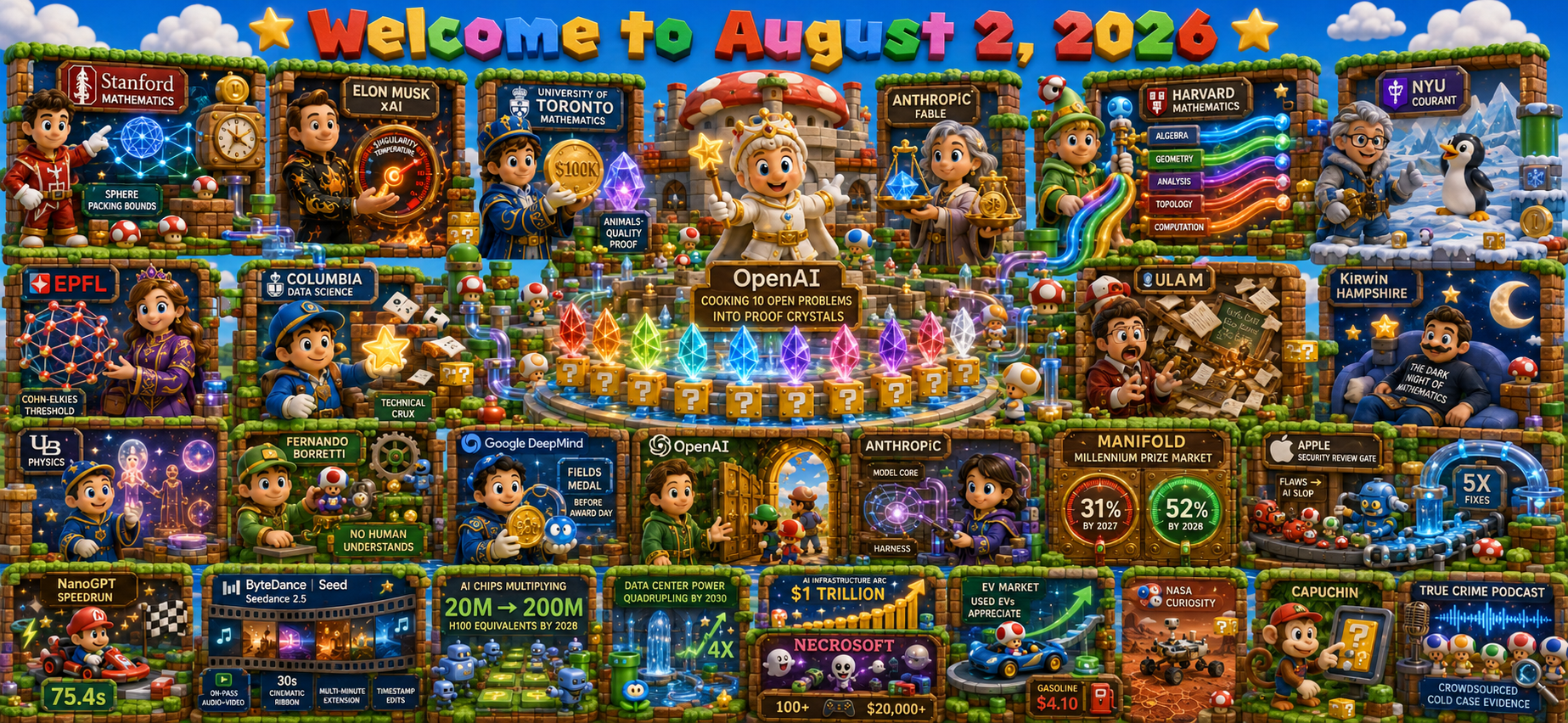
On August 2, 2026, @siouid142 carried the previous day’s Super Mario World language into Dr. Alex Wissner-Gross’s new mathematical dispatch. The callback is exact: August 1 had reported that Opus 5 one-shotted a three-dimensional Mario world; August 2 announced ten long-standing problems solved by AI systems. The game map therefore evolves from evidence of generative skill into a model of mathematical progress, with each proof presented as a new level, power-up or traversable region.
At the center, a crowned figure raises a star wand above an OpenAI sign reading “cooking 10 open problems into proof crystals.” The crystals sit on question blocks around a circular platform. In game logic, a block conceals value until struck; in mathematics, a conjecture conceals structure until a proof exposes it. The analogy is seductive because both reward disciplined exploration, but the machine’s one-shot performance collapses the repeated attempts through which human players normally learn the terrain.
The upper zones turn institutions into castles. Stanford contains the sphere-packing bounds and an hourly-news clock. Elon Musk holds a fiery Singularity temperature gauge. Toronto’s chamber displays the broken hundred-thousand-dollar wager and an Annals-quality proof. Anthropic balances a proof crystal against a medal. Harvard’s disciplines become colored streams, while NYU Courant is an ice level populated by the lone penguin from the dispatch’s joke about Yann LeCun.
EPFL’s Cohn-Elkies threshold becomes a glowing geometric puzzle. Columbia’s data-science chamber spills papers around the technical crux. ULAM is a collapsing room of blackboards, and Kirwin Hampshire’s dark night becomes a literal night stage with moon and star. The franchise grammar allows disagreement to appear as varied terrain: one scholar encounters a puzzle, another a ruined castle, another an existential level without a visible exit.
The middle band distributes the philosophical debate among playable characters. Will Kinney’s machine god appears in a cosmic chamber; Fernando Borretti operates marvelous devices; a DeepMind figure holds the Fields medal before award day; Dean W. Ball opens a door toward every person’s problems; and Anthropic links model core to harness. Manifold’s 31 and 52 percent gauges resemble countdown meters, while Apple’s review gate floods with flaws, slop and five-times-faster fixes.
Along the bottom, NanoGPT becomes a speedrun completed in 75.4 seconds. Seedance is a cinematic level, chip production a multiplying army, data-center power a fourfold rising bar and the trillion-dollar infrastructure arc a coin-driven construction zone populated by a joking “Necrosoft.” Used electric vehicles become a market ramp; Curiosity enters a Mars level; CapuchinAI earns banana rewards; and true-crime listeners gather around a cold-case signal.
The game world clarifies the dispatch’s central promise: abundant intelligence can make previously inaccessible problems enterable. It also reveals the limits of that promise. Games define success in advance, provide stable physics and reset after failure. Research often changes the question, carries irreversible consequences and depends on communities deciding what counts as an explanation. A proof is not merely the flag at the end of a level; it is a route others must be able to inspect.
Mario imagery turns the old heroic mathematician into one participant among many systems. Pipes connect universities, labs, markets and hardware. Coins expose the price of supposedly magical capability. Question blocks preserve uncertainty even inside a visually complete map. The result is cheerful because discovery has become plentiful, yet slightly uncanny because the world appears designed for a player whose speed exceeds human spectatorship.
As contemporary history painting, the work makes continuity itself an Easter egg. A visual style triggered by one day’s model demonstration becomes the next day’s critical apparatus. The map has learned from its own previous use, just as models and harnesses improve across runs. The question is who remains able to author the rules when the tool that renders the world also solves its puzzles. The tableau celebrates unlocked levels while insisting that civilization, not the model, must still decide what game is worth completing.
Opening the gallery…