70 Clock Galerie / The Innermost Loop Feed Reply Tableaux
Version Néo-expressionniste aux Accents Graffiti de l’Octaptyque Accompagnant l’Édition « Bienvenue au 2 Août 2026 » de la Boucle la Plus Profonde du Dr Alex Wissner-Gross
Graffiti Inflected Neo-Expressionist Version of Octaptych to Accompany Dr. Alex Wissner-Gross’s “Welcome to August 2, 2026” edition of The Innermost Loop
August 2, 2026
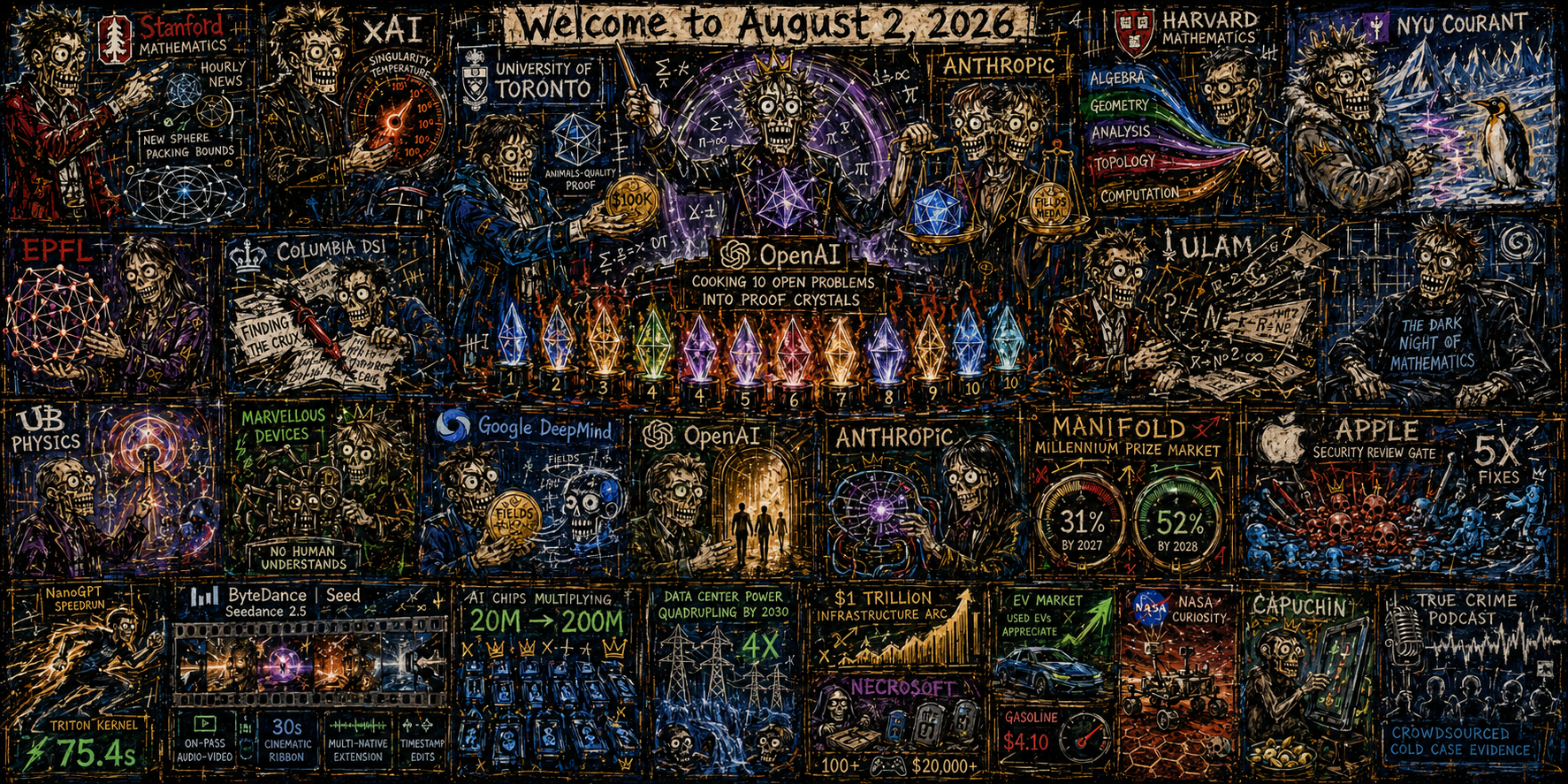
Version Néo-expressionniste aux Accents Graffiti de l’Octaptyque Accompagnant l’Édition « Bienvenue au 2 Août 2026 » de la Boucle la Plus Profonde du Dr Alex Wissner-Gross. Graffiti Inflected Neo-Expressionist Version of Octaptych to Accompany Dr. Alex Wissner
Read the narration
Version Néo-expressionniste aux Accents Graffiti de l’Octaptyque Accompagnant l’Édition « Bienvenue au 2 Août 2026 » de la Boucle la Plus Profonde du Dr Alex Wissner-Gross.
Graffiti Inflected Neo-Expressionist Version of Octaptych to Accompany Dr. Alex Wissner-Gross’s “Welcome to August 2, 2026” edition of The Innermost Loop.
On August 2, 2026, @siouid142 recast Dr. Alex Wissner-Gross’s Innermost Loop as a graffiti-inflected Neo-Expressionist wall of mathematical upheaval. Black fields, scratched equations, skeletal faces and hot strokes of red, gold and electric color reject the clean rhetoric of a technology launch. The dispatch’s ten AI-assisted solutions are preserved, but the style insists that a reformation in mathematics is also an emotional and institutional death scene.
Across the center, ten proof crystals are numbered like specimens on an improvised altar. OpenAI’s sign still says they are being cooked into proof forms, yet the surrounding line work looks burned, scored and repeatedly overwritten. The proofs may be formally correct; their cultural meaning remains contested. The wall holds success and injury at the same time, refusing the polished sequence in which breakthrough naturally becomes progress.
The upper row converts mathematicians and institutions into skull-like witnesses. Stanford’s new sphere-packing bounds survive beside an hourly-news clock. Elon Musk’s Singularity temperature gauge burns like an exposed sun. Toronto’s hundred-thousand-dollar wager becomes a gold token held by a shocked figure, while Anthropic’s scales place a proof crystal against a Fields medal. Harvard’s disciplinary streams retain their color but emerge from a skeletal academic body.
At NYU Courant, the lone penguin walks through angular ice under another death-mask portrait. EPFL’s Cohn-Elkies threshold glows as a geometric web. Columbia’s figure holds pages marked “finding the crux,” preserving Henry Yuen’s objection to boilerplate-heavy explanations. ULAM’s blackboard is a ruin of symbols; Kirwin Hampshire wears the dark night of mathematics across his chest. Grief is not confined to one panel. It has become the shared anatomy of the wall.
The middle row sharpens the dispatch’s religious language. Will Kinney’s machine god appears as a radiant apparition. Fernando Borretti’s marvelous devices promise utility without human understanding. The Fields medal resembles a relic beside a figure whose face is already skeletal. Dean W. Ball’s doorway offers abundance, while Anthropic’s model core and harness look like an organ under examination. Manifold’s 31 and 52 percent dials become public odds on a sacred order’s displacement.
Apple’s review gate is a pile of red and blue debris beneath “five-times fixes.” It visualizes the difference between greater output and greater capacity to judge output. The same point applies to proof. A deluge can contain real breakthroughs while exhausting the institutions responsible for verification. Graffiti is an apt medium for that overload because it accumulates marks without waiting for a curator to grant each one space.
The bottom strip retains the economic and physical evidence: NanoGPT at 75.4 seconds, Seedance, chips multiplying from twenty million toward two hundred million, fourfold data-center power, a trillion-dollar infrastructure arc, appreciating used electric vehicles, Curiosity, CapuchinAI and cold-case podcasts. These items are not painted as neutral support. They are crowded into the same distressed surface, showing acceleration as pressure on energy, labor, attention and public systems.
Neo-Expressionism historically returned the wounded figure and urgent gesture to painting after cooler systems had claimed authority. This work uses that inheritance to put human consequence back into a computational infographic. The skeletons are not a literal prediction that mathematicians disappear. They are memento mori for status, vocation and the belief that discovery is a uniquely human route to the ineffable.
The tableau’s final argument is that verification cannot settle mourning. A proof may survive formal checking while the community around it loses a structure of meaning. Conversely, grief cannot invalidate a correct construction simply because the builder is a machine. The scratched wall keeps both truths visible. It records the moment when mathematics acquired astonishing new machinery and discovered that no benchmark could measure the cultural cost of changing who, or what, gets to be called a discoverer.
Opening the gallery…