70 Clock Galerie / The Innermost Loop Feed Reply Tableaux
Version Enfantine Naïve de l’Octaptyque Accompagnant l’Édition « Bienvenue au 2 Août 2026 » de la Boucle la Plus Profonde du Dr Alex Wissner-Gross
Child Naive Version of Octaptych to Accompany Dr. Alex Wissner-Gross’s “Welcome to August 2, 2026” edition of The Innermost Loop
August 2, 2026
Version Enfantine Naïve de l’Octaptyque Accompagnant l’Édition « Bienvenue au 2 Août 2026 » de la Boucle la Plus Profonde du Dr Alex Wissner-Gross. Child Naive Version of Octaptych to Accompany Dr. Alex Wissner-Gross’s “Welcome to August 2, 2026” edition of Th
Read the narration
Version Enfantine Naïve de l’Octaptyque Accompagnant l’Édition « Bienvenue au 2 Août 2026 » de la Boucle la Plus Profonde du Dr Alex Wissner-Gross.
Child Naive Version of Octaptych to Accompany Dr. Alex Wissner-Gross’s “Welcome to August 2, 2026” edition of The Innermost Loop.
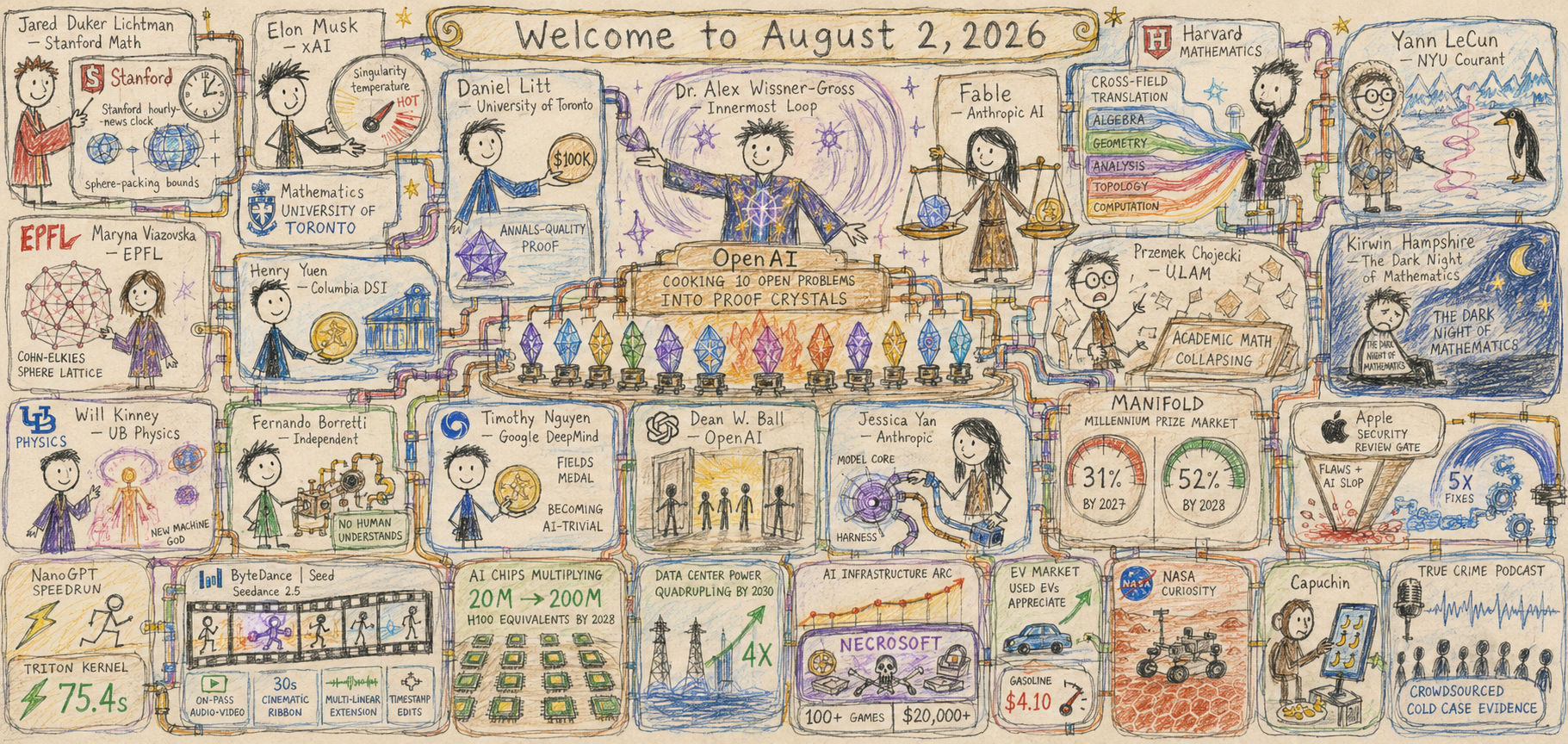
On August 2, 2026, @siouid142 redrew Dr. Alex Wissner-Gross’s Innermost Loop as a child-naive classroom chart. Colored pencil, wavering boxes and hand-lettered names replace the authority of polished scientific visualization. The choice is pointed because the dispatch announced ten AI-assisted mathematical solutions sophisticated enough to unsettle leading researchers. A childlike surface asks whether a new generation will encounter such results as a terrifying rupture or simply as the ordinary way mathematics is done.
Dr. Wissner-Gross stands at the center inside a purple whirl of equations and network marks. Below him, an OpenAI sign says that ten open problems are being cooked into proof crystals. The crystals sit in a row like science-fair projects, trophies or classroom manipulatives. By making proofs look touchable, the drawing converts an inaccessible claim about frontier reasoning into a process a listener can follow: problems enter through a network and emerge as distinct objects to be inspected.
The upper portraits restore names to the event. Jared Duker Lichtman appears with Stanford’s hourly-news clock and sphere-packing bounds. Elon Musk holds the Singularity temperature gauge. Daniel Litt stands beside the University of Toronto and the broken hundred-thousand-dollar wager. Fable balances a proof against a Fields medal; a Harvard mathematician channels algebra, geometry, analysis, topology and computation; and Yann LeCun occupies a snowy NYU Courant panel with the dispatch’s solitary penguin.
At left, Maryna Viazovska and EPFL anchor the Cohn-Elkies sphere-packing threshold. Henry Yuen’s Columbia panel points from boilerplate to the technical crux. Will Kinney presents the new machine god; Fernando Borretti tends a marvelous mathematical device labeled “no human understands.” At right, Przemek Chojecki and ULAM face collapsing academic math, while Kirwin Hampshire’s dark night receives a moon, stars and a visibly grieving figure. The naive hand allows anxiety to remain emotionally direct.
The center-lower row stages institutional responses. A DeepMind researcher holds a Fields medal before an award-day timer can be overtaken by AI. Dean W. Ball opens an ordinary doorway onto people carrying their own problems. Anthropic’s Jessica Yan physically connects model core and harness. Manifold’s two large dials show 31 percent by 2027 and 52 percent by 2028. Apple’s security gate separates genuine flaws, accumulated slop and five-times-faster fixes.
Pipes and wires run among nearly every compartment. They are drawn with the same visible awkwardness as the figures, refusing the illusion that knowledge moves frictionlessly. Cross-field translation becomes infrastructure: mathematics is not a collection of isolated geniuses but a network of universities, models, benchmarks, reviewers, markets and machines. The childish line makes dependence easier to see because it does not disguise connection as seamless system design.
The bottom row keeps material scale in view. NanoGPT’s 75.4-second speedrun, ByteDance Seedance, twenty million chips rising toward two hundred million, fourfold data-center power, the trillion-dollar infrastructure arc, appreciating used electric vehicles and $4.10 gasoline all sit beside Curiosity on Mars, CapuchinAI and a true-crime podcast. The arrangement teaches the dispatch as one large worksheet: theorem proving shares paper with energy, media, animal cognition and collective investigation.
Child-naive art can be mistaken for simplification, but here it performs a moral test. The style removes prestige effects from portraits and brands. A Fields medal, a banana reward, a proof crystal and a gas price are all rendered with similar care. That equality refuses the assumption that abstract mathematics is automatically more important than the bodies, power systems and social institutions through which its consequences arrive.
The work finally asks what education should preserve when answers become abundant. A classroom cannot compete with a machine by withholding solutions or worshiping difficulty for its own sake. It can teach how to inspect a proof, locate the crux, recognize uncertainty, understand provenance and decide which problems deserve attention. The trembling lines do not mourn rigor. They imagine rigor becoming a shared literacy before machine-generated mathematics hardens into another authority ordinary people are expected merely to trust.
Opening the gallery…