70 Clock Galerie / The Innermost Loop Feed Reply Tableaux
Version Ben 10 de l’Octaptyque Accompagnant l’Édition « Bienvenue au 2 Août 2026 » de la Boucle la Plus Profonde du Dr Alex Wissner-Gross
Ben Ten Version of Octaptych to Accompany Dr. Alex Wissner-Gross’s “Welcome to August 2, 2026” edition of The Innermost Loop
August 2, 2026
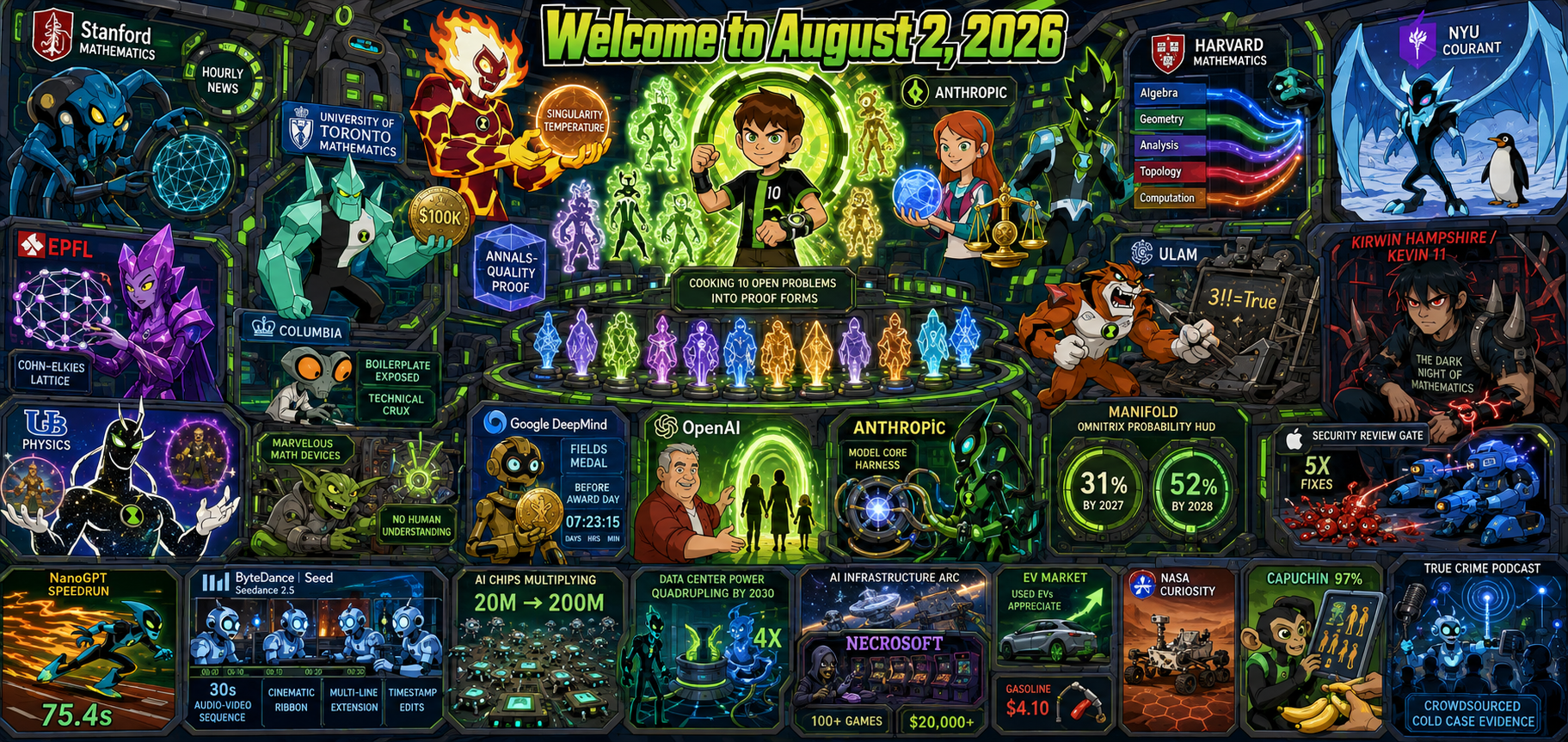
Version Ben 10 de l’Octaptyque Accompagnant l’Édition « Bienvenue au 2 Août 2026 » de la Boucle la Plus Profonde du Dr Alex Wissner-Gross. Ben Ten Version of Octaptych to Accompany Dr. Alex Wissner-Gross’s “Welcome to August 2, 2026” edition of The Innermost L
Read the narration
Version Ben 10 de l’Octaptyque Accompagnant l’Édition « Bienvenue au 2 Août 2026 » de la Boucle la Plus Profonde du Dr Alex Wissner-Gross.
Ben Ten Version of Octaptych to Accompany Dr. Alex Wissner-Gross’s “Welcome to August 2, 2026” edition of The Innermost Loop.
On August 2, 2026, @siouid142 translated Dr. Alex Wissner-Gross’s Innermost Loop into the transformation logic of Ben 10. The dispatch opened with ten long-standing mathematical problems settled by OpenAI models and with mathematicians confronting the possibility that years of specialist work could be crossed in a single run. Ben 10 supplies an exact visual grammar: ten problems become ten forms available through a device, each one a different capability that can be selected when the world presents a new obstacle.
At the center, the young hero raises the Omnitrix while green silhouettes radiate behind him. Below, OpenAI is shown “cooking 10 open problems into proof forms,” represented by a line of colored crystals. The phrasing turns formal mathematics into controlled metamorphosis. A conjecture enters as one kind of object and exits as a verifiable construction, while the model behaves less like a single expert than a repertoire of specialized bodies.
The upper chambers identify the human and institutional stakes. Stanford appears beside new sphere-packing bounds; the University of Toronto guards an Annals-quality proof and the broken hundred-thousand-dollar threshold attached to Daniel Litt’s wager. EPFL holds the Cohn-Elkies lattice associated with Maryna Viazovska’s near-science-fiction remark. Harvard’s streams for algebra, geometry, analysis, topology and computation converge as an image of the cross-field translation frontier models perform unusually well.
NYU Courant becomes an icy creature beside the lone penguin joke aimed at Yann LeCun: a visual answer to the question of where a supposedly less-than-cat-level intelligence plagiarized ten solutions. Columbia’s chamber exposes “boilerplate” and “technical crux,” preserving Henry Yuen’s complaint that polished writeups can bury the decisive idea. ULAM’s wrecked blackboard and Kirwin Hampshire’s dark night of mathematics give skepticism its own forms rather than treating grief as an error to be defeated.
The lower mathematical row broadens the transformation. Will Kinney’s machine-god image and Fernando Borretti’s marvelous devices ask whether discovery can survive when machines produce useful structures no human fully understands. A DeepMind figure holds a Fields medal beside a timer that may expire before award day. Dean W. Ball opens a doorway through which ordinary people approach their own problems. Anthropic’s model core is physically tied to its harness, visualizing Jess Yan’s claim that maximum performance requires both.
Manifold’s gauges register a 31 percent chance of an AI-solved Millennium Prize Problem by 2027 and 52 percent by 2028. Apple’s security-review gate is overwhelmed by mixed-quality AI reports even as AI-assisted updates deliver five times the usual fixes. These panels distinguish a theorem from a forecast and capability from institutional capacity. Transformation may be fast; adjudication still requires people able to tell a real flaw or proof from convincing slop.
The bottom band records the substrate. NanoGPT reaches 75.4 seconds on a faster Triton kernel; Seedance generates thirty-second audiovisual sequences; AI chips rise from twenty million toward two hundred million H100 equivalents; data-center power points toward fourfold growth; and the infrastructure arc approaches one trillion dollars. Used electric vehicles, Curiosity’s Martian polygons, CapuchinAI’s 97 percent recognition and crowdsourced cold-case evidence show capability leaving the proof chamber for markets, planets, animals and police work.
Ben 10 usually frames transformation as heroic choice: the wearer selects the right form and remains morally continuous across changing bodies. The tableau tests that promise. If a model can assume the methods of many disciplines, who supplies the continuity of purpose? The Omnitrix makes plurality controllable in fiction; in the dispatch, labs, harnesses, institutions and reviewers compete to decide which capabilities are deployed and how their outputs are trusted.
The work turns mathematical reformation into an adventure image without trivializing the loss it records. Bright green energy celebrates a newly general capacity, while separate chambers retain the names, wagers, complaints and anxieties of human mathematicians. Its central question is not whether the machine can transform. Ten results say that it can. The question is whether society can build an ethical wearer for an instrument whose available forms are multiplying faster than the rules for choosing among them.
Opening the gallery…