70 Clock Galerie / The Innermost Loop Feed Reply Tableaux
Version Solve Everything Seize Moonshots des Visuels Accompagnant l’Édition « Bienvenue au 1er Août 2026 » de la Boucle la Plus Profonde du Dr Alex Wissner-Gross
Solve Everything Sixteen Moonshots Version of Visuals to Accompany Dr. Alex Wissner-Gross’s “Welcome to August 1, 2026” edition of The Innermost Loop
August 1, 2026
Version Solve Everything Seize Moonshots des Visuels Accompagnant l’Édition « Bienvenue au 1er Août 2026 » de la Boucle la Plus Profonde du Dr Alex Wissner-Gross. Solve Everything Sixteen Moonshots Version of Visuals to Accompany Dr. Alex Wissner-Gross’s “Welc
Read the narration
Version Solve Everything Seize Moonshots des Visuels Accompagnant l’Édition « Bienvenue au 1er Août 2026 » de la Boucle la Plus Profonde du Dr Alex Wissner-Gross.
Solve Everything Sixteen Moonshots Version of Visuals to Accompany Dr. Alex Wissner-Gross’s “Welcome to August 1, 2026” edition of The Innermost Loop.
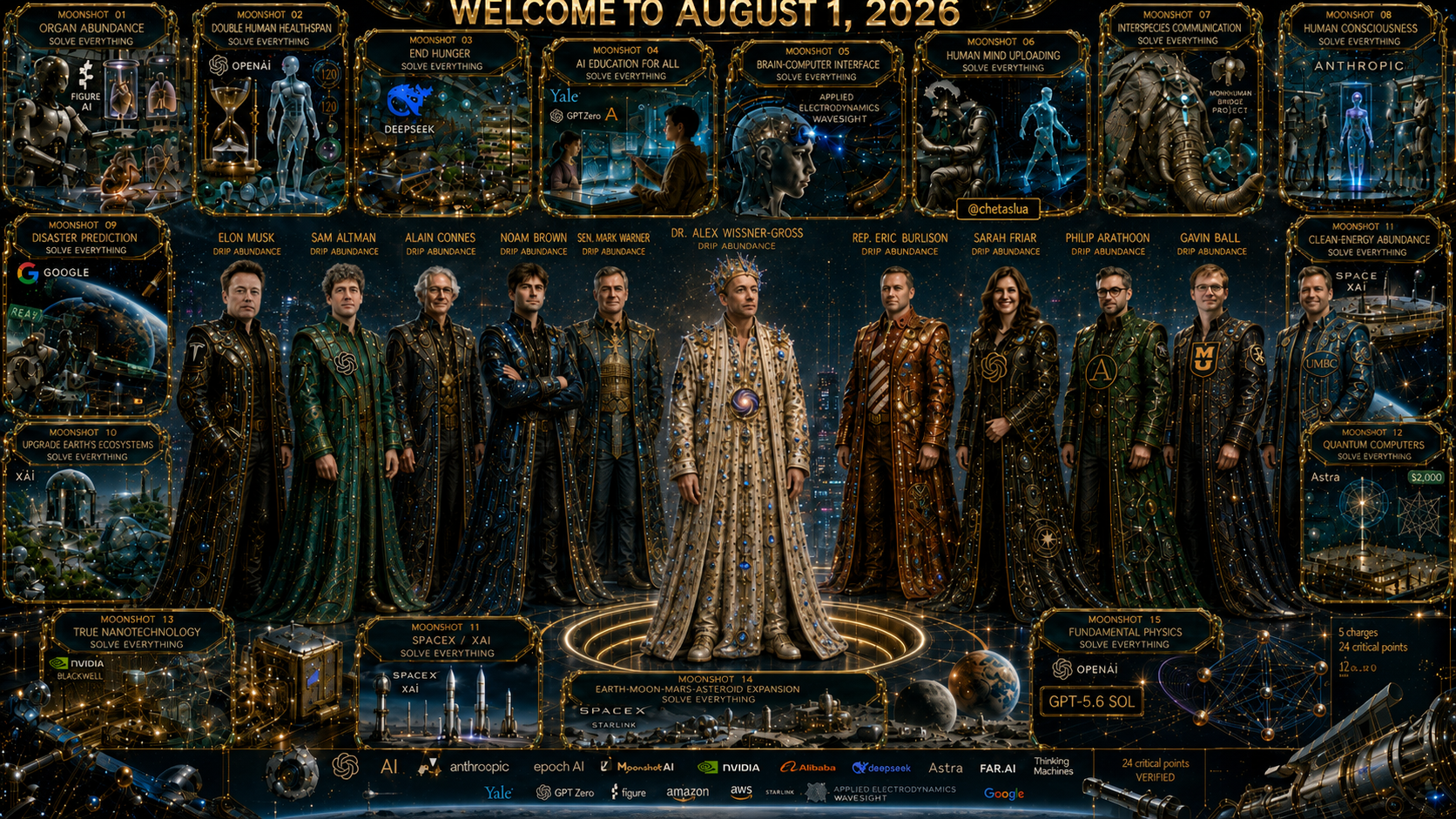
On August 1, 2026, @siouid142 produced a second response to Dr. Alex Wissner-Gross’s Innermost Loop: a formal Solve Everything procession surrounded by moonshot panels. Where the companion Super Mario image translates the program into playable levels, this work gives it the gravity of a civic altarpiece. Black, teal and gold turn the day’s scattered announcements into an illuminated charter for directing abundant intelligence toward explicit human and planetary ends.
Dr. Wissner-Gross occupies the central axis in a white-and-gold circuit robe, standing on a luminous ring and wearing a radiant crown. The enlargement distinguishes the person assembling the daily synthesis from the people and systems being synthesized. It is ceremonial rather than documentary scale. The image makes intellectual coordination monumental, then surrounds that monument with named goals so prestige remains accountable to a program.
Across the middle stand Elon Musk, Sam Altman, Alain Connes, Noam Brown, Senator Mark Warner, Representative Eric Burlison, Sarah Friar, Philip Arathoon, Gavin Ball and Matthew D. Kvalheim. Their dark garments carry organization-colored circuitry. The line resembles a council, court and runway at once. It records the heterogeneous cast brought into the source conversation without implying that any one participant owns a moonshot or that appearing beside an objective constitutes completing it.
The visible border numbers fifteen goal panels: organ abundance, doubled human healthspan, ending hunger, AI education for all, brain-computer interfaces, human mind uploading, interspecies communication, human consciousness, disaster prediction, upgraded Earth ecosystems, clean-energy abundance, quantum computers, true nanotechnology, Earth-Moon-Mars-asteroid expansion and fundamental physics. The central command to Solve Everything acts as the organizing term that turns those fifteen destinations into the sixteen-part program named by the title.
Each frame pairs aspiration with a source marker. Figure appears with organ production; OpenAI with healthspan and fundamental physics; DeepSeek with hunger; Yale and GPTZero with education; WaveSight with a device that sees through walls; X with uploading; the Nonhuman Rights Project with an elephant; Anthropic with consciousness; Google with planetary observation; SpaceX and xAI with energy, ecosystems and expansion; Astra with quantum mathematics; and Nvidia hardware with nanotechnology. The pairings are associative coordinates, not claims of completed responsibility.
The border also preserves the August 1 edition’s sharper technical details. Astra’s ten decade-old open problems and FrontierMath establish the mathematical frontier. A notation for five charges and twenty-four critical points recalls the counterexample to the old Maxwell bound. Model-security costs, open-weight release, the one-shot three-dimensional Mario world, AI music disputes, UAP waivers and the Yale examination lawsuit circulate through smaller labels and logos. The ideal program remains tethered to the untidy news cycle that prompted it.
Gold circuit lines bind panels to bodies and continue into the architectural frame. They resemble both neural pathways and the gilded tracery of a religious object. This double reading matters. The work presents technological coordination as a source of hope, but it also acknowledges that “solve everything” can become a creed. An agenda capable of mobilizing capital and intelligence requires symbols; symbols can clarify purpose while also concentrating authority.
The moonshot frames promise abundance, yet their symmetry refuses a simple hierarchy among needs. Consciousness and food, quantum computers and elephant rights, Mars expansion and education receive comparable visual weight. That equivalence is the work’s political proposition: acceleration should be judged not only by model scores or corporate value but by the breadth of problems it is organized to address.
As art criticism, the image operates between manifesto, group portrait and future-history painting. The participants occupy the present tense while the surrounding panels describe desired horizons. Its dark ground makes every filament and objective glow as though already energized, but the gaps between frames remain visible. Those gaps are governance, verification, distribution and time. The tableau does not prove that the moonshots will be solved. It makes the proposed destination legible enough that acceleration can be asked where, for whom and under whose command it is moving.
Opening the gallery…