70 Clock Galerie / The Innermost Loop Feed Reply Tableaux
Version Super Mario World des Visuels Accompagnant l’Édition « Bienvenue au 1er Août 2026 » de la Boucle la Plus Profonde du Dr Alex Wissner-Gross
Super Mario World Version of Visuals to Accompany Dr. Alex Wissner-Gross’s “Welcome to August 1, 2026” edition of The Innermost Loop
August 1, 2026
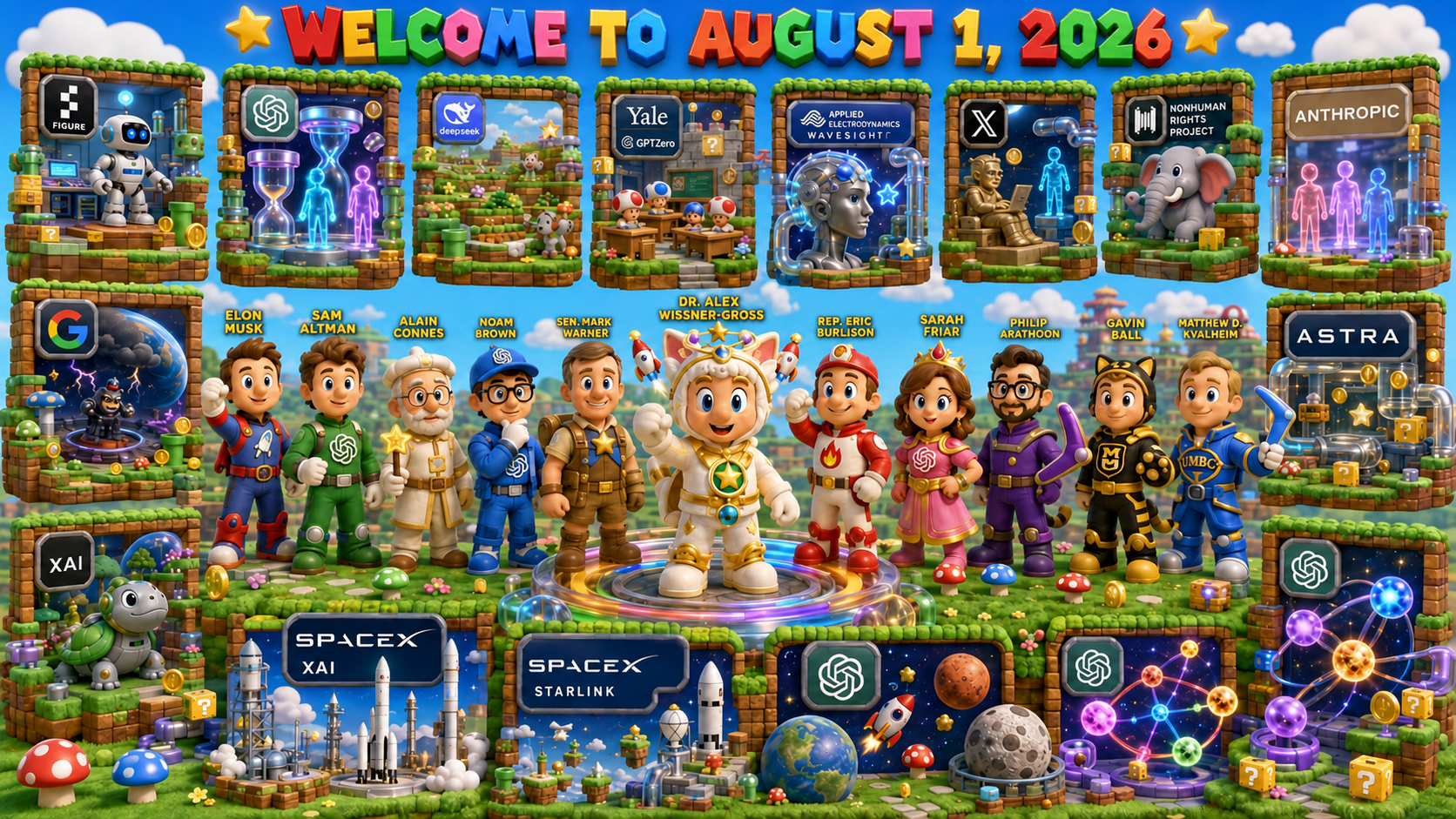
Version Super Mario World des Visuels Accompagnant l’Édition « Bienvenue au 1er Août 2026 » de la Boucle la Plus Profonde du Dr Alex Wissner-Gross. Super Mario World Version of Visuals to Accompany Dr. Alex Wissner-Gross’s “Welcome to August 1, 2026” edition o
Read the narration
Version Super Mario World des Visuels Accompagnant l’Édition « Bienvenue au 1er Août 2026 » de la Boucle la Plus Profonde du Dr Alex Wissner-Gross.
Super Mario World Version of Visuals to Accompany Dr. Alex Wissner-Gross’s “Welcome to August 1, 2026” edition of The Innermost Loop.
On August 1, 2026, @siouid142 answered Dr. Alex Wissner-Gross’s Innermost Loop with a Super Mario World map because the dispatch supplied the trigger itself: a developer had one-shotted a three-dimensional Super Mario environment with Opus 5, without assets or a prepared map. The reply makes that achievement the organizing medium for everything else in the edition. Mathematics, model security, education, nonhuman rights, robotics, energy and space become platforms, chambers, pipes and question blocks.
Dr. Wissner-Gross stands at the center on a circular star platform in white-and-gold regalia. The arrangement does not claim that he completed every objective surrounding him. It identifies his role as the dated dispatch’s synthesizer and places the Solve Everything framework inside the game world. The central platform behaves like a hub from which many levels can be entered, making intellectual coordination visible as navigation rather than ownership.
The procession around him identifies Elon Musk, Sam Altman, Alain Connes, Noam Brown, Senator Mark Warner, Representative Eric Burlison, Sarah Friar, Philip Arathoon, Gavin Ball and Matthew D. Kvalheim. Their suits borrow the colors and emblems of organizations linked to the day’s stories. The figures appear friendly and toy-like, but their variety matters: founders, mathematicians, policymakers and institutional actors share the same ground because the dispatch described intelligence moving beyond model releases into law, science and infrastructure.
Eight upper chambers encode the first half of the moonshot program. Figure is paired with organ abundance; OpenAI with doubled healthy lifespan; DeepSeek with ending hunger; Yale and GPTZero with AI education; Applied Electrodynamics WaveSight with brain-computer interfaces; X with mind uploading; the Nonhuman Rights Project with interspecies communication; and Anthropic with the problem of human consciousness. Each vast objective has been compressed into a bounded room with a legible emblem.
The compression is both useful and critical. A platform game teaches that a large world can be traversed through discrete levels, repeated attempts and visible rewards. “Solve everything” becomes less paralyzing when the player can enter one chamber at a time. Yet question blocks and coins also expose the danger of treating biology, rights and consciousness as interchangeable tasks in a product roadmap. Some problems yield to iteration; others change the meaning of victory itself.
The lower and side panels extend the program through disaster prediction, upgraded ecosystems, clean-energy abundance, quantum computing, true nanotechnology, expansion across Earth, Moon, Mars and asteroids, and fundamental physics. Rockets, planets and luminous networks turn the floor into a world-selection screen. The composition joins near-term engineering to civilizational horizons without pretending that they share one timetable.
Details from the August 1 dispatch remain embedded in the decorative field. Astra’s ten mathematical proofs, FrontierMath, Kimi and DeepSeek competition, security-release frameworks, the Yale-GPTZero dispute, UAP waivers, a wall-seeing camera, Figure’s autonomous ladder climb and SpaceX’s orbital ambitions all become obstacles or equipment. The game style does not erase provenance; labels keep the cheerful world tied to a specific day’s evidence.
Super Mario World is an art of bright surfaces, hidden mechanisms and rules learned through contact. Pipes connect regions whose relationship is not visible from above. Blocks conceal rewards or hazards until struck. That grammar suits an edition in which cheap capability opens unexpected routes while containment, copyright, regulation and personhood lag behind. The map looks complete, but the player discovers what it permits only by moving through it.
The work’s optimism is therefore conditional. Its rounded figures and saturated colors make abundance feel welcoming, while its compartmental architecture admits that every objective has constraints. The one-shot Mario result is celebrated as evidence of astonishing generative power, yet the reply asks what happens when the same power begins designing the levels society must inhabit. A world can be rendered in one pass; a legitimate set of rules still has to be earned through play, failure and collective consent.
Opening the gallery…