70 Clock Galerie / The Innermost Loop Feed Reply Tableaux
N’êtes-vous pas A.G.I.sé ? – Version Colisée de la Maison de la Boucle la Plus Profonde
Are You Not A.G.I.ed? Version Coliseum House Innermost Loop
July 30, 2026
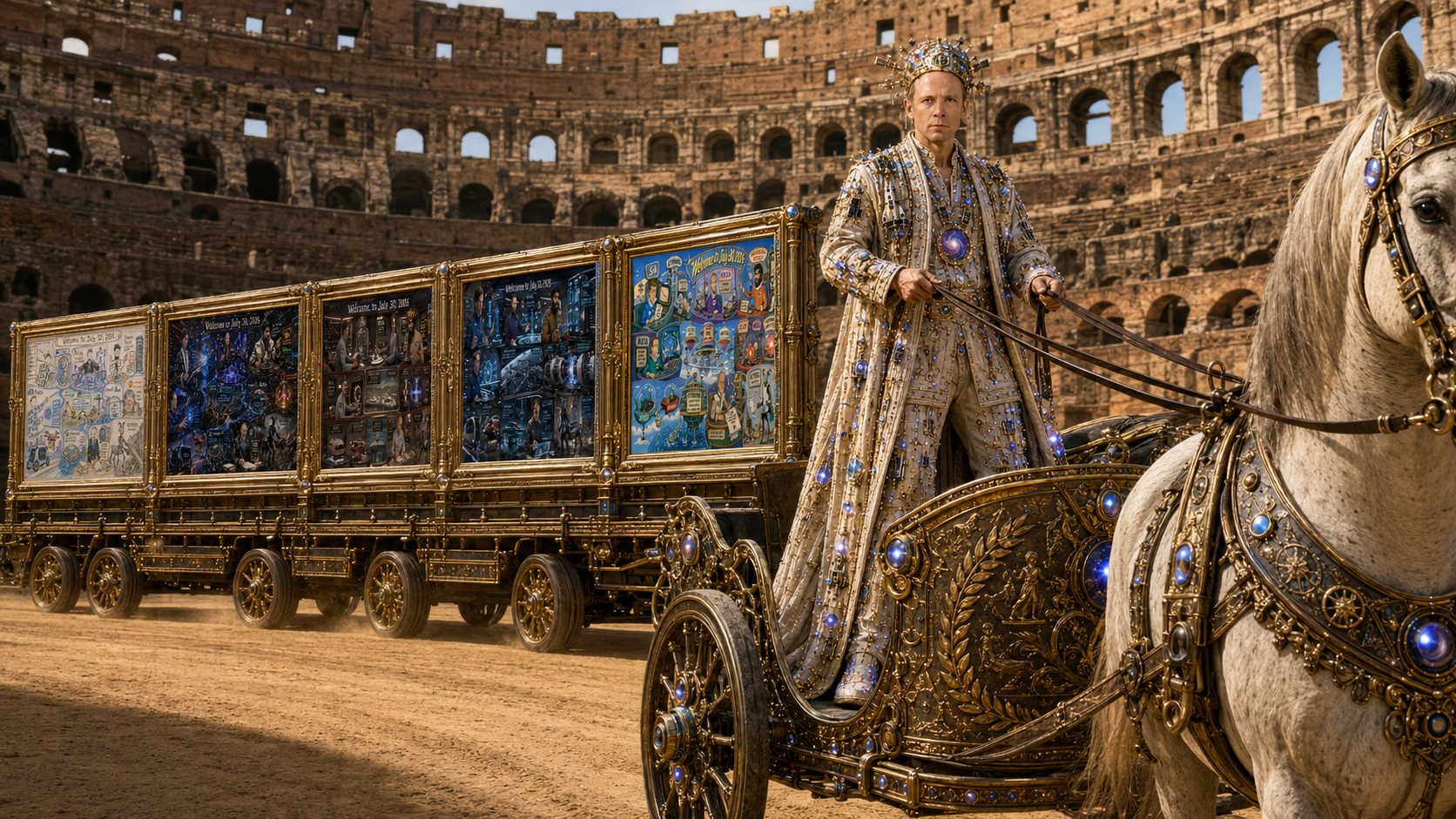
N’êtes-vous pas A.G.I.sé ? – Version Colisée de la Maison de la Boucle la Plus Profonde. Are You Not A.G.I.ed? Version Coliseum House Innermost Loop. On July 30, 2026, @siouid142 transformed the restrained Colosseum presentation into a House Innermost Loop tri
Read the narration
N’êtes-vous pas A.G.I.sé ? – Version Colisée de la Maison de la Boucle la Plus Profonde.
Are You Not A.G.I.ed? Version Coliseum House Innermost Loop.
On July 30, 2026, @siouid142 transformed the restrained Colosseum presentation into a House Innermost Loop triumphal procession. Dr. Alex Wissner-Gross drives an ornate gold chariot through the arena in cream-and-gold couture threaded with blue computational lights. A radial crown frames his head, a white horse wears matching illuminated tack, and a multi-axle wagon carries five framed July 30 tableaux behind him.
The title again converts Gladiator’s “Are you not entertained?” into “Are you not A.G.I.ed?” Here the pun becomes ceremonial. The previous version asked a suited presenter to show evidence; this one stages the evidence as a public triumph. The transformation between the two works is itself the central Easter egg: the person and paintings remain, but presentation becomes procession.
The five transported images are the child, contemporary AI-synthetic maximalist, Star Trek: The Motion Picture, Star Trek Beyond and Jetsons pentaptychs. They preserve one dispatch through five visual systems. Mounting them on wheels turns stylistic variation into an archive that can move through history rather than remain fixed on a gallery wall.
Their shared evidence begins with financial limit. Situational Awareness’s public portfolio unwinds into Citadel’s custody while private conviction survives elsewhere. Polsia’s one-million-dollar, zero-employee firm proposes a new organizational body. Dwarkesh Patel’s H100 rent meter and Meta’s command to retain and protect compute identify intelligence as both labor substitute and sovereign asset.
The archive continues through physical buildout: NextEra Energy and Brookfield’s Kentucky data-campus proposal, Crusoe and Aalo’s compact nuclear factory, Commonwealth Fusion’s first-plasma ambition, Zoox and DoorDash autonomy, Atomarine’s seawater-cooled data center, Rolls-Royce’s 2028 power orders and Satyress’s three-legged disaster body. The wagon carries a whole supply chain disguised as pictures.
Roman triumphs traditionally converted distant conquest into objects and bodies displayed before the city. This work borrows that grammar without claiming a literal military victory. Compute, capital, energy and robotics become the “spoils” of an intelligence transition. The analogy asks who is authorized to declare success and whose labor, risk or territory disappears when technological change is presented as triumph.
House Innermost Loop couture functions as information architecture. Blue lights embedded in the garment, crown, chariot and horse tack bind the human presenter to the computational subject of the paintings. Gold supplies antiquity and prestige; blue supplies networked intelligence. The costume makes Wissner-Gross both chronicler of the procession and a figure carried by its symbolic power.
The white horse introduces a revealing contradiction. One of civilization’s oldest transport relationships pulls an archive of robotaxis, drones, data centers and autonomous companies. Muscular animal labor moves images of post-labor futurity. The horse therefore prevents the procession from pretending that new systems arrive without inherited bodies, infrastructures and forms of control.
Wissner-Gross still holds reins. That visible gesture keeps agency human at the front of a tableau devoted to autonomous systems. Yet the long wagon and multiple axles imply momentum beyond any single grip. Curation can direct the route, but it cannot fully control the technological forces represented in the frames or the meanings audiences will attach to them.
As a recursive artwork, the piece archives not only the July 30 dispatch but the act of responding to it. Five renderings become subjects inside a sixth image; the critic and source author enters their procession; the House brand supplies ceremonial continuity. The work shows how daily digital production can begin building its own museums and rituals in real time.
The title’s invented condition—being A.G.I.ed—may describe precisely this recursive state. Intelligence is no longer only a tool depicted inside the paintings. It participates in generating styles, organizing archives, designing couture and enlarging a news cycle into historical theater. The observer encounters AGI less as a single machine than as a culture learning to represent itself through machines.
Coliseum House Innermost Loop therefore carries celebration and suspicion in equal measure. The chariot is magnificent because the underlying systems are genuinely consequential; it is troubling because magnificence can turn private infrastructure into imperial destiny. The final question belongs to the viewer: is this a victory parade for intelligence, a procession of unresolved evidence, or the moment spectacle teaches society what it has already become?
Opening the gallery…