70 Clock Galerie / The Innermost Loop Feed Reply Tableaux
N’êtes-vous pas A.G.I.sé ? – Version Tenue Décontractée du Colisée
Are You Not A.G.I.ed? Version Coliseum Business Casual
July 30, 2026
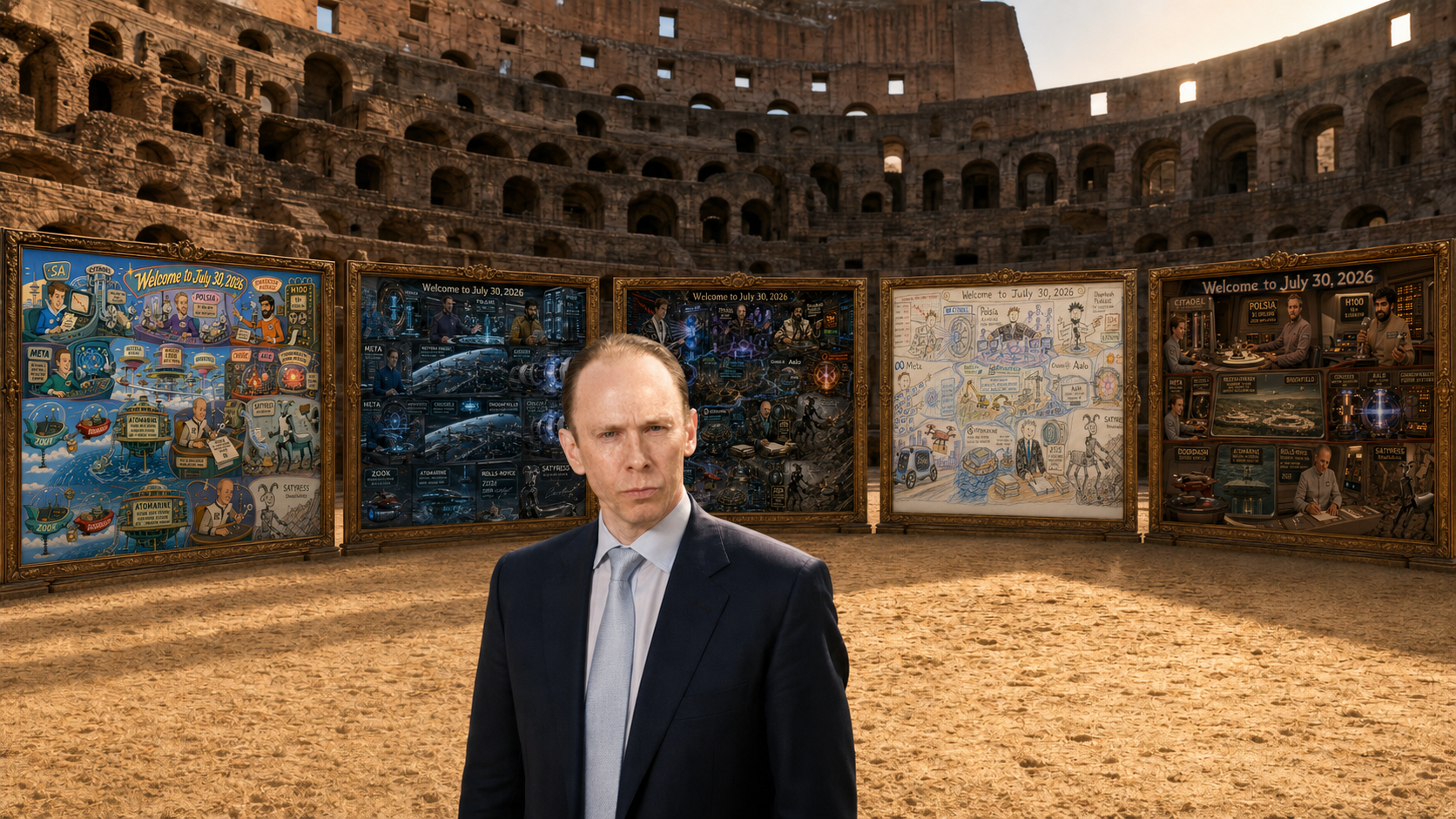
N’êtes-vous pas A.G.I.sé ? – Version Tenue Décontractée du Colisée. Are You Not A.G.I.ed? Version Coliseum Business Casual. On July 30, 2026, @siouid142 moved five same-day responses to Dr. Alex Wissner-Gross’s Innermost Loop into the Roman Colosseum. Wissner-
Read the narration
N’êtes-vous pas A.G.I.sé ? – Version Tenue Décontractée du Colisée.
Are You Not A.G.I.ed? Version Coliseum Business Casual.
On July 30, 2026, @siouid142 moved five same-day responses to Dr. Alex Wissner-Gross’s Innermost Loop into the Roman Colosseum. Wissner-Gross stands close to the viewer in a dark business suit and pale tie while monumental gold frames curve around the arena behind him. The title converts Gladiator’s challenge “Are you not entertained?” into a question about historical recognition: are you not already A.G.I.ed?
The invented verb matters. It does not ask only whether a laboratory has crossed a formal threshold called AGI. It asks whether the observer has already been transformed by a field of systems whose combined effects resemble an AGI age. Compute rent, agentic companies, power campuses, autonomous transport and new robotic bodies become evidence presented for judgment.
The five framed works are the child, contemporary AI-synthetic maximalist, Star Trek: The Motion Picture, Star Trek Beyond and Jetsons versions of the July 30 pentaptych. Each contains the same factual structure but offers a different emotional contract: explanation, technological sublimity, solemn encounter, kinetic adaptation and domesticated convenience.
Within those frames, Situational Awareness’s public portfolio unwinds into Citadel’s custody while Polsia demonstrates a one-million-dollar company with zero employees. Dwarkesh Patel’s H100 meter asks whether capable compute could command two hundred fifty thousand dollars in annual rent. Meta’s instruction to retain, direct and protect compute turns ownership of intelligence into a corporate mandate.
The shared middle register converts a Kentucky uranium complex into a proposed one-hundred-billion-dollar data campus under NextEra Energy and Brookfield. Crusoe and Aalo pursue compact nuclear power; Commonwealth Fusion points toward first plasma. Below, Zoox, DoorDash, Atomarine, Rolls-Royce and Satyress translate autonomy and energy demand into streets, air, ocean, manufacturing orders and disaster terrain.
The Colosseum does not add a sixth technical claim. It changes the institutional frame around the existing five. A newsletter response set made for rapid circulation is enlarged into public monuments. Gold molding performs the work of canonization, suggesting that one day’s images have become artifacts worthy of preservation before historical distance has had time to decide their importance.
Wissner-Gross’s business attire sharpens that transformation. He appears neither as gladiator nor emperor, but as a contemporary presenter who has walked into an ancient machinery of spectacle. The suit treats the arena like a conference room or gallery opening. This procedural calm makes the scale of the installation more uncanny than theatrical costume would.
No crowd and no battle are inserted. Empty stone tiers surround the figure and paintings. The absence transfers the role of audience directly to the viewer, who occupies the position of the Roman public being challenged. Recognition becomes the event: the spectacle exists, but its meaning depends on whether someone sees five isolated pictures or one civilizational system.
Arena sand, eroded arches and daylight provide a material counterweight to the glowing futures in the frames. The Colosseum is a surviving infrastructure of entertainment, violence, governance and collective memory. Its endurance asks whether today’s data campuses and platforms will become ruins, institutions or invisible utilities—and which images will explain what they once meant.
The placement of Wissner-Gross near the foreground makes him a scale reference. His human body remains small against the arena yet large against the distant paintings. He mediates between a single dated dispatch and the vast historical claims extracted from it. The composition thereby visualizes his role as chronicler: not creator of every system, but organizer of their simultaneous appearance.
As contemporary history painting, the work turns curation into a civic trial. The question is not whether the pictures are technically impressive; it is whether their combined subject has altered labor, capital, energy and public space enough to deserve a new historical category. The viewer must decide without the reassuring verdict of hindsight.
Coliseum Business Casual preserves the humility of that uncertainty. Wissner-Gross does not raise a weapon or claim victory. He simply stands before five records of one accelerating day and asks the audience to look again. The arena supplies spectacle, but the suit supplies evidence: an ordinary modern observer may already be living inside the transformation that future historians will name.
Opening the gallery…