70 Clock Galerie / The Innermost Loop Feed Reply Tableaux
Version Les Jetson du Pentaptyque Accompagnant l’Édition « Bienvenue au 30 Juillet 2026 » de la Boucle la Plus Profonde du Dr Alex Wissner-Gross
Jetsons Version of Pentaptych to Accompany Dr. Alex Wissner-Gross’s “Welcome to July 30, 2026” edition of The Innermost Loop
July 30, 2026
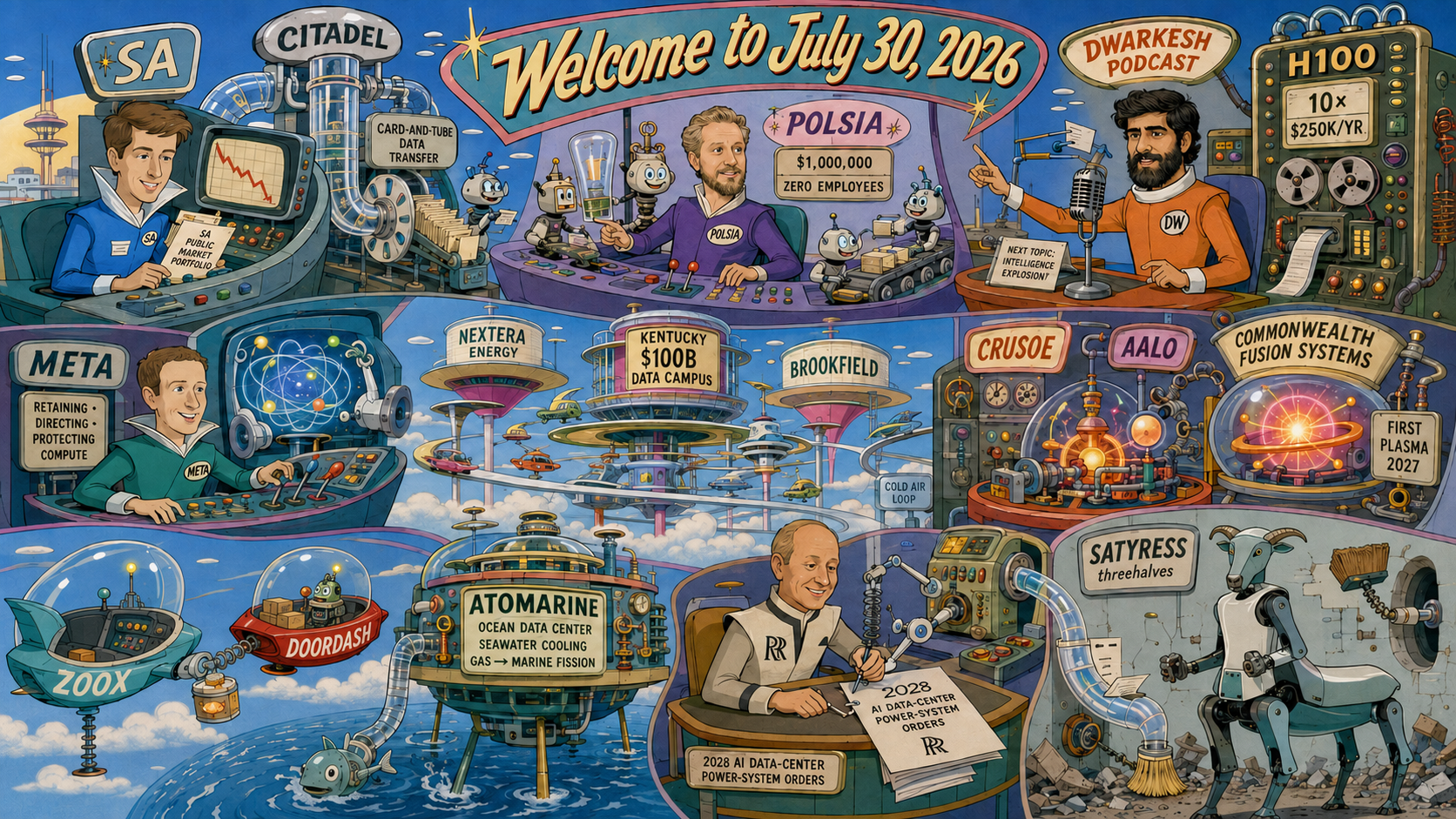
Version Les Jetson du Pentaptyque Accompagnant l’Édition « Bienvenue au 30 Juillet 2026 » de la Boucle la Plus Profonde du Dr Alex Wissner-Gross. Jetsons Version of Pentaptych to Accompany Dr. Alex Wissner-Gross’s “Welcome to July 30, 2026” edition of The Inne
Read the narration
Version Les Jetson du Pentaptyque Accompagnant l’Édition « Bienvenue au 30 Juillet 2026 » de la Boucle la Plus Profonde du Dr Alex Wissner-Gross.
Jetsons Version of Pentaptych to Accompany Dr. Alex Wissner-Gross’s “Welcome to July 30, 2026” edition of The Innermost Loop.
On July 30, 2026, @siouid142 translated Dr. Alex Wissner-Gross’s Innermost Loop into the bright retro-future associated with The Jetsons. Bubble vehicles, circular platforms, reel-to-reel computers and smiling operators make autonomous firms, robotaxis, delivery drones, nuclear power and ocean data centers look like ordinary domestic infrastructure. The historical joke is exact: yesterday’s cartoon conveniences are arriving through systems far larger and more contested than the cartoon ever showed.
At upper left, Situational Awareness’s public portfolio appears on an old monitor while a card-and-tube apparatus feeds Citadel’s vault. The financial unwind is rendered as office machinery from an optimistic future. A market loss becomes a stack of cards moving through pneumatic systems, exposing how every age tries to domesticate risk through the design language of its administrative tools.
Polsia sits beneath “one million dollars, zero employees” while cheerful robots operate a conveyor and control board. The scene literalizes the labor substitution hidden in the phrase. The founder is surrounded by activity, but the workers have become appliances. Retro-futurism makes that arrangement charming enough to reveal how easily automation can be normalized when it arrives with rounded edges and a smile.
Dwarkesh Patel broadcasts beside a towering H100 machine with a ten-times meter and a two-hundred-fifty-thousand-dollar annual figure. A note announces the next topic as “intelligence explosion.” In the Jetsons idiom, compute rent resembles a household utility bill from the future, except the appliance may perform work valuable enough to charge more than a human salary.
Mark Zuckerberg operates Meta’s atomic display beneath “retaining, directing, protecting compute.” The panel resembles a family control room, yet its subject is ownership of industrial intelligence. Corporate strategy has been converted into the friendly push-button language by which mid-century culture promised that complex systems would become effortless.
The Kentucky data campus floats at the center on elevated platforms marked NextEra Energy and Brookfield. Flying vehicles circle a one-hundred-billion-dollar build. By lifting the construction into the clouds, the image shows how data infrastructure is popularly imagined—as clean, weightless and detached from land—while the label insists on its actual territorial scale.
Crusoe and Aalo’s compact nuclear equipment occupies a countertop laboratory beside Commonwealth Fusion’s glowing first-plasma machine. The devices resemble appliances, shrinking difficult energy systems into consumer-friendly forms. Their domestication is critical: society wants gigawatt solutions to behave like products that can be ordered, installed and trusted without sharing the complexity of their operation.
The lower left gives Zoox and DoorDash transparent flying pods. Their routes pass through open sky rather than difficult streets or airspace regulation. The cartoon fulfills the service promise embedded in autonomy—transport and delivery appearing exactly when desired—while suppressing the mapping, certification, labor and public rules required to make that convenience safe.
Atomarine becomes an offshore household of computation, its pipes descending into seawater while gas transitions toward marine fission. A small mechanical fish swims beneath the platform. The image turns the ocean into both coolant and neighborhood, raising the question retro-futures rarely ask: where do the heat, fuel, cables and maintenance live when the service interface looks effortless?
A Rolls-Royce representative signs 2028 data-center power-system orders with a mechanical pen. The desk is surrounded by coils, tubes and automated tools, giving procurement the same visual importance as invention. The future depends not only on breakthroughs but on factories agreeing what they can deliver several years ahead.
Satyress appears as a smiling robotic goat using different tools against a damaged wall. Three legs, multiple arms and teleoperation make the centaur useful where human bodies would be exposed. In a Jetsons world, even disaster response becomes another household machine, but the rubble prevents the fantasy from becoming completely frictionless.
The July 30 future is therefore both realized and deferred. Robotaxis, drone delivery and agentic companies already resemble Jetsons props; abundant power and effortless intelligence remain massive construction projects. The work asks whether society is inheriting the cartoon’s benefits, its blind spots, or both—and who performs the unseen maintenance after every smiling button is pressed.
Opening the gallery…