70 Clock Galerie / The Innermost Loop Feed Reply Tableaux
Version Star Trek Sans Limites du Pentaptyque Accompagnant l’Édition « Bienvenue au 30 Juillet 2026 » de la Boucle la Plus Profonde du Dr Alex Wissner-Gross
Star Trek Beyond Version of Pentaptych to Accompany Dr. Alex Wissner-Gross’s “Welcome to July 30, 2026” edition of The Innermost Loop
July 30, 2026
Version Star Trek Sans Limites du Pentaptyque Accompagnant l’Édition « Bienvenue au 30 Juillet 2026 » de la Boucle la Plus Profonde du Dr Alex Wissner-Gross. Star Trek Beyond Version of Pentaptych to Accompany Dr. Alex Wissner-Gross’s “Welcome to July 30, 2026
Read the narration
Version Star Trek Sans Limites du Pentaptyque Accompagnant l’Édition « Bienvenue au 30 Juillet 2026 » de la Boucle la Plus Profonde du Dr Alex Wissner-Gross.
Star Trek Beyond Version of Pentaptych to Accompany Dr. Alex Wissner-Gross’s “Welcome to July 30, 2026” edition of The Innermost Loop.
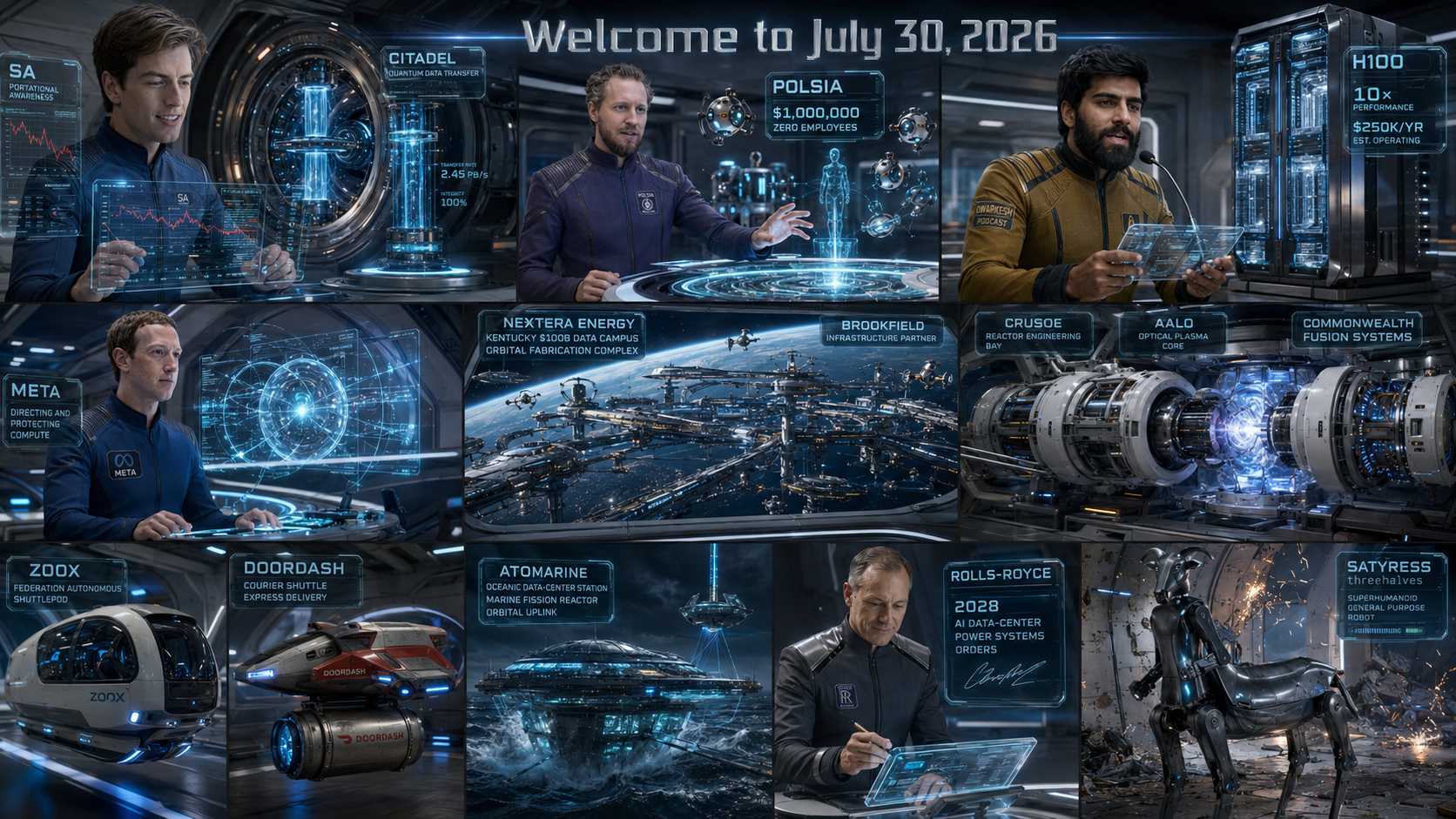
On July 30, 2026, @siouid142 reframed Dr. Alex Wissner-Gross’s Innermost Loop through the kinetic visual world of Star Trek Beyond. Cool blue interfaces, sleek uniforms, transparent overlays and sharply divided action bays replace the contemplative machinery of the Motion Picture variant. The same dispatch now feels like a federation struggling to hold formation while markets, agents, energy systems and autonomous machines accelerate in different directions.
Situational Awareness occupies the upper-left station with its declining public portfolio floating in front of the operator. Citadel’s quantum-like transfer chamber stands beside it. The translucent displays make loss look clean and measurable, but the movement of assets remains a change in power: one highly leveraged view of the AI future reaches its liquidity boundary, and another institution receives the book.
Polsia’s one-million-dollar, zero-employee company appears as a bridge of holographic agents around a single human coordinator. The futuristic setting removes any temptation to interpret “zero employees” as inactivity. The company is visibly busy. What disappears is not work itself, but the conventional employment relation through which work was counted, supervised and socially recognized.
At right, Dwarkesh Patel works beside a towering H100 system labeled ten-times performance and two hundred fifty thousand dollars per year. The compute-rent thesis becomes a starship resource calculation. Efficiency can reduce the price of individual operations while raising the strategic value of the machine capable of performing them at expert level.
Mark Zuckerberg controls Meta’s spherical compute map from the middle left. “Directing and protecting compute” reads as a defensive doctrine. The image turns capital allocation into fleet command: compute is not merely sold as excess capacity, but retained so its intelligence can be aimed, governed and monetized by the organization that owns the engines.
The center viewport shows NextEra Energy and Brookfield’s Kentucky data campus as an orbital fabrication complex. The transformation is an intentional exaggeration. A former uranium site becomes a one-hundred-billion-dollar intelligence base, aligning terrestrial construction with the scale of planetary infrastructure imagined by science fiction.
Crusoe, Aalo and Commonwealth Fusion form an extended reactor assembly at right. Compact nuclear equipment and a plasma core appear mechanically joined. Their fictional integration helps the eye understand why the dispatch grouped them, but the labels retain their differences. The need for gigawatts creates an alliance of energy narratives before the technologies themselves have reached equal readiness.
The lower row converts Zoox into a shuttle, DoorDash into an express courier craft and Atomarine into an oceanic station with a marine-fission reactor. Faster cinematic lines make delivery and mobility look inevitable, yet each machine remains inside a separate frame. Regulation, certification and deployment still divide the federation into jurisdictions that a vehicle cannot cross by speed alone.
A Rolls-Royce executive signs 2028 power orders from a transparent console. Beside him, Satyress moves through sparks and damaged structure on three robotic legs. Procurement and disaster response share a row because both translate technological promise into contact with matter: one schedules manufacturing; the other enters terrain too dangerous or unstable for an ordinary body.
Star Trek Beyond is a particularly apt lens for a dispatch that begins with a robot trade war and continues through price cuts, benchmark disputes and corporate pacing. The film’s imagery of swarms and fractured structures gives acceleration a tactical rhythm. Institutions are not calmly surveying the future; they are adapting while their architecture is under pressure.
As art criticism, the work treats franchise futurism as an inherited political promise. The Federation traditionally imagines abundance coordinated through public purpose; the dispatch describes abundance being assembled through private vaults, corporate compute, enormous campuses and licensed autonomy. The visual language offers unity while the evidence records competition over who controls it.
The July 30 banner fixes the action before resolution. The Singularity may remain exponential longer than investors remain solvent, but starships also fail when systems outrun coordination. This version asks whether civilization has built a crew, a command structure and a shared mission equal to the engines now coming online—or only a faster collection of compartments.
Opening the gallery…