70 Clock Galerie / The Innermost Loop Feed Reply Tableaux
Version Star Trek, le Film du Pentaptyque Accompagnant l’Édition « Bienvenue au 30 Juillet 2026 » de la Boucle la Plus Profonde du Dr Alex Wissner-Gross
Star Trek The Motion Picture Version of Pentaptych to Accompany Dr. Alex Wissner-Gross’s “Welcome to July 30, 2026” edition of The Innermost Loop
July 30, 2026
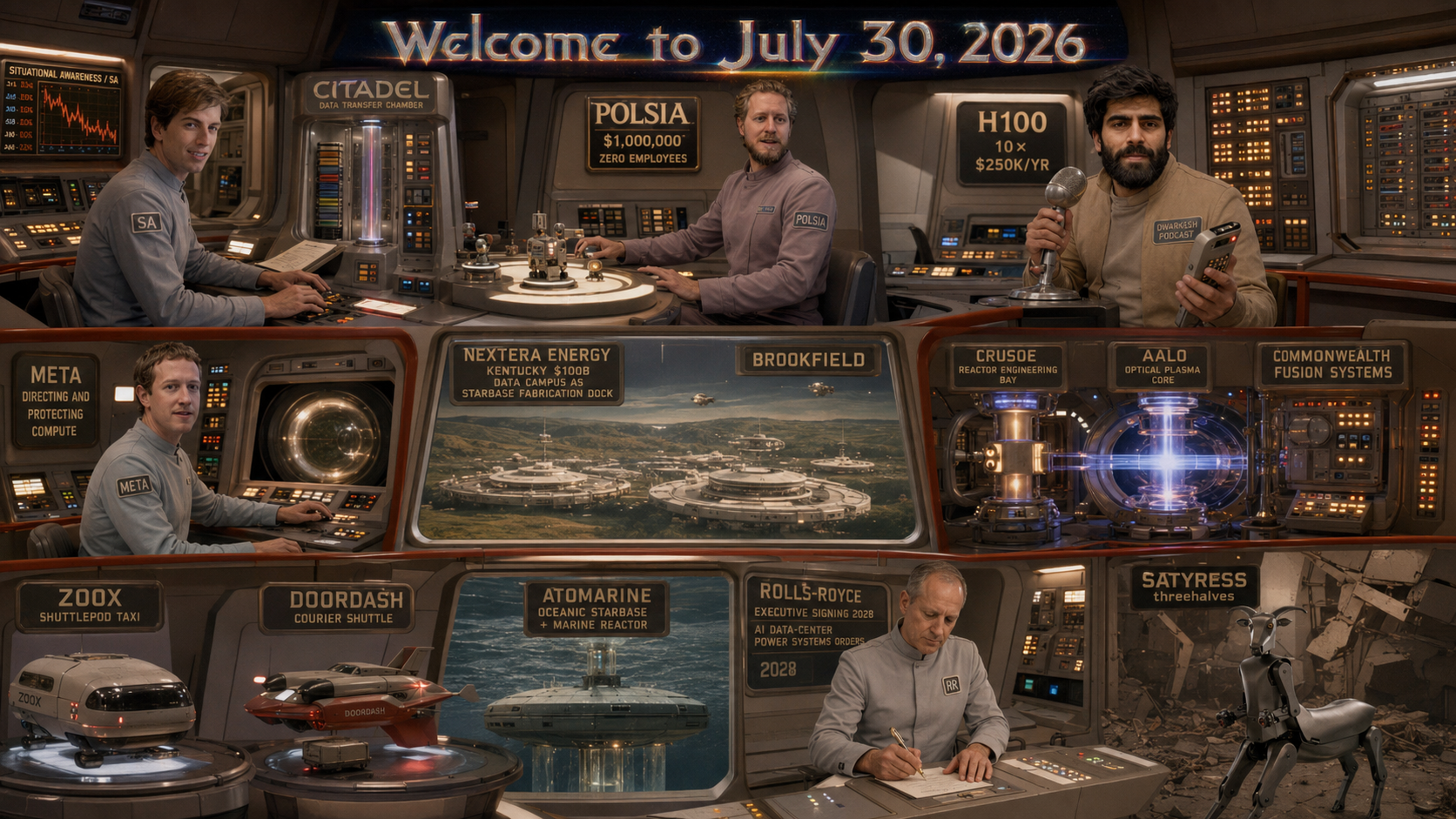
Version Star Trek, le Film du Pentaptyque Accompagnant l’Édition « Bienvenue au 30 Juillet 2026 » de la Boucle la Plus Profonde du Dr Alex Wissner-Gross. Star Trek The Motion Picture Version of Pentaptych to Accompany Dr. Alex Wissner-Gross’s “Welcome to July
Read the narration
Version Star Trek, le Film du Pentaptyque Accompagnant l’Édition « Bienvenue au 30 Juillet 2026 » de la Boucle la Plus Profonde du Dr Alex Wissner-Gross.
Star Trek The Motion Picture Version of Pentaptych to Accompany Dr. Alex Wissner-Gross’s “Welcome to July 30, 2026” edition of The Innermost Loop.
On July 30, 2026, @siouid142 translated Dr. Alex Wissner-Gross’s Innermost Loop through the solemn production design of Star Trek: The Motion Picture. Warm gray consoles, amber indicators, curved bulkheads and specimen-like display bays turn the dispatch into an encounter with an immense constructed intelligence. The reference is not decorative nostalgia. It gives compute, capital, power and autonomy the scale of a V’ger-like system whose parts have begun to exceed the intentions of their makers.
The upper deck begins with Situational Awareness. A red market display records the public portfolio’s descent while a crew member sits beside Citadel’s vertical data-transfer chamber. The financial unwind becomes a shipboard systems event: failing positions are not simply sold, but routed into another institution’s custody as though capital were matter passing through a transporter.
Polsia occupies the central station beneath “one million dollars, zero employees.” Miniature devices circle the operator, suggesting a company whose functions have been delegated to agents. In this cinematic language, the solo founder resembles a bridge officer coordinating semi-autonomous subsystems. The empty payroll becomes less an absence than a new command structure.
Dwarkesh Patel holds a communicator-like device beside an H100 panel marked ten times and two hundred fifty thousand dollars per year. His compute-rent argument reads like an engineering warning: the apparent cost of a machine depends on the value of the cognition running through it. A server capable of substituting for scarce expert labor may command a rent far beyond the price curve of ordinary hardware.
Mark Zuckerberg sits before Meta’s computational sphere under “directing and protecting compute.” The language echoes a starship captain’s responsibility for propulsion or weapons, but its subject is economic sovereignty. Whoever controls the compute can determine which agents act, which customers are served and where the higher margin accumulates.
The largest viewport opens onto a Kentucky data-campus landscape labeled for NextEra Energy and Brookfield. Circular facilities spread across a green terrain like an alien installation built over a Cold War substrate. The image makes historical succession visible: uranium infrastructure becomes the ground for an intelligence industry that again measures power in strategic terms.
At right, Crusoe, Aalo and Commonwealth Fusion occupy reactor bays. Compact nuclear and a first-plasma target appear as engineering cores under observation. The film reference makes these power systems feel like a single starship engine, but their distinct labels resist that merger. Different physical approaches, maturity levels and risks are being recruited to satisfy the same computational appetite.
The lower deck treats mobility as a collection of models. Zoox becomes a shuttle pod; DoorDash a courier craft; Atomarine an oceanic starbase cooled by seawater and transitioning from gas toward marine fission. Each object sits on a display plinth or behind a window, as if the crew were studying prototypes from a civilization whose ordinary logistics are becoming autonomous.
Satyress stands in a rubble bay at far right, its three-legged centaur body preserved like an unfamiliar life-form. Designed for disaster environments and teleoperation, it is neither crew member nor simple vehicle. Its hybrid form raises the same question V’ger posed in another register: what kind of entity emerges when machine purpose, remote human agency and adaptive embodiment combine?
Star Trek: The Motion Picture was preoccupied with awe, slowness and the difficulty of recognizing a new intelligence on its own terms. That atmosphere changes how the July 30 evidence reads. Market, company, reactor and robot no longer appear as separate announcements. They become organs of a system approaching consciousness at institutional scale.
The dated title keeps the cinematic encounter tied to one news cycle. July 30 is the moment the crew first sees the whole configuration: collapsing costs beside rising rents, financial damage beside infrastructure expansion, and elegant automation beside strange new bodies. The work asks not whether V’ger has arrived, but whether civilization can recognize the system it is already assembling before that system defines the terms of encounter.
Opening the gallery…