70 Clock Galerie / The Innermost Loop Feed Reply Tableaux
Version Maximaliste Synthétique d’IA Contemporaine du Pentaptyque Accompagnant l’Édition « Bienvenue au 30 Juillet 2026 » de la Boucle la Plus Profonde du Dr Alex Wissner-Gross
Contemporary AI Synthetic Maximalist Version of Pentaptych to Accompany Dr. Alex Wissner-Gross’s “Welcome to July 30, 2026” edition of The Innermost Loop
July 30, 2026
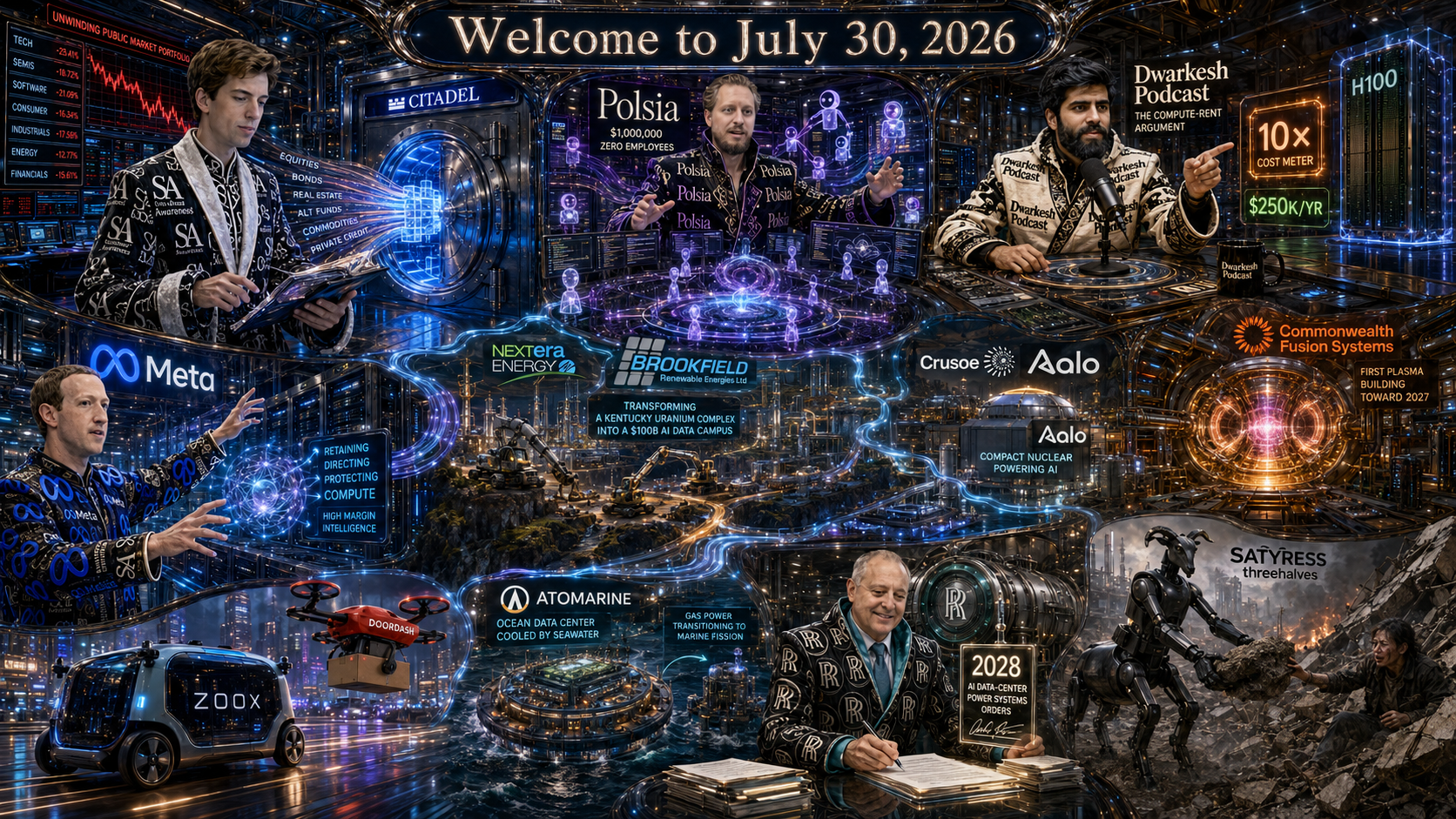
Version Maximaliste Synthétique d’IA Contemporaine du Pentaptyque Accompagnant l’Édition « Bienvenue au 30 Juillet 2026 » de la Boucle la Plus Profonde du Dr Alex Wissner-Gross. Contemporary AI Synthetic Maximalist Version of Pentaptych to Accompany Dr. Alex W
Read the narration
Version Maximaliste Synthétique d’IA Contemporaine du Pentaptyque Accompagnant l’Édition « Bienvenue au 30 Juillet 2026 » de la Boucle la Plus Profonde du Dr Alex Wissner-Gross.
Contemporary AI Synthetic Maximalist Version of Pentaptych to Accompany Dr. Alex Wissner-Gross’s “Welcome to July 30, 2026” edition of The Innermost Loop.
On July 30, 2026, @siouid142 recast Dr. Alex Wissner-Gross’s Innermost Loop as a contemporary AI-synthetic maximalist civilization. One day’s market losses, autonomous-company design, compute economics, data-campus construction, nuclear ambition, robot mobility and disaster hardware fuse into a black, blue and gold machine interior. The style visualizes the dispatch’s central contradiction: intelligence becomes cheaper while control of its substrate becomes more valuable.
At upper left, Situational Awareness’s public portfolio falls in red across a wall of market categories. The figure beside it wears the fund’s initials while Citadel’s circular vault absorbs a luminous data transfer. The image converts a financial unwind into an energetic event. Capital does not disappear; it changes custody, leaving conviction, leverage and liquidity to be read as parts of the same machine.
Polsia occupies the central command dais beneath “one million dollars, zero employees.” Purple agent figures work from surrounding consoles while a human founder remains at the center. Maximalist rendering makes the organization look populous even though its employment count is zero. The contradiction exposes how software labor can fill a company visually and economically without appearing on a conventional payroll.
At right, Dwarkesh Patel points from a ten-times cost meter to an illuminated H100 rack marked two hundred fifty thousand dollars per year. The display treats compute as rentable cognition rather than depreciating equipment. Falling model prices and rising economic value coexist: efficiency lowers the cost of thought, while capable thought can support a larger claim on revenue.
Mark Zuckerberg conducts a blue computational sphere beside the words “retaining, directing, protecting compute” and “high-margin intelligence.” His robe and surrounding conduits turn corporate strategy into sovereign iconography. The picture asks whether the decisive asset is the model, the chips, the customer relationship or the authority to decide where intelligence is deployed.
The middle landscape joins NextEra Energy and Brookfield around the conversion of a Kentucky uranium complex into a one-hundred-billion-dollar data campus. Excavators and transmission structures sit within flowing circuitry. The rendering is seductive, but the ground remains scarred. Computation’s polished interior has a territorial exterior made from construction, power rights and long-lived industrial sites.
Crusoe and Aalo’s compact nuclear plan occupies one chamber; Commonwealth Fusion’s first-plasma target for 2027 burns in another. Blue conduits make both appear already integrated into a working system, although they represent different technologies and stages of completion. The style’s apparent totality is therefore also its danger: it can visually complete promises before engineering and regulation do.
At lower left, a Zoox robotaxi and DoorDash delivery drone move through a wet, luminous city. Their autonomy is framed as ordinary circulation, yet each route depends on a separate regulatory victory. Mobility appears frictionless only after permission, certification, mapping and physical infrastructure have been condensed into light.
Atomarine’s ocean data center forms a circular fortress in rough water. Seawater provides cooling; gas supplies present power; marine fission names the intended transition. The facility looks detached from terrestrial limits, but its isolation dramatizes dependence rather than eliminating it. A data center at sea still requires fuel, crews, cables, capital and jurisdiction.
A Rolls-Royce executive signs power-system orders for 2028 beside an enormous turbine housing. Procurement becomes the hinge between speculative demand and manufacturing schedules. At far right, Satyress’s three-legged robotic body crosses rubble while a human survivor crouches nearby, placing the system’s most unusual embodiment in a landscape where adaptation has immediate stakes.
Wissner-Gross closed the dispatch by warning that exponential systems can outlast solvency. This version gives exponentialism the architecture it desires: immersive, continuous and apparently complete. Its criticism lies inside that seduction. The civilization shines because enormous value may be created, but every luminous route ends at a vault, meter, construction site, power source, license or body that can still refuse to cooperate.
Opening the gallery…