70 Clock Galerie / The Innermost Loop Feed Reply Tableaux
Version Enfantine du Pentaptyque Accompagnant l’Édition « Bienvenue au 30 Juillet 2026 » de la Boucle la Plus Profonde du Dr Alex Wissner-Gross
Child Version of Pentaptych to Accompany Dr. Alex Wissner-Gross’s “Welcome to July 30, 2026” edition of The Innermost Loop
July 30, 2026
Version Enfantine du Pentaptyque Accompagnant l’Édition « Bienvenue au 30 Juillet 2026 » de la Boucle la Plus Profonde du Dr Alex Wissner-Gross. Child Version of Pentaptych to Accompany Dr. Alex Wissner-Gross’s “Welcome to July 30, 2026” edition of The Innermo
Read the narration
Version Enfantine du Pentaptyque Accompagnant l’Édition « Bienvenue au 30 Juillet 2026 » de la Boucle la Plus Profonde du Dr Alex Wissner-Gross.
Child Version of Pentaptych to Accompany Dr. Alex Wissner-Gross’s “Welcome to July 30, 2026” edition of The Innermost Loop.
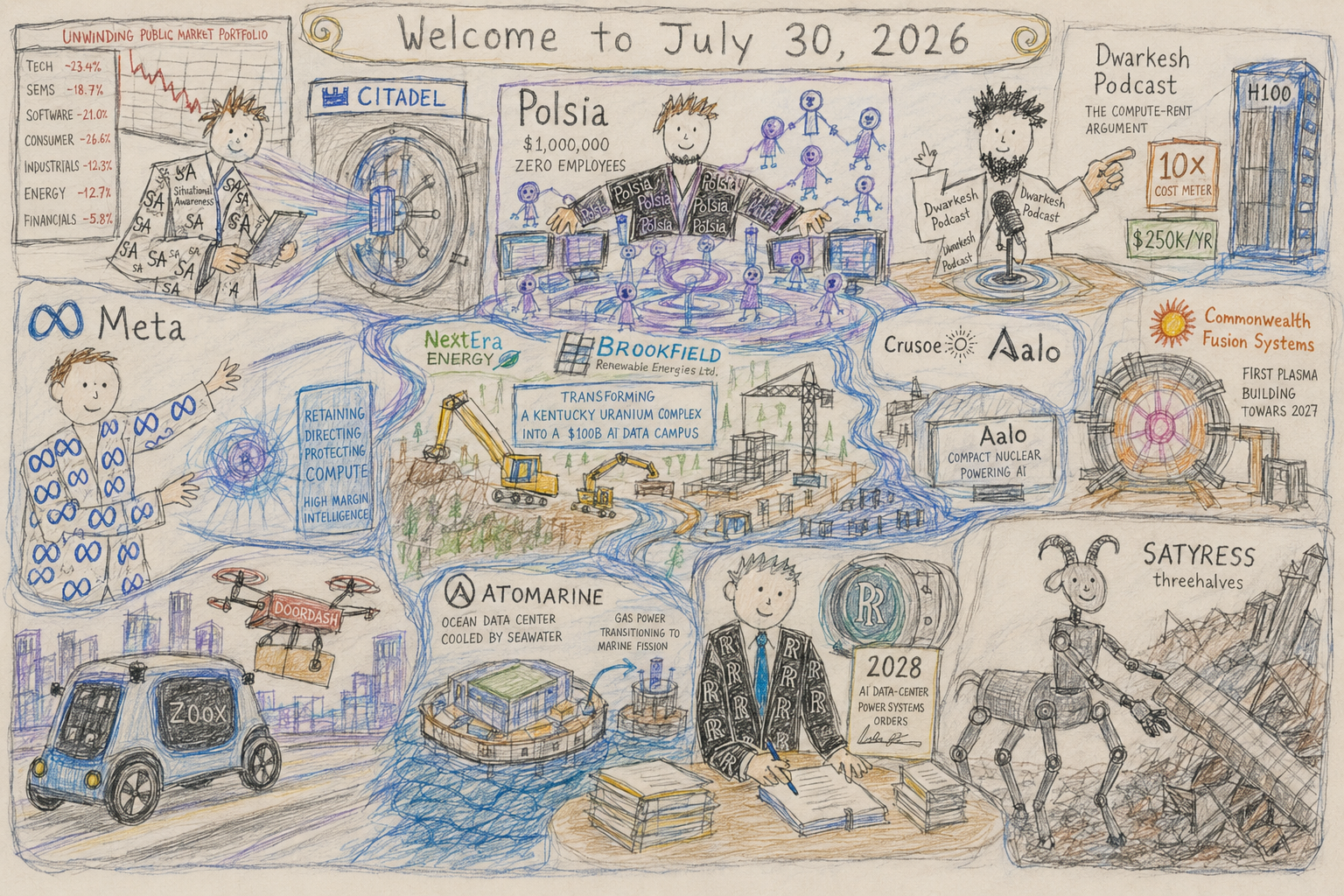
On July 30, 2026, @siouid142 translated Dr. Alex Wissner-Gross’s Innermost Loop into a child-drawn pentaptych of pencils, crayons and plainly labeled compartments. The dispatch’s closing warning—that the Singularity can remain exponential longer than an investor can remain solvent—organizes the page. Falling compute prices, rising infrastructure rents, autonomous firms, giant power projects and a damaged public portfolio become one worksheet about acceleration and ownership.
At upper left, a red graph marks the unwinding of Situational Awareness’s public-market portfolio across technology, semiconductors, software, consumer, industrial, energy and financial holdings. A figure in a jacket covered with “SA” stands before a Citadel vault as the public book changes hands. The drawing preserves the distinction between liquid positions being sold and private stakes remaining outside the transfer.
Polsia occupies the central panel beneath “one million dollars, zero employees.” Small agent figures operate screens around a human founder. The scene visualizes a new company form in which the person remains legally and strategically central while software performs tasks once assigned to departments. Zero employees does not mean zero labor. It means labor has been displaced into models, services and infrastructure that the diagram keeps visible.
At right, Dwarkesh Patel presents the compute-rent argument beside an H100 tower, a ten-times cost meter and the figure of two hundred fifty thousand dollars per year. The proposition is deliberately paradoxical. Model inference can become cheaper through efficiency, yet a machine capable of performing human-level engineering may justify a much higher economic rent. The refrigerator-like server becomes a prospective salaried worker, landlord and capital asset at once.
Mark Zuckerberg occupies the middle left in a robe patterned with Meta emblems. A tablet reads “retaining, directing, protecting compute” and “high-margin intelligence.” The garment converts his capital-allocation argument into corporate heraldry: selling spare capacity may produce revenue now, but controlling the intelligence running on that capacity may capture the larger margin later.
The center landscape joins NextEra Energy and Brookfield at a former Kentucky uranium complex being transformed into a one-hundred-billion-dollar data campus. Cranes, transmission structures and roads interrupt the green ground. The childish drawing makes the causal chain easy to follow: models require servers; servers require power and land; enormous forecasts become excavators in a particular place.
Crusoe and Aalo occupy a neighboring chamber where compact nuclear power feeds an AI facility. Commonwealth Fusion’s machine glows beside “first plasma toward 2027.” The two approaches are not treated as interchangeable accomplishments. They appear as competing temporal promises—one linked to a planned nuclear-powered factory, the other still reaching toward plasma—both summoned by demand that conventional grids may not satisfy.
Across the lower register, a Zoox vehicle and DoorDash drone make autonomy look almost toy-like, but their labels preserve the regulatory achievements behind them: paid robotaxi service without human controls and certified aerial delivery. Movement through streets and air depends on public permission even when the machines themselves appear to have no driver.
Atomarine floats offshore, cooled by seawater and powered by gas while pointing toward marine fission. Its circular platform turns the data center into an island whose apparent independence still requires fuel, cables, maintenance and law. Beside it, a Rolls-Royce representative signs power-system orders for 2028, showing that the future arrives first as a procurement schedule.
Satyress, the three-legged robotic goat, stands amid disaster rubble at lower right. Threehalves was presented as a teleoperated centaur for hazardous zones. Its anomalous anatomy completes the page’s argument: the “robots not banned” are not merely humanoid replacements. They can assume forms designed around terrain, leverage and remote human control.
The resulting worksheet does not claim that the future is simple. It claims that its dependencies should be explainable. July 30 appears as a contest between exponential capacity and finite institutions: portfolios can break, grids must be built, permissions must be won and someone must retain control of the machines. The crayon hand makes those relations legible before scale turns them back into spectacle.
Opening the gallery…