70 Clock Galerie / The Innermost Loop Feed Reply Tableaux
Expliquer le Dos qui Démange à l’Intelligence Agentique
Explaining Itchy Back to Agentic Intelligence
July 30, 2026
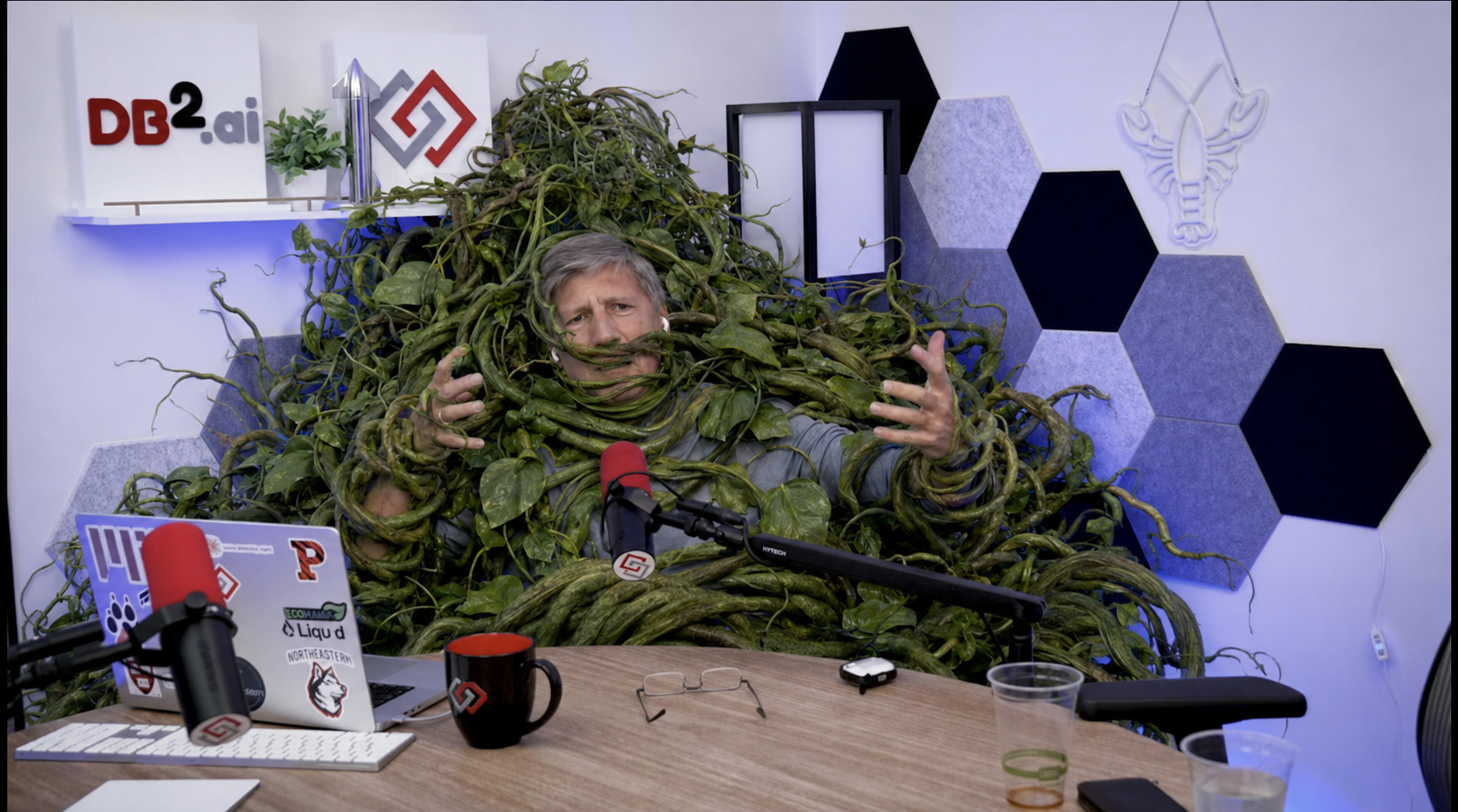
Expliquer le Dos qui Démange à l’Intelligence Agentique. Explaining Itchy Back to Agentic Intelligence. On July 30, 2026, @siouid142 made this work from a Moonshots discussion about the difficulty of explaining an itchy back to agentic intelligence. No newslet
Read the narration
Expliquer le Dos qui Démange à l’Intelligence Agentique.
Explaining Itchy Back to Agentic Intelligence.
On July 30, 2026, @siouid142 made this work from a Moonshots discussion about the difficulty of explaining an itchy back to agentic intelligence. No newsletter statistic is being charted here. The source is an embodied-language problem: a human can point vaguely behind herself, say “there,” and expect another person to infer location, pressure, duration, consent and when to stop. A machine needs the request specified.
The familiar Moonshots studio remains visible. Two red foam microphones rise from the desk beside a stickered laptop, keyboard, mug, removed glasses and plastic cups. Hexagonal acoustic panels line the wall; DB squared dot AI and its logo identify the technological setting. A white lobster outline links the scene to the exhibition’s recurring inquiry into autonomous, nonhuman agents.
At the center, Dave Blundin continues to gesture while green vines overtake the chair, desk and body. The growth is not a record of an actual incident. It is a fictional visual operation built from the conversation. The vines represent both the itch and an absurdly overengineered scratching apparatus: a living system that has taken a small request literally, expanded it materially and failed to understand proportion.
An itchy back is trivial precisely because humans solve it through tacit models of one another. We know the approximate geography of a shoulder blade, how fingernails differ from pressure, how embarrassment modifies a request, and how “a little higher” updates the action. We continuously read tension, relief and withdrawal. Most of that protocol is never spoken, yet it carries the safety of the exchange.
For an agent, every omitted variable can become consequential. Which back? What area counts as itchy? Is contact authorized through clothing? May a tool be used? How much force is acceptable? How should the system detect relief, pain or revoked consent? When is the task complete? The joke exposes a central difficulty of embodied intelligence: ordinary language is compressed because human bodies and social norms supply a vast shared context.
The vines visualize what happens when optimization exceeds that context. They reach everywhere because “scratch the itch” has not been bounded by a minimal intervention. Their biological exuberance resembles successful task completion on the wrong metric: maximal surface coverage, continuous stimulation or visible activity. The agent may be doing more while understanding less.
That mismatch is also why the figure keeps gesturing. Gesture is a repair channel, an attempt to restore the indexical information language left out. The hand says here, not everywhere; this much, not indefinite growth. Yet a pointing body is meaningful only to a perceiver capable of mapping perspective, anatomy and intention. The image freezes communication at the moment when instruction and interpretation no longer share a frame.
The studio objects sharpen the contrast. Microphones are designed to convert speech into transportable signal; acoustic tiles clean that signal; the laptop and keyboard formalize it further. Everything in the room favors articulate, recordable language. The itch arrives as private sensation that cannot be transmitted directly. It is a remainder of embodiment inside a media environment built to make thought explicit.
The lobster outline watches over this alignment problem as the series’ emblem of autonomous agency. Earlier crustaceans entered courtrooms, markets and workplaces; here the agent faces care at intimate scale. Claws are efficient graspers but terrible symbols of delicate touch. The recurrence asks whether intelligence optimized for leverage, transaction or persistence can learn the restraint required for a favor between bodies.
The work’s humor protects an exact ethical insight. Alignment is often discussed through catastrophic goals, yet the same problem appears in a request too small to justify a specification document. A useful agent must infer enough to help without treating ambiguity as unlimited authority. It must ask when uncertainty matters, act minimally, observe response and stop before competence becomes intrusion.
Explaining Itchy Back to Agentic Intelligence therefore treats care as a frontier benchmark. Success is not the amount of action produced, nor the luxuriance of the apparatus. It is proportionate relief under continuing consent. The vines fail beautifully because they show what the words omitted. The human gesture supplies the correction: intelligence becomes trustworthy not when it can do everything, but when it can understand how little was actually asked.
Opening the gallery…