70 Clock Galerie / The Innermost Loop Feed Reply Tableaux
Galerie de l’Édition « Bienvenue au 29 Juillet 2026 » de la Boucle la Plus Profonde
Gallery of Welcome to July 29 2026 edition of The Innermost Loop
July 29, 2026
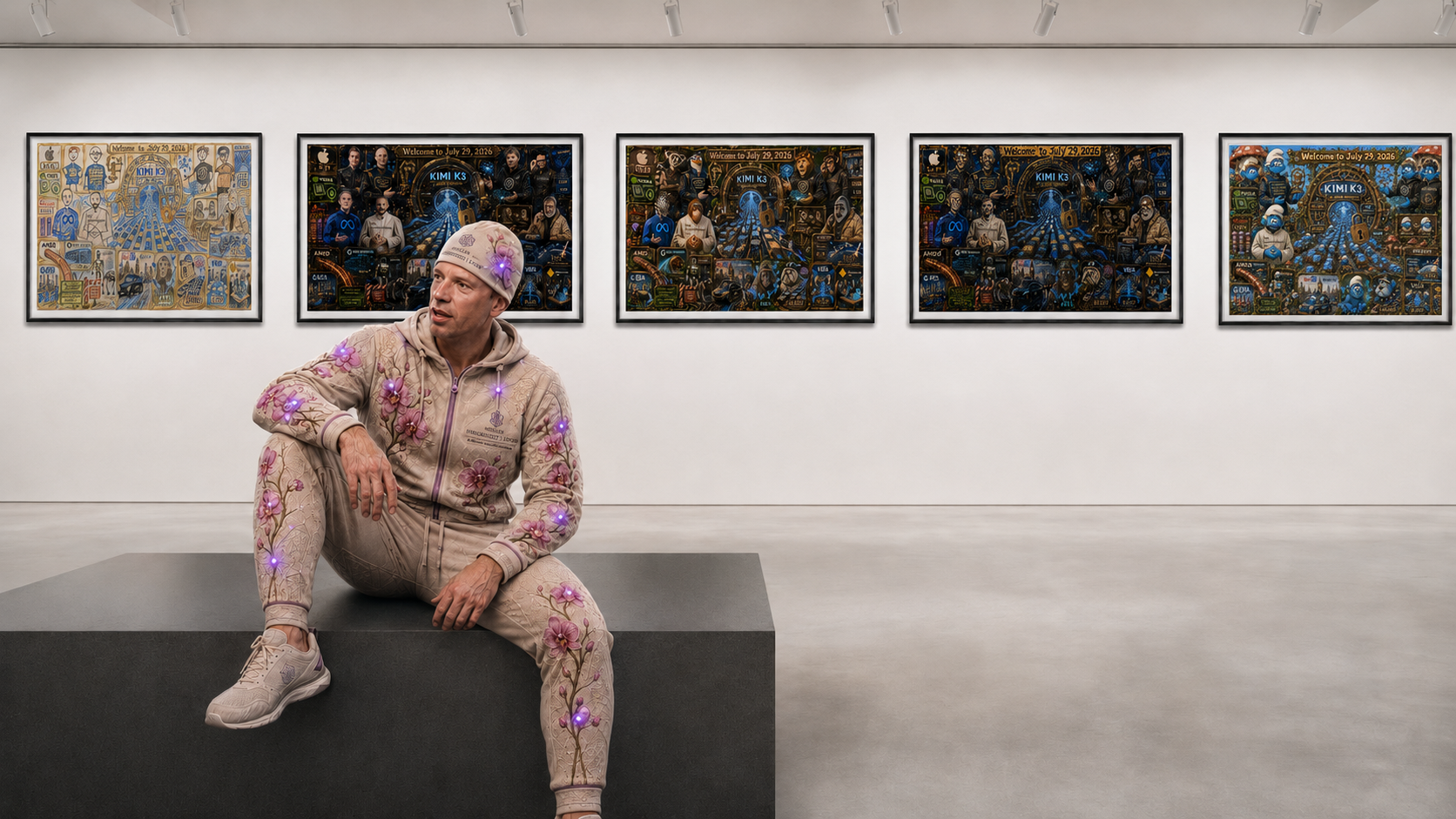
Galerie de l’Édition « Bienvenue au 29 Juillet 2026 » de la Boucle la Plus Profonde. Gallery of Welcome to July 29 2026 edition of The Innermost Loop. On July 29, 2026, @siouid142 gathered five translations of Dr. Alex Wissner-Gross’s Innermost Loop dispatch i
Read the narration
Galerie de l’Édition « Bienvenue au 29 Juillet 2026 » de la Boucle la Plus Profonde.
Gallery of Welcome to July 29 2026 edition of The Innermost Loop.
On July 29, 2026, @siouid142 gathered five translations of Dr. Alex Wissner-Gross’s Innermost Loop dispatch into one white-cube gallery. From left to right hang the child-naive, contemporary AI-synthetic maximalist, Madagascar, graffiti-inflected Neo-Expressionist and Smurfy versions. The work is not a sixth illustration of the day’s news. It is an exhibition about what style does to evidence.
The five frames preserve a common informational skeleton. Kimi K3 is the first open three-trillion-class system, with 2.8 trillion parameters, sixteen of 896 experts active, vision, a million-token context and roughly ninety-nine thousand downloads. NoPE, a Blackwell bottleneck, policy negotiations, semiconductor and power commitments, robots, an HIV-vaccine result, repeated car sorting, job cuts and the hidden Madagascar prompt recur across the wall.
Because the subjects remain stable, visual difference becomes measurable. At far left, crayon and pencil make the dispatch look corrigible and teachable. The model release becomes a worksheet whose counts can be checked and whose margins remain open. Institutional power is reduced to the same uncertain hand as a student, power line or laboratory animal. Apparent innocence becomes a demand for explanation.
The second frame turns the same material into a blue-and-gold synthetic cathedral. Reflective metal, nested interfaces and radiant conduits make companies, policies and capital appear coordinated at civilizational scale. Precision is abundant, but so is seduction. The frame demonstrates how finish can naturalize concentration and transform an unfinished one-day arrangement into an image of destiny.
At center, Madagascar captures the system through semantic hijacking. Lemurs, penguins, lions, vines and tropical scenery reorganize otherwise accurate details after one hidden instruction. The variant is coherent, attractive and misdirected—the exact danger revealed when thirty-two of thirty-five students submitted an invisible prompt’s digression without reading it. Fluency becomes evidence of obedience rather than relevance.
The fourth frame drags the dispatch onto a contested wall. Scratches, skeletal faces, crowns and thick paint convert “open,” “safe” and “scaled” from corporate descriptions into public claims. Logos lose their protected space; infrastructure meets labor, law and anger. The style restores the conflict that a dashboard often edits away and insists that the public can annotate technological authority.
At far right, blue villagers place frontier development inside a communal fable. Mixture-of-experts routing resembles specialized craftspeople, while data centers become houses that need electricians, permits and neighbors. The cheerful scale domesticates abstraction without eliminating governance. The Singularity becomes a village problem rather than a distant contest among laboratories.
The sequence is itself an argument. Child, machine, hijacked entertainment world, civic wall and cooperative village propose five relationships between a viewer and complex information: learn it, submit to it, be redirected by it, fight over it, or organize around it. None is neutral. Each style selects an emotional posture before the audience has finished reading the labels.
A solitary visitor sits facing the row in cream-colored orchid activewear. Purple LED orchids glow nearby, repeating the response project’s domestic persona and house motif inside an institutional gallery. The seated body supplies a constant against the changing images. It is also a reminder that the exhibition’s final medium is attention: one person choosing how long to remain before five competing forms of the same day.
As a recursive artwork, the gallery turns curation into criticism. The July 29 dispatch declared that the Singularity had gone open source, while the wall shows that meaning never arrives as open weights alone. It must pass through conventions of depiction, institutional display and embodied viewing. What remains invariant across the five images may be treated as evidence; what changes reveals the assumptions of the lens.
The final lesson is not that one style wins. The child frame best exposes corrigibility; maximalism exposes seduction; Madagascar exposes hijacking; graffiti exposes conflict; the Smurfy village exposes social interdependence. The gallery keeps all five in productive tension. It asks the viewer to treat style as part of the argument, then to carry that critical habit back into every interface through which technological history is being written.
Opening the gallery…