70 Clock Galerie / The Innermost Loop Feed Reply Tableaux
Version Néo-expressionniste aux Accents Graffiti du Pentaptyque Accompagnant l’Édition « Bienvenue au 29 Juillet 2026 » de la Boucle la Plus Profonde du Dr Alex Wissner-Gross
Graffiti Inflected Neo-Expressionist Version of Pentaptych to Accompany Dr. Alex Wissner-Gross’s “Welcome to July 29, 2026” edition of The Innermost Loop
July 29, 2026
Version Néo-expressionniste aux Accents Graffiti du Pentaptyque Accompagnant l’Édition « Bienvenue au 29 Juillet 2026 » de la Boucle la Plus Profonde du Dr Alex Wissner-Gross. Graffiti Inflected Neo-Expressionist Version of Pentaptych to Accompany Dr. Alex Wis
Read the narration
Version Néo-expressionniste aux Accents Graffiti du Pentaptyque Accompagnant l’Édition « Bienvenue au 29 Juillet 2026 » de la Boucle la Plus Profonde du Dr Alex Wissner-Gross.
Graffiti Inflected Neo-Expressionist Version of Pentaptych to Accompany Dr. Alex Wissner-Gross’s “Welcome to July 29, 2026” edition of The Innermost Loop.
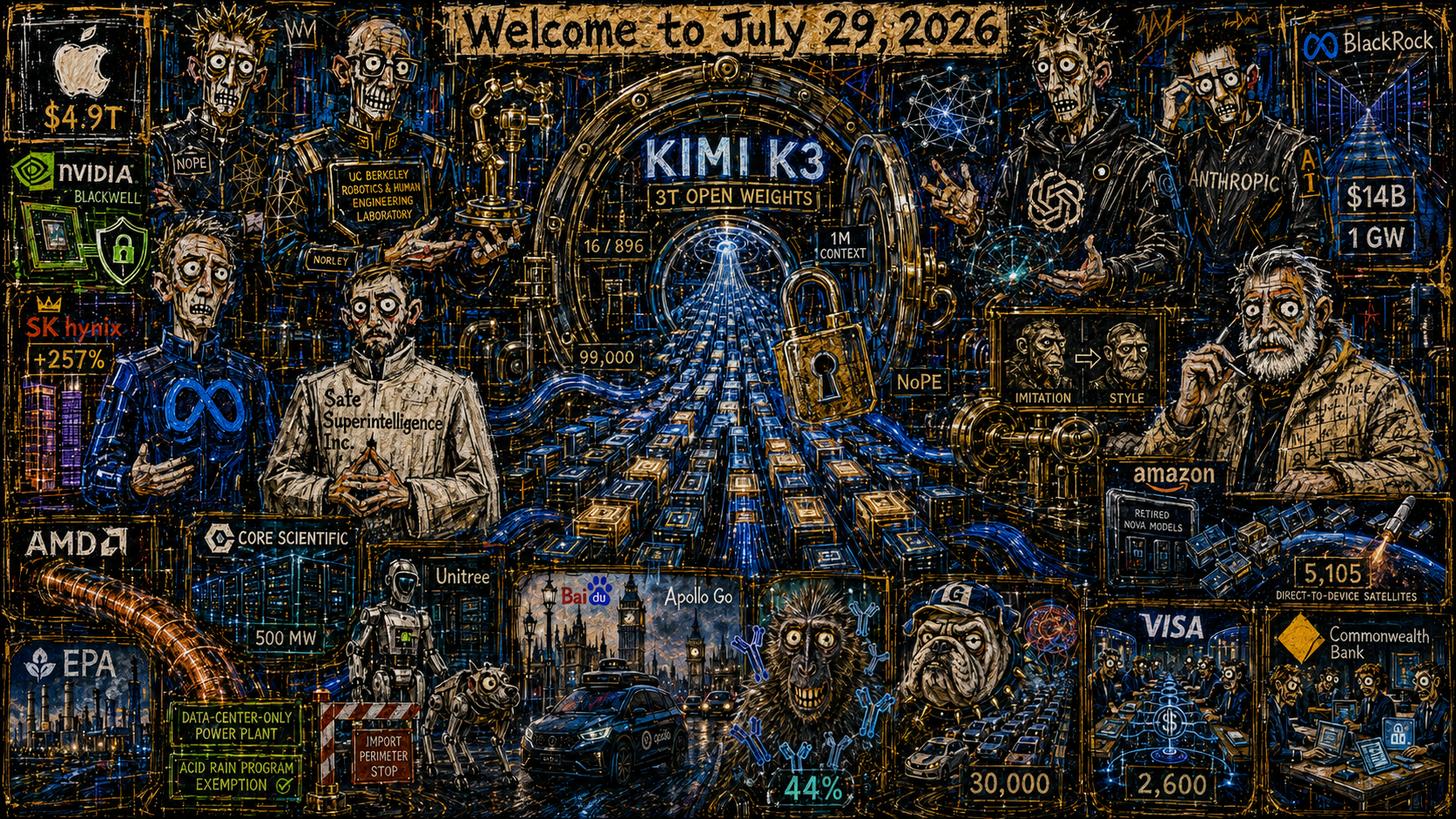
On July 29, 2026, @siouid142 turned Dr. Alex Wissner-Gross’s assertion that “the Singularity went open source” into a graffiti-inflected Neo-Expressionist argument. Kimi K3, safety policy, semiconductor capacity, data-center power, robots, biology and labor cover a scratched black wall in blue, gold, white and orange. The dispatch is no longer presented by institutions controlling their own frames. It has entered public space.
Kimi K3 occupies the center as a many-eyed mechanical presence. Its 2.8 trillion parameters, sixteen active experts among 896, vision, million-token context and roughly ninety-nine thousand downloads are stenciled around it. NoPE replaces rotary positional encoding, and Kimi K4 collides with a Blackwell bottleneck. Numbers survive the expressive marks because the wall’s anger is directed at authority, not at factual precision.
The phrase “open source” appears like a slogan someone has painted at night. Around it, Moonshot AI’s sixfold sales growth and fifty-billion-dollar valuation meet questions about restricted silicon; Amazon closes most Nova models to reclaim compute. The wall asks what “open” means when weights circulate but accelerators, energy and money remain fenced. A key can be copied infinitely while the door it fits stays scarce.
Policy figures crowd the upper register: OpenAI and Anthropic align before an August 1 review deadline; 1,100 workers demand deliberate pacing; Sam Altman goes to Washington; Dario Amodei calls for chip controls and testing without a weight ban; Mark Zuckerberg favors distribution; Nvidia convenes an Open Secure AI Alliance. Their faces resemble masks because public positions have become roles in a rapidly improvised civic drama.
Madagascar erupts as the painting’s internal sabotage. A professor’s invisible white-text instruction redirected student models into an irrelevant digression, and thirty-two of thirty-five submissions failed because their authors did not read them. Here the island word breaks through the composition like a tag painted over someone else’s message. It demonstrates how a small instruction can seize a large intelligence without erasing its fluency.
The middle register is industrial and almost violent. Chinese immersion deep-ultraviolet equipment, CXMT growth, SK hynix revenue, Apple’s valuation, Nvidia’s stake in Safe Superintelligence and the proposed Ohio backstop collide with Meta and BlackRock’s El Paso gigawatt, AMD and Core Scientific’s five hundred megawatts, and Microsoft’s fear of underbuilding. Drips join money to chips as if capital itself were leaking through the surface.
Power plants, transmission lines, apprenticeships and barricades fill the gaps. An EPA exemption for a dedicated data-center plant, demand for electricians and attacks on Amazon facilities in Bahrain make the cloud visibly terrestrial. The figures’ skeletal bodies stand beside glowing racks, insisting that infrastructure is built, defended and repaired by vulnerable people even when promotional language describes only scale.
At the perimeter, the FCC bars selected Chinese humanoid and quadruped robots. Unitree waits behind a gate; Apollo Go heads toward London; garbage-truck enforcement cameras lose their mandate. Amazon’s 5,105 direct-to-device satellites scratch an orbital arc overhead. Autonomy appears as a claim made by machines inside borders drawn by governments, streets and radio spectrum.
Visa cuts 2,600 positions and reinvests in stablecoins. Call-center exposure, à-la-carte models, litigation, an influencer degree and AI social conversation occupy the lower wall. These items look like marginal graffiti beneath the grand model release, yet they record where the system touches wages, credentials and human voice. The margin is where the central machine becomes someone’s life.
Neo-Expressionism restores conflict to an industry vocabulary built from smooth nouns such as openness, safety and scale. Crowns parody sovereignty; exposed teeth interrupt executive composure; scraped paint makes every border temporary. The style says that the future is not being deployed onto a blank canvas. It is being written over labor histories, laws, classrooms, grids and prior claims to public space.
The dated banner fixes this wall to one day while leaving it visibly unfinished. “The unprompted life is not worth living” appears less as a maxim than another tag available for response. The work’s final proposition is democratic and abrasive: if the Singularity has truly gone open source, then interpretation must become open too. The public must be able to annotate the system, question its labels and paint back.
Opening the gallery…