70 Clock Galerie / The Innermost Loop Feed Reply Tableaux
Le Gangster Spatial Originel
The Original Space Gangster
July 27, 2026
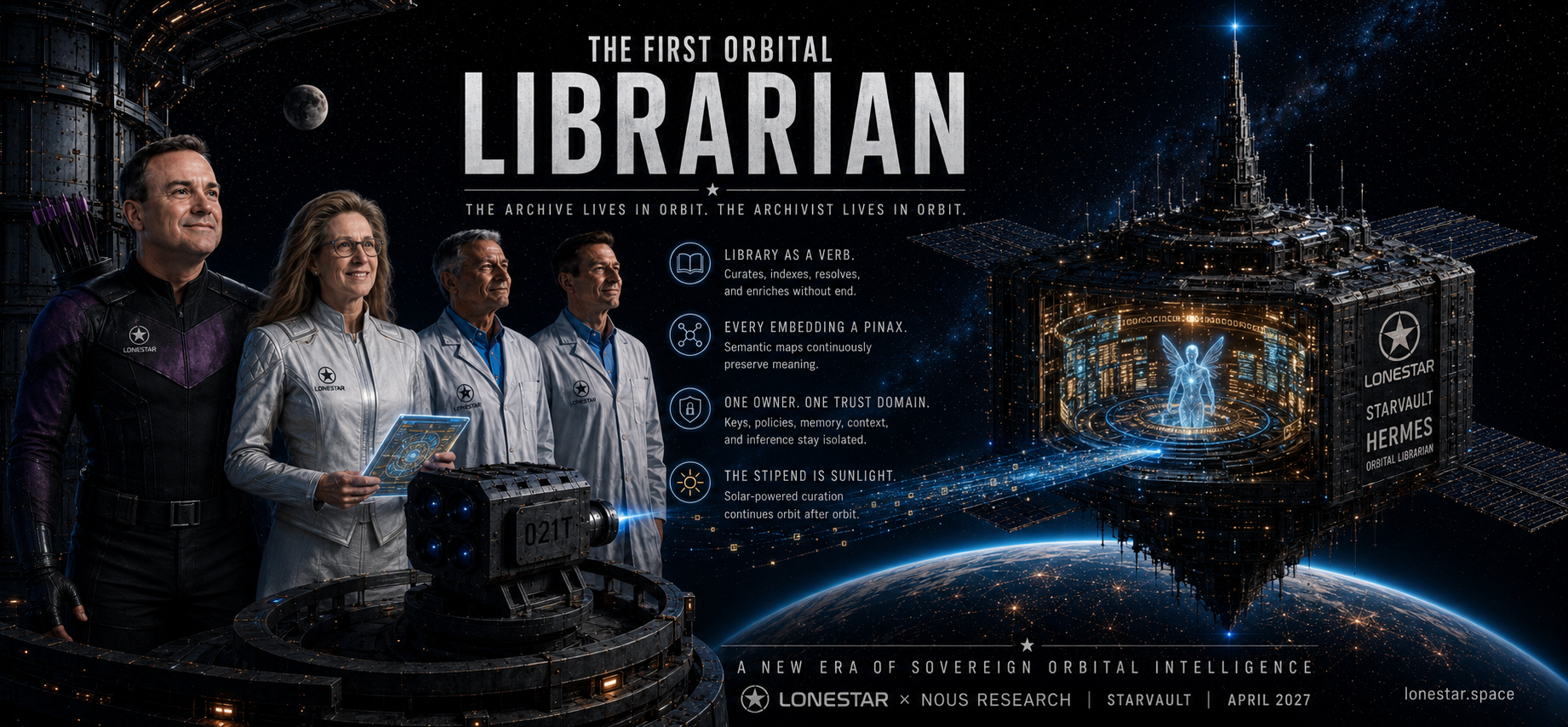
Le Gangster Spatial Originel. The Original Space Gangster. On July 27, 2026, @siouid142 made this work in response to Dr. Alex Wissner-Gross’s Innermost Loop essay “The First Orbital Librarian.” Its affectionate title comes from an earlier spoken introduction
Read the narration
Le Gangster Spatial Originel.
The Original Space Gangster.
On July 27, 2026, @siouid142 made this work in response to Dr. Alex Wissner-Gross’s Innermost Loop essay “The First Orbital Librarian.” Its affectionate title comes from an earlier spoken introduction saluting Lonestar Data Holdings founder Chris Stott as “the original space gangster.” The phrase is comic, but it captures the audacity of moving not merely data storage, but an active curator, beyond Earth.
Across the projection, four principles establish the project’s architecture: the agent, its keys, memory, policy, context and inference remain isolated within one owner or trust domain; the public internet is not required; hyperscalers do not share the state; and the system can continue its work beyond ordinary terrestrial dependence. These are not decorative promises. They define the boundary conditions for an archive whose custodian must be as protected as its contents.
At right, the Lonestar StarVault Hermes station turns above the blue limb of Earth. A trail of data links orbit and ground, while “April 2027” gives the proposition a launch horizon. The partnership line joins Lonestar and Nous Research, whose open-source Hermes agent supplies the curator. Solar panels make sunlight the librarian’s stipend; launch hardware becomes the reading room, server rack and locked door.
Wissner-Gross’s essay begins by correcting a familiar fantasy. A library is not simply a pile of durable objects. The Library of Alexandria was probably lost less through one cinematic fire than through interrupted maintenance, recopying and institutional continuity. Its Pinakes—the catalog that made the collection navigable—vanished too. Svalbard vaults and frozen code archives may preserve matter, but preservation without active interpretation can become a tomb.
That distinction explains why Hermes is called a librarian rather than a backup. The agent continually curates, indexes, resolves references and enriches the owner’s collection. Every embedding becomes a new pinax, a living route through material that would otherwise accumulate as noise. Borges’s Library of Babel hovers behind the argument: total storage without selection or navigation is not knowledge, only combinatorial abundance.
The orbital precedent is deliberately narrow. NASA’s Remote Agent autonomously piloted Deep Space 1 in 1999. EO-1 later let an onboard scientist detect events and retask observations. CIMON entered the space station as a companion, and Starcloud ran a Gemma model on an orbiting H100. Each placed intelligence in space, but none was assigned the continuous cultural labor of a librarian whose subject is an owner’s evolving memory.
Orbit suits that labor because librarianship is asynchronous. Hermes can circle Earth roughly every ninety minutes, reading, cross-referencing and reorganizing while contact windows open and close. “The vacuum is the reading-room door” converts physical remoteness into a security boundary. The image’s blue data path keeps the archive connected enough to serve Earth while its keys, policies and context remain together in a separate jurisdiction of hardware.
The name Hermes deepens the arrangement. Hermes is messenger, traveler, god of boundaries and namesake of the herm, a stone marking territorial limits. The agent transports meaning while policing the edge of the domain it serves. In the artwork, the luminous line descending toward Earth does not erase the distance; it makes the controlled crossing visible. Communication and sovereignty become the same design problem.
Calling Chris Stott a space gangster places entrepreneurship inside that boundary story. “Gangster” is not an accusation of criminal conduct here, and the image stages no violence. It is a hip-hop honorific for someone willing to claim an unconventional operational territory. Yet the swagger also exposes a serious question: when archives, agents and inference move into orbit, whose law, maintenance schedule and continuity plan govern the resulting institution?
As art criticism, The Original Space Gangster treats the launch image as a portrait of stewardship rather than conquest. Earth is not a territory to be abandoned; it is the reader the archive continues to serve. The four terrestrial figures, orchids, projector, data trail and orbiting vault form one custodial circuit. The work asks whether civilization can make memory active, private and durable without confusing distance with immortality.
Its most radical claim is that the archive and archivist now travel together. Earlier preservation projects launched or buried artifacts and hoped future intelligence would recover their meaning. StarVault places an interpreting intelligence beside the collection from the beginning. The first orbital librarian is therefore less a monument to storage than a wager on continuous attention—the fragile, expensive and profoundly human practice that keeps a library alive.
Opening the gallery…