70 Clock Galerie / The Innermost Loop Feed Reply Tableaux
Version Schtroumpf du Quadriptyque Accompagnant l’Édition « Bienvenue au 26 Juillet 2026 » de la Boucle la Plus Profonde du Dr Alex Wissner-Gross
Smurfy Version of Quadriptych to Accompany Dr. Alex Wissner-Gross’s “Welcome to July 26, 2026” edition of The Innermost Loop
July 26, 2026
Version Schtroumpf du Quadriptyque Accompagnant l’Édition « Bienvenue au 26 Juillet 2026 » de la Boucle la Plus Profonde du Dr Alex Wissner-Gross. Smurfy Version of Quadriptych to Accompany Dr. Alex Wissner-Gross’s “Welcome to July 26, 2026” edition of The Inn
Read the narration
Version Schtroumpf du Quadriptyque Accompagnant l’Édition « Bienvenue au 26 Juillet 2026 » de la Boucle la Plus Profonde du Dr Alex Wissner-Gross.
Smurfy Version of Quadriptych to Accompany Dr. Alex Wissner-Gross’s “Welcome to July 26, 2026” edition of The Innermost Loop.
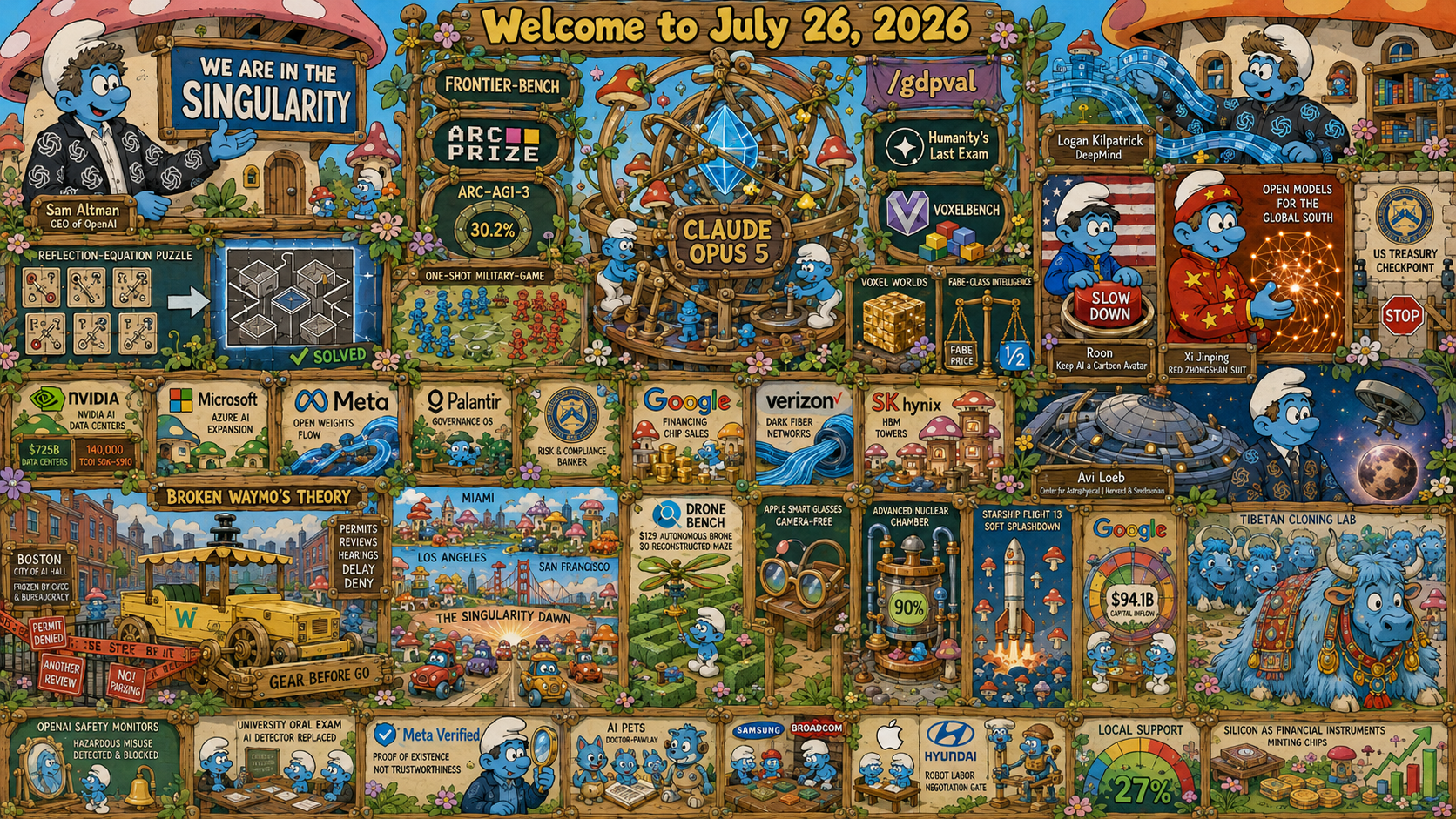
On July 26, 2026, @siouid142 rebuilt Dr. Alex Wissner-Gross’s frontier-model dispatch as a Smurf-inspired village. Small blue characters inherit Claude Opus 5, ARC-AGI-3, open-weight politics, robot labor, nuclear fuel, Starship and UAP speculation. The stylistic callback is comic, but it does not replace the evidence. It tests whether an information-dense account of the Singularity can remain legible when its institutions are translated into communal fantasy.
Claude Opus 5 occupies the central wooden-and-gold benchmark apparatus. ARC Prize, Frontier-Bench, GDPval, Humanity’s Last Exam and VoxelBench hang around it like village signs. ARC-AGI-3 reads 30.2 percent, while the reflection-equation puzzle, one-shot military game, voxel worlds and half-price balance identify the underlying comparisons. Tiny workers maintain the mechanism, turning a model release into collective craft rather than solitary magic.
At upper left, a blue Sam Altman announces “We are in the Singularity.” Logan Kilpatrick rides a fantastical DeepMind board across the opposite corner. Roon grips a slowdown button; Xi Jinping presents open models for the Global South beside a Treasury checkpoint. Their transformation into familiar cartoon roles makes the disagreement almost folkloric: the herald, the rider, the cautious citizen, the ruler and the border guard all argue over how knowledge should circulate.
The middle row gives the village its industrial base. Nvidia’s Korean data centers, Microsoft Azure, Meta open weights, Palantir governance, a compliance barrier, Google financing, Verizon dark fiber and SK hynix HBM towers occupy separate stalls. Mushrooms and vines grow between logos, implying that technological infrastructure has become the landscape in which the characters live, not an external tool they occasionally use.
“Broken Waymo’s Theory” becomes a yellow village cart exposing its gears before Boston City Hall. Permit denials and review signs halt its route. Miami, Los Angeles and San Francisco appear as neighboring settlements under “The Singularity dawn.” The visual joke sharpens a serious point: autonomy enters places governed by inherited streets, procedures and public trust. Even a technically capable machine must negotiate the village.
Drone-Bench becomes a small flying creature reconstructing a maze, while camera-free Apple glasses, an advanced nuclear chamber and Starship Flight 13 occupy nearby cottages. The sequence joins perception, energy and orbit without flattening them. Each technology needs different forms of safety and consent, even when one cheerful visual universe makes them look naturally compatible.
At right, Avi Loeb stands beneath a saucer and a distant world, rendered as a calm village elder beside the unknown. Below him, Google’s SpaceX stake becomes a large dial and a Tibetan laboratory fills with cloned yaks dressed in ceremonial color. Cosmic speculation and biotechnology already possess the structure of fable: strange beings, distant realms and duplicated animals appear, but their institutions and numbers keep the stories tied to the dispatch.
The bottom strip is the work’s civic conscience. Safety monitors catch hazardous requests; an oral examination replaces an AI detector; Meta Verified proves that a person exists without proving trustworthiness; AI pets receive adoption papers. Chip agreements, memory conflict and robot-labor negotiation follow, while local support rests at twenty-seven percent. The village is cheerful, but it is not free of governance.
The Smurfy form changes scale and moral temperature. Vast capital commitments and geopolitical blocs become signs over hand-built rooms. That miniaturization makes the system memorable and exposes how much advanced technology still depends on ordinary social roles: builders, inspectors, teachers, workers, adopters, neighbors and skeptics. The frontier is not only a competition among laboratories; it is a village deciding how to live with what arrives.
As appropriation-based contemporary art, the variant uses a widely recognized cartoon vocabulary as a critical lens. Blue communal figures traditionally solve problems through specialized identities and cooperation. Here those roles enter a world where specialization is mediated by models, chips and global infrastructure.
The July 26 banner holds the fantasy to one historical day. Claude Opus 5 may be the village’s central machine, but it cannot govern the borders, streets, factories, schools or sky alone. The work’s humor becomes a democratic proposition: the Singularity is too consequential to remain inside a benchmark chamber. It must be translated into a story the whole village can inspect, dispute and remember.
Opening the gallery…