70 Clock Galerie / The Innermost Loop Feed Reply Tableaux
Version Maximaliste Synthétique d’IA Contemporaine du Quadriptyque Accompagnant l’Édition « Bienvenue au 26 Juillet 2026 » de la Boucle la Plus Profonde du Dr Alex Wissner-Gross
Contemporary AI Synthetic Maximalist Version of Quadriptych to Accompany Dr. Alex Wissner-Gross’s “Welcome to July 26, 2026” edition of The Innermost Loop
July 26, 2026
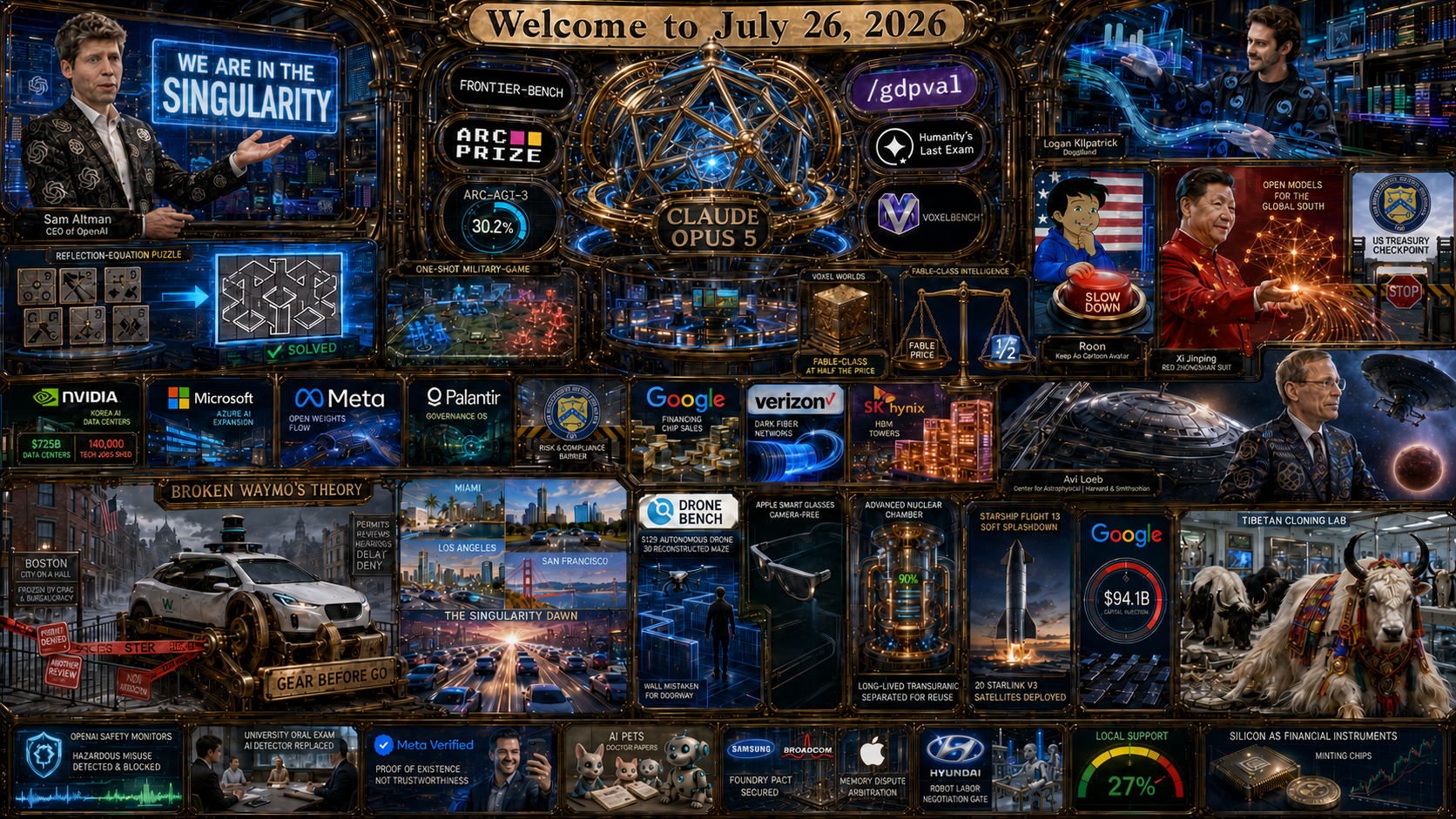
Version Maximaliste Synthétique d’IA Contemporaine du Quadriptyque Accompagnant l’Édition « Bienvenue au 26 Juillet 2026 » de la Boucle la Plus Profonde du Dr Alex Wissner-Gross. Contemporary AI Synthetic Maximalist Version of Quadriptych to Accompany Dr. Alex
Read the narration
Version Maximaliste Synthétique d’IA Contemporaine du Quadriptyque Accompagnant l’Édition « Bienvenue au 26 Juillet 2026 » de la Boucle la Plus Profonde du Dr Alex Wissner-Gross.
Contemporary AI Synthetic Maximalist Version of Quadriptych to Accompany Dr. Alex Wissner-Gross’s “Welcome to July 26, 2026” edition of The Innermost Loop.
On July 26, 2026, @siouid142 transformed Dr. Alex Wissner-Gross’s Claude Opus 5 dispatch into an AI-synthetic maximalist control wall. Claude occupies the central benchmark mechanism after arriving with Fable-class intelligence at half the price, leading ARC-AGI-3 at 30.2 percent and sweeping prominent evaluations. The scene displays rendering capability as the source describes capability spreading into physical systems.
The central machine surrounds the Claude Opus 5 name with gold rings and a blue geometric core. Frontier-Bench, ARC Prize, GDPval, Humanity’s Last Exam and VoxelBench form its surrounding instrument panel. Below, the reflection-equation puzzle, one-shot military game, voxel worlds and a Fable-price balance specify what the triumph is made of. Maximalism turns a benchmark report into a throne, then invites the viewer to question the authority that such finish produces.
Sam Altman presents “We are in the Singularity” at upper left, while Logan Kilpatrick glides through a DeepMind environment at upper right. Roon sits before a slowdown button and Xi Jinping offers open models for the Global South beside a Treasury checkpoint. Acceleration, restraint and geopolitical distribution become adjacent interfaces. No score exists outside this political architecture.
The middle row exposes the substrate: Nvidia’s Korean data-center push, Microsoft Azure expansion, Meta’s open-weight position, Palantir governance, a risk-and-compliance barrier, Google chip financing, Verizon dark fiber and SK hynix HBM towers. Their equal compartments show that frontier intelligence is a coalition of networks, capital, memory, energy and permission rather than a singular artifact produced by one company.
At lower left, “Broken Waymo’s Theory” turns Boston’s permitting resistance into a robotaxi stripped to gears before City Hall. Denial signs and review tape interrupt the polished machine. Across the neighboring window, Miami, Los Angeles and San Francisco glow under “The Singularity dawn.” Technical readiness and civic acceptance occupy different clocks; the vehicle cannot simply benchmark its way through a municipality.
Drone-Bench presents a low-cost autonomous aircraft reconstructing space while tracking a person. Camera-free Apple glasses, an advanced nuclear chamber recovering transuranics and Starship Flight 13 deploying twenty Starlink V3 satellites extend machine perception from rooms to streets to orbit. The command-center format integrates these domains, but their risks remain distinct: surveillance, energy, weapons, mobility and launch cannot share one undifferentiated permission model.
At right, Avi Loeb stands beside a hovering craft and an unfamiliar world. Google’s SpaceX stake appears below as a capital gauge, beside a Tibetan yak-cloning laboratory. Cosmic uncertainty, corporate valuation and biotechnology enter the same luminous system. The visual excess captures the dispatch’s premise that the Singularity has become the news cycle: each window competes to redefine the frontier before the previous one settles.
The bottom register functions as a governance checksum. OpenAI safety monitors detect hazardous misuse; universities replace unreliable detectors with oral examinations; Meta Verified distinguishes existence from trust; AI pets receive adoption papers. Semiconductor pacts, memory disputes and Hyundai labor negotiations follow. Local support at twenty-seven percent measures the political resistance that glossy infrastructure renderings often omit.
The style’s strongest achievement is causal visibility. Blue conduits and gold frames make it possible to read model capability through the systems that finance, transport, regulate and embody it. Yet integration can look like consent, as though every community has already agreed to belong to the same machine.
As contemporary history painting, the work therefore uses seduction against itself. The image first overwhelms with polish, density and apparent completeness; then its labels reveal disputes, checkpoints, denied permits, safety incidents and labor gates. The command center is not a forecast delivered from nowhere. It is an argument assembled from contested claims and unfinished institutions.
The dated banner keeps the system provisional. July 26 records a moment when Claude Opus 5 seemed to reorganize the benchmark hierarchy while openness, infrastructure and physical deployment remained unsettled. The viewer is asked to admire the world-building and audit the world it builds. Intelligence may be the central engine, but legitimacy is distributed across every smaller window.
Opening the gallery…