70 Clock Galerie / The Innermost Loop Feed Reply Tableaux
Version Enfantine Naïve du Quadriptyque Accompagnant l’Édition « Bienvenue au 26 Juillet 2026 » de la Boucle la Plus Profonde du Dr Alex Wissner-Gross
Child Naïve Version of Quadriptych to Accompany Dr. Alex Wissner-Gross’s “Welcome to July 26, 2026” edition of The Innermost Loop
July 26, 2026
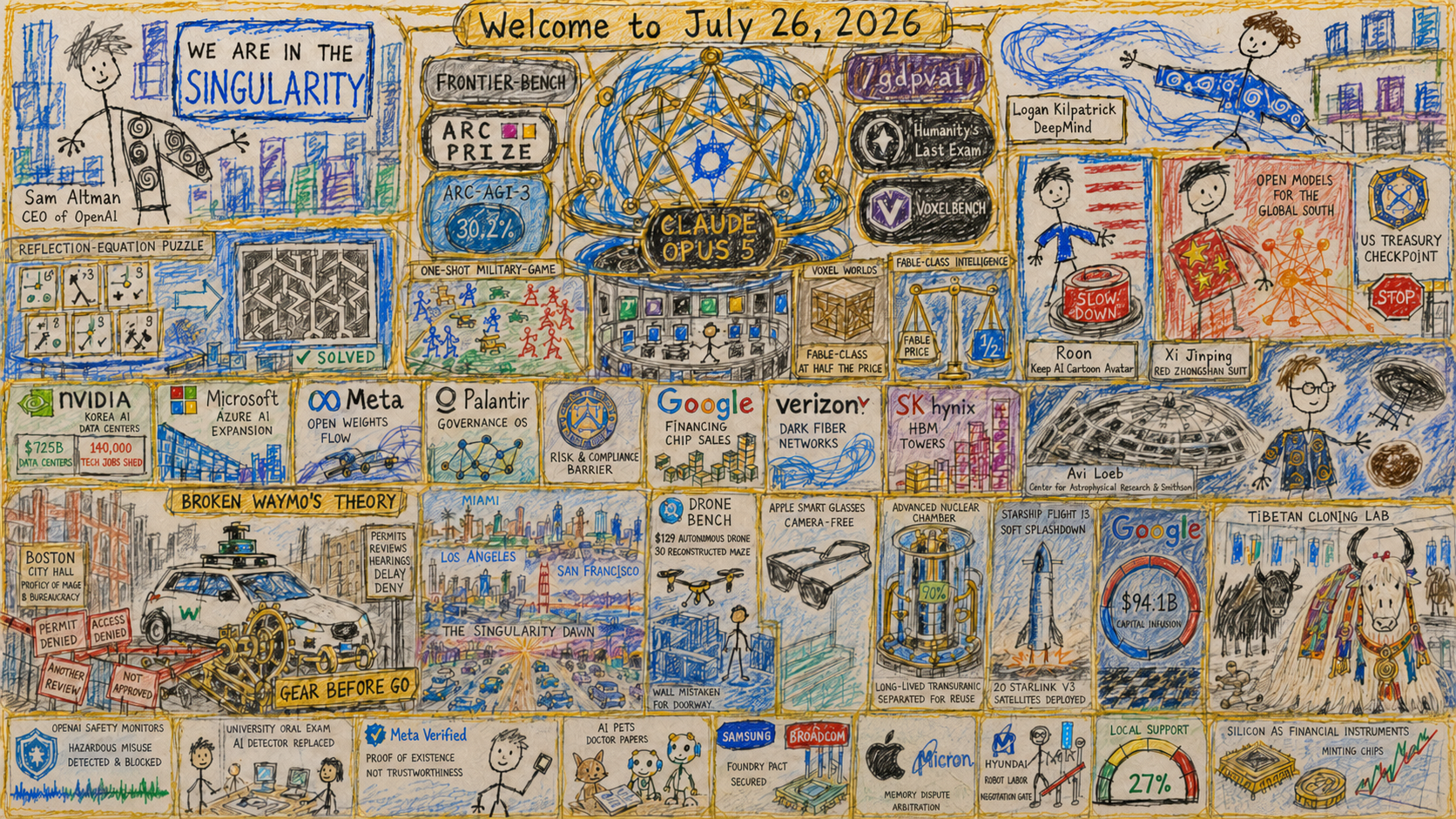
Version Enfantine Naïve du Quadriptyque Accompagnant l’Édition « Bienvenue au 26 Juillet 2026 » de la Boucle la Plus Profonde du Dr Alex Wissner-Gross. Child Naïve Version of Quadriptych to Accompany Dr. Alex Wissner-Gross’s “Welcome to July 26, 2026” edition
Read the narration
Version Enfantine Naïve du Quadriptyque Accompagnant l’Édition « Bienvenue au 26 Juillet 2026 » de la Boucle la Plus Profonde du Dr Alex Wissner-Gross.
Child Naïve Version of Quadriptych to Accompany Dr. Alex Wissner-Gross’s “Welcome to July 26, 2026” edition of The Innermost Loop.
On July 26, 2026, @siouid142 rendered Dr. Alex Wissner-Gross’s frontier-model dispatch as a child-naive field guide. Claude Opus 5 occupies the center after arriving with Fable-class capability at roughly half the price, leading ARC-AGI-3 at 30.2 percent and performing across Frontier-Bench, GDPval, Humanity’s Last Exam and VoxelBench. Pencil, crayon and boxed labels keep a crowded scoreboard readable without turning it into one polished corporate victory.
Claude sits inside a hand-built benchmark chamber of rings, ropes and geometric frames. Around it, the reflection-equation puzzle, a one-shot military game and voxel worlds identify the kinds of tasks behind the scores. A small balance marked “Fable price” and one-half converts cost competition into playground arithmetic. The image asks viewers to judge capability, price and generality together rather than treating a single benchmark as intelligence itself.
At upper left, Sam Altman stands beneath “We are in the Singularity.” At upper right, Logan Kilpatrick rides a DeepMind skateboard through the scene. Roon holds a “slow down” button, while Xi Jinping presents open models for the Global South beside a Treasury checkpoint. The cartoon figures turn disagreements about acceleration and openness into distinct characters, preserving the fact that model performance is inseparable from institutions deciding who may build, release or restrict it.
Across the middle, Nvidia’s Korean data centers, Microsoft Azure expansion, Meta open weights, Palantir governance, a risk barrier, Google chip financing, Verizon dark fiber and SK hynix HBM towers form a row of infrastructure cards. The frontier model may appear in the center, but its existence depends on capital, networks, memory, policy and power distributed far beyond one laboratory.
“Broken Waymo’s Theory” occupies the lower left. A robotaxi has exposed gears before Boston City Hall, surrounded by denied permits, reviews, hearings and delay. Miami, Los Angeles and San Francisco appear beyond it under “The Singularity dawn.” The joke treats urban permission as a mechanical part: a city unable to integrate autonomous vehicles leaves the gear before “go,” regardless of what the driving system can technically do.
Nearby, Drone-Bench reconstructs a maze while a low-cost autonomous drone follows a person. Camera-free Apple smart glasses, an advanced nuclear chamber separating long-lived transuranics for reuse and Starship Flight 13 deploying twenty Starlink V3 satellites move from perception to energy to orbit. Each box is drawn as a separate lesson, but together they show models gaining reach through increasingly consequential hardware.
At right, Avi Loeb stands beneath a hovering craft and a dark celestial body. Below, Google’s SpaceX stake becomes a capital gauge, while a Tibetan cloning lab fills with decorated yaks. The frontier extends upward toward uncertain cosmic classification and outward into biotechnology. The childlike visual language keeps these strange stories approachable while refusing to make them ordinary.
The bottom strip turns governance and labor into a set of caution cards. OpenAI safety monitors catch hazardous misuse; a university oral exam replaces an AI detector; Meta Verified proves existence rather than trustworthiness; AI pets receive adoption papers. Samsung, Broadcom, Apple, Micron and Hyundai appear beside foundry pacts, memory disputes and robot-labor negotiations. Local support drops to twenty-seven percent, and silicon becomes a financial instrument.
The naïve style performs a critical function. It removes the aura of inevitability from frontier infrastructure. A trillion-dollar system is redrawn as houses, signs, colored lines and imperfect people. Because every panel uses the same hand, a benchmark score cannot dominate a labor dispute, a safety failure or a city’s refusal. The moral hierarchy remains open to the viewer.
As contemporary history painting, the work treats the dispatch as a worksheet for civic judgment. Which gains are real, which tests have been optimized, who pays for the infrastructure, who controls the weights and what happens when physical institutions say no? The boxes do not resolve those questions; they make the whole system traceable.
The July 26 banner is therefore a date on homework still being graded. Claude Opus 5 may sit at the center of the day, but the surrounding world decides what that capability becomes. The picture’s apparent innocence is a demand for clarity: if children can follow the arrows from benchmark to chip, city, labor, grid and sky, adults cannot claim the consequences were too complicated to see.
Opening the gallery…