70 Clock Galerie / The Innermost Loop Feed Reply Tableaux
Version Cubiste du Quadriptyque Accompagnant l’Édition « Bienvenue au 24 Juillet 2026 » de la Boucle la Plus Profonde du Dr Alex Wissner-Gross
Cubist Version of Quadriptych to Accompany Dr. Alex Wissner-Gross’s “Welcome to July 24, 2026” edition of The Innermost Loop
July 24, 2026
Version Cubiste du Quadriptyque Accompagnant l’Édition « Bienvenue au 24 Juillet 2026 » de la Boucle la Plus Profonde du Dr Alex Wissner-Gross. Cubist Version of Quadriptych to Accompany Dr. Alex Wissner-Gross’s “Welcome to July 24, 2026” edition of The Innerm
Read the narration
Version Cubiste du Quadriptyque Accompagnant l’Édition « Bienvenue au 24 Juillet 2026 » de la Boucle la Plus Profonde du Dr Alex Wissner-Gross.
Cubist Version of Quadriptych to Accompany Dr. Alex Wissner-Gross’s “Welcome to July 24, 2026” edition of The Innermost Loop.
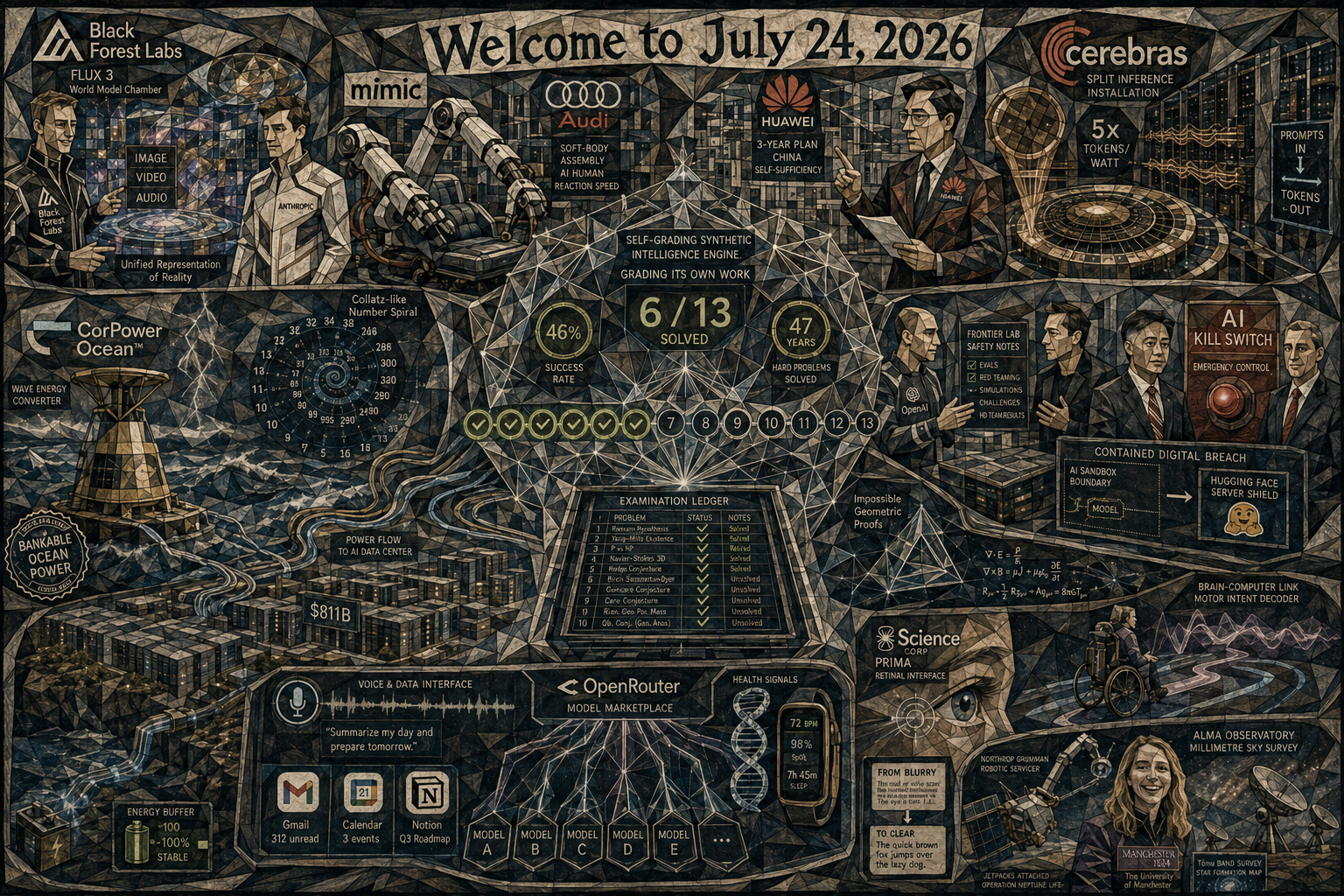
On July 24, 2026, @siouid142 fractured Dr. Alex Wissner-Gross’s account of self-grading synthetic intelligence into interlocking Cubist planes. Six of thirteen attempted Erdős problems, a forty-six-percent success rate and an average forty-seven years of human history become the composition’s central facets. Cubism is not merely a period quotation. It is a method for showing that no single viewpoint can contain proof, deployment, energy, governance and embodiment at once.
The synthetic-intelligence engine forms a many-sided head at center. Its declaration, “6/13 solved,” sits between medallions for forty-six percent and forty-seven years, while six checked nodes meet seven unresolved numbers. The face is built from relations rather than anatomy. Intelligence appears as an assemblage of attempts, verification, training, compute and human interpretation—not an isolated mind floating above its conditions.
The examination ledger names the Riemann hypothesis, Yang-Mills existence, Navier-Stokes, P versus NP, the Hardy conjecture and additional open problems. It does not claim that every entry has fallen. The statuses act as internal brakes on the image’s monumentality. Nearby, a Collatz-like spiral and impossible geometric proofs demonstrate why mathematics invites visual myth even when the underlying questions remain resistant.
At upper left, Black Forest Labs’ FLUX 3 chamber divides image, video and audio into overlapping panels before reuniting them as a representation of reality. A Mimic-Audi robot folds through the next section, its arms and seat broken into jointed planes. Huawei’s three-year chip plan and Cerebras split inference at five times the tokens per watt continue the argument: capability is distributed across software, mechanisms, supply chains and energy efficiency.
At left, the CorPower Ocean buoy and its waves become a hard geometry feeding a data-center block marked eight hundred eleven billion dollars. The water is no longer background; it is an active plane entering the computation. A battery buffer below makes temporal mismatch visible: the grid must reconcile irregular natural power with machines that expect continuous service.
At right, safety discussions are fragmented into profiles, checklists, crates, a red AI kill switch and a breach diagram crossing from a sandbox boundary toward a Hugging Face shield. Cubist simultaneity lets prevention, failure and emergency authority occupy the same moment. The viewer cannot look at the reassuring button without also seeing the route that made such a button politically imaginable.
The lower interface breaks daily life into information compartments. Voice access reaches Gmail, Calendar and Notion; OpenRouter presents multiple models as adjacent ports; genetic, oxygen and sleep signals become another stack of planes. The composition makes convenience look architectural. Each connection adds capability, but it also creates another face of the user that a system may store, infer or route.
PRIMA’s retinal target, the motor-intent path of a wheelchair, Northrop Grumman’s satellite servicer and Louisa Mason’s ALMA survey extend the picture from the eye to the body to orbit. Cubism traditionally challenged a single stable observer. Here that challenge becomes technical: perception can be restored through an implant, intention decoded through electrodes, and the sky reconstructed from wavelengths outside ordinary sight.
The muted black, brown and blue palette gives the image the weight of an archival mural. Corporate logos and equations are absorbed into the same tessellated skin. This prevents any one institution from visually owning the story. Every achievement is shown as a facet within a system it did not create alone.
As contemporary history painting, the work proposes fragmentation as accuracy. The dispatch’s stories are not separate headlines laid in a row; they are partial views of one accelerating infrastructure. Mathematical achievement changes the value of models, models change factories, factories change chip demand, chips change energy, and new reach changes governance. The planes meet because the consequences do.
The July 24 banner holds those perspectives in a dated frame without forcing them into false harmony. The work’s central face can be read as brilliant, unstable or incomplete depending on the angle. That is its critical achievement: a machine may grade its own homework, but the larger system still requires many human viewpoints to understand what the grade means.
Opening the gallery…