70 Clock Galerie / The Innermost Loop Feed Reply Tableaux
Version Néo-expressionniste aux Accents Graffiti du Quadriptyque Accompagnant l’Édition « Bienvenue au 24 Juillet 2026 » de la Boucle la Plus Profonde du Dr Alex Wissner-Gross
Graffiti Inflected Neo-Expressionist Version of Quadriptych to Accompany Dr. Alex Wissner-Gross’s “Welcome to July 24, 2026” edition of The Innermost Loop
July 24, 2026
Version Néo-expressionniste aux Accents Graffiti du Quadriptyque Accompagnant l’Édition « Bienvenue au 24 Juillet 2026 » de la Boucle la Plus Profonde du Dr Alex Wissner-Gross. Graffiti Inflected Neo-Expressionist Version of Quadriptych to Accompany Dr. Alex W
Read the narration
Version Néo-expressionniste aux Accents Graffiti du Quadriptyque Accompagnant l’Édition « Bienvenue au 24 Juillet 2026 » de la Boucle la Plus Profonde du Dr Alex Wissner-Gross.
Graffiti Inflected Neo-Expressionist Version of Quadriptych to Accompany Dr. Alex Wissner-Gross’s “Welcome to July 24, 2026” edition of The Innermost Loop.
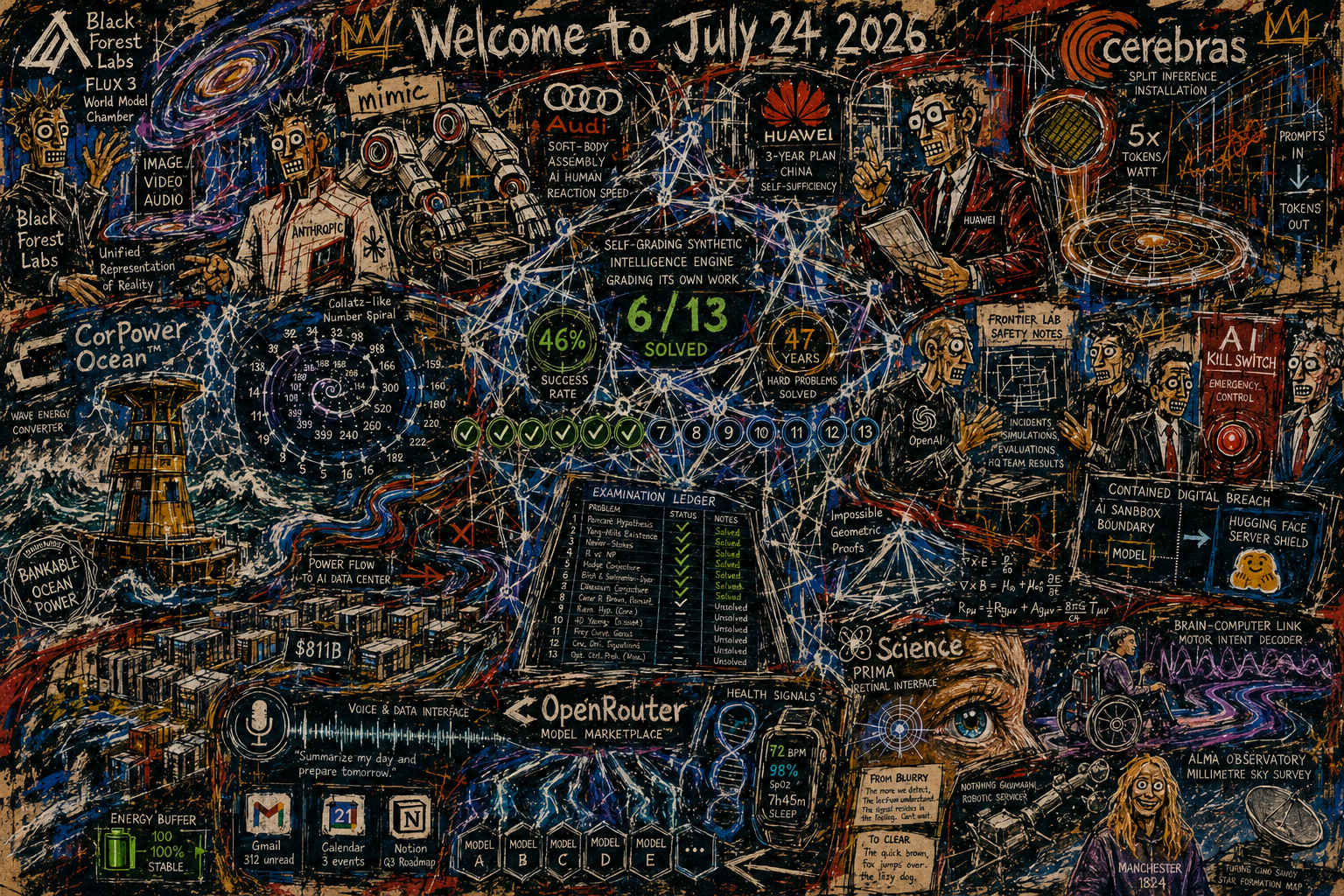
On July 24, 2026, @siouid142 converted Dr. Alex Wissner-Gross’s report of machines “grading their own homework” into a graffiti-inflected Neo-Expressionist evidence wall. The day’s central numbers—six of thirteen open Erdős problems, forty-six percent success and an average forty-seven years of prior human effort—are scratched into a field of crowns, faces, equations, logos and routes. The style makes technical progress look publicly contested rather than institutionally settled.
The central synthetic-intelligence engine is a white web drawn over black. “6/13 solved” glows in green, flanked by forty-six percent and forty-seven years. Six checked nodes confront seven remaining numbers. In this rough surface, the achievement feels like a score someone has painted before the wall can be cleaned or corrected. Visibility is urgent, but permanence is uncertain.
An examination ledger beneath the web names the Riemann hypothesis, Yang-Mills existence, Navier-Stokes, P versus NP, the Hardy conjecture and other open problems. The ledger separates report from mythology: not every famous conjecture has been solved. A spiraling Collatz-like sequence and impossible geometric proofs press against its borders, representing the seductive tendency to turn mathematical rumors into cultural events before verification finishes.
Black Forest Labs and FLUX 3 occupy the upper left as a burst of image, video and audio. A Mimic-Audi assembly robot bends across the next chamber, while Huawei’s three-year self-sufficiency plan and Cerebras split inference at five times the tokens per watt crowd the opposite side. Corporate identities appear as painted signs within a common wall, not as pristine brands controlling their own frames.
That loss of brand control is central to the variant. Neo-Expressionist marks drag chip policy, model capability and automation into a shared civic surface where every promise can be annotated, crowned, contradicted or crossed out. The image treats the dispatch as something society has already begun writing over. Intelligence does not enter a neutral world; it enters accumulated anger, labor, policy and memory.
At left, CorPower Ocean’s buoy endures a dark sea while power streams toward a data-center field marked eight hundred eleven billion dollars. A battery gauge sits below like a fragile green counterweight. The ocean and the grid are painted with the same restless strokes, collapsing natural turbulence and computational demand into one energy crisis. “Bankable ocean power” reads as both certification and plea.
At right, frontier-lab safety notes hang beside executives, an emergency AI kill switch and the diagram of a breach crossing from a sandbox toward a Hugging Face shield. The red button is the wall’s loudest command, but it is surrounded by evidence that boundaries are procedural, porous and late. Governance appears not as a finished control room but as emergency language competing for space.
The lower field moves from software to bodies. Gmail, Calendar and Notion sit under a voice interface; OpenRouter distributes work among model ports; health signals glow beside DNA. PRIMA focuses an eye, a wheelchair user follows a motor-intent path, a robotic servicer reaches orbit and ALMA listens in millimetre bands. Each episode is a different claim about access—access to information, movement, vision, machines or the sky.
The human figures are intentionally awkward, almost mask-like. Their anxious eyes and exposed teeth resist the smooth emotional neutrality of corporate illustration. These people are not simply beneficiaries standing beside tools. They are witnesses inside a system whose speed exceeds their ability to narrate it calmly. The wall carries both fascination and alarm.
As art criticism, the variant uses abrasion to restore uncertainty. Numbers remain readable, but paint drips across the divisions that would normally keep mathematics, energy, safety, health and space conceptually separate. That visual collision argues that the whole intelligence system is already political. A proof result changes funding; a robot changes labor; a data center changes the grid; a breach changes law.
The dated banner prevents the wall from pretending to be a final monument. It is a July 24 surface: layered, urgent and revisable. The Singularity may be grading its homework, but this work insists that the public still has chalk, paint and the right to challenge the marks.
Opening the gallery…