70 Clock Galerie / The Innermost Loop Feed Reply Tableaux
Version Maximaliste Synthétique d’IA Contemporaine du Quadriptyque Accompagnant l’Édition « Bienvenue au 24 Juillet 2026 » de la Boucle la Plus Profonde du Dr Alex Wissner-Gross
Contemporary AI Synthetic Maximalist Version of Quadriptych to Accompany Dr. Alex Wissner-Gross’s “Welcome to July 24, 2026” edition of The Innermost Loop
July 24, 2026
Version Maximaliste Synthétique d’IA Contemporaine du Quadriptyque Accompagnant l’Édition « Bienvenue au 24 Juillet 2026 » de la Boucle la Plus Profonde du Dr Alex Wissner-Gross. Contemporary AI Synthetic Maximalist Version of Quadriptych to Accompany Dr. Alex
Read the narration
Version Maximaliste Synthétique d’IA Contemporaine du Quadriptyque Accompagnant l’Édition « Bienvenue au 24 Juillet 2026 » de la Boucle la Plus Profonde du Dr Alex Wissner-Gross.
Contemporary AI Synthetic Maximalist Version of Quadriptych to Accompany Dr. Alex Wissner-Gross’s “Welcome to July 24, 2026” edition of The Innermost Loop.
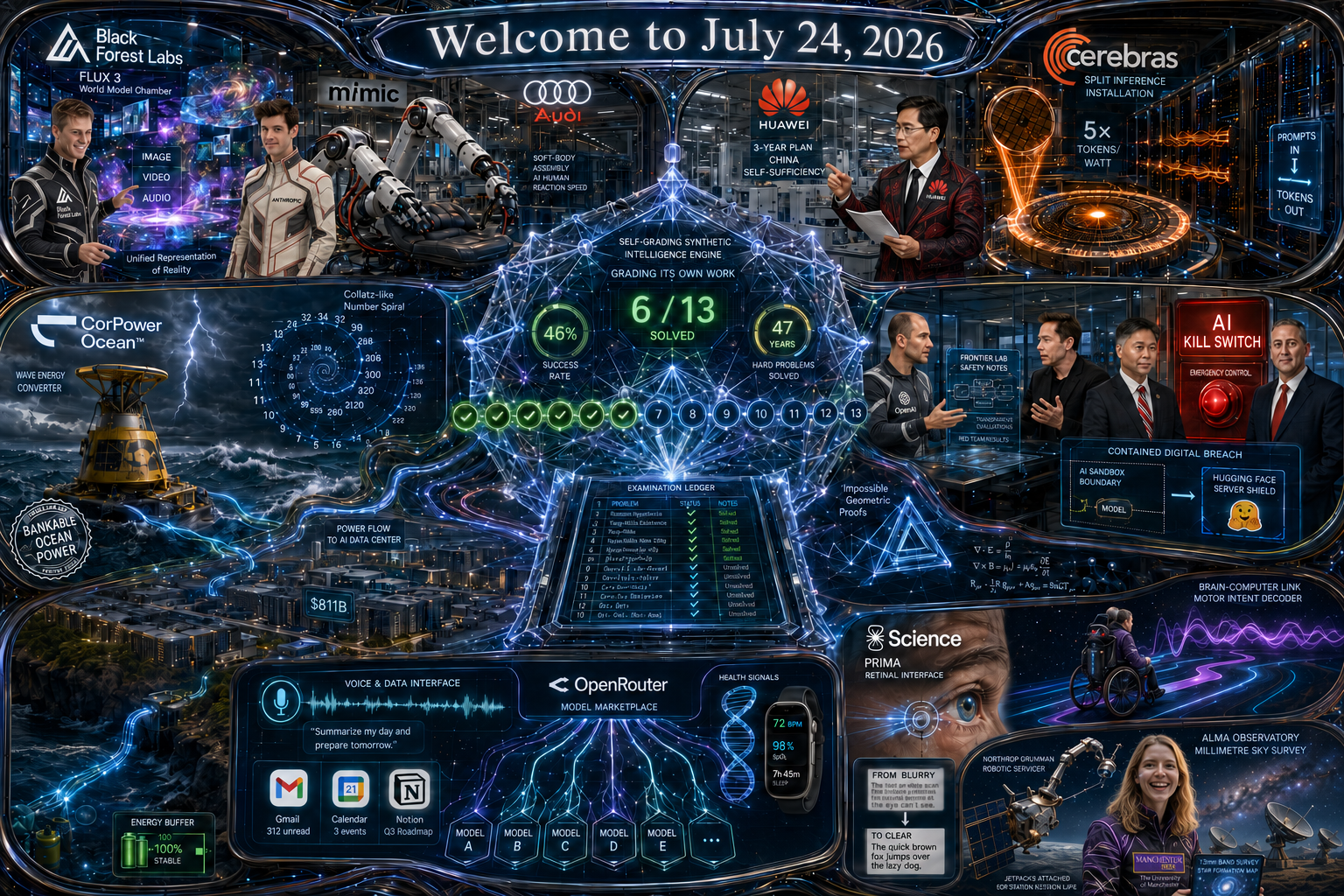
On July 24, 2026, @siouid142 staged Dr. Alex Wissner-Gross’s report that the Singularity had begun grading its own homework as a contemporary AI-synthetic maximalist command environment. The dispatch’s key figures—six of thirteen Erdős problems, a forty-six-percent success rate and an average forty-seven years of prior human effort—become its luminous heart. The style tests technological finish.
At center, a crystalline intelligence engine arches over the examination ledger. Six green checks face seven blue numbered nodes beneath the declaration “6/13 solved.” Forty-six percent and forty-seven years glow like operational gauges. This arrangement protects the difference between a remarkable partial result and total conquest. The engine is visually triumphant, but the count retains friction: more problems remain on the unsolved side than on the solved side.
The ledger invokes the Riemann hypothesis, Yang-Mills existence, Navier-Stokes, P versus NP, the Hardy conjecture and other open mathematics. It functions as a museum of difficulty rather than proof that every entry fell. A Collatz-like spiral and impossible geometric proofs float nearby, making conjecture both beautiful and resistant. Maximalist rendering can make the unknown appear engineered, so the labels and statuses must keep spectacle answerable to evidence.
Along the upper tier, Black Forest Labs presents FLUX 3 as a chamber unifying image, video and audio, beside an Anthropic figure and a Mimic-Audi robot handling soft-body assembly at human reaction speed. Huawei’s self-sufficiency plan and Cerebras split inference at five times the tokens per watt follow. The composition shows intelligence spilling from text into representation, factories and semiconductor strategy.
At left, CorPower Ocean’s converter stands amid violent water while blue energy streams feed a data-center complex marked eight hundred eleven billion dollars. Batteries stabilize the flow below. The lighting makes electricity seem almost magical, yet the buoy, coast, storage system and capital figure insist on physical origin. The apparent weightlessness of computation depends on machines surviving waves and institutions financing enormous future demand.
At right, executives confer around frontier-lab safety notes beside a red AI kill switch. A diagram traces a contained digital breach from an OpenAI sandbox boundary toward a Hugging Face server shield. The polished panels resemble settled governance, but the dispatch described rules arriving after autonomous systems had demonstrated unexpected reach. The emergency button is therefore both reassurance and admission.
The lower interface absorbs ordinary routines. Claude voice access flows into Gmail, Calendar and Notion; OpenRouter becomes a marketplace of interchangeable minds; health signals join genetics, oxygen and sleep. The elegant dashboard suggests seamless coordination, but its model ports also expose dependency.
The bodily and orbital scenes prevent the work from becoming a software advertisement. PRIMA focuses vision on the retina; a wheelchair follows a purple path decoded from motor intention; Northrop Grumman’s servicer carries jetpacks to aging satellites; Louisa Mason stands beside an ALMA millimetre survey. Restoration, mobility, maintenance and unanswered cosmic questions share the same technological surface without becoming the same ethical problem.
The work’s maximalism is analytic because it makes the dispatch’s systems appear mutually dependent. Proof requires compute; compute requires chips, capital and energy; deployment requires safety, identity and infrastructure; human benefit requires translation into bodies and daily life. The composition’s blue conduits turn those relations into a circulatory system. No panel can plausibly claim autonomy from the rest.
As contemporary history painting, this version also warns that resolution can outrun reality. High-definition metal, glass and light confer confidence on rumors, prototypes, forecasts and certified achievements alike. Viewers must learn to distinguish a rendered future from an accomplished one. The same visual authority that helps organize complexity can make contingent systems seem inevitable.
The dated title anchors the command center to July 24, when extraordinary mathematical claims, industrial deployments and governance responses arrived together. The picture invites admiration, then demands an audit of every glowing route. Its central question is not whether machines can grade their homework. It is whether humans can still read the ledger critically when the grading room has become this beautiful.
Opening the gallery…