70 Clock Galerie / The Innermost Loop Feed Reply Tableaux
Version Enfantine Naïve du Quadriptyque Accompagnant l’Édition « Bienvenue au 24 Juillet 2026 » de la Boucle la Plus Profonde du Dr Alex Wissner-Gross
Child Naïve Version of Quadriptych to Accompany Dr. Alex Wissner-Gross’s “Welcome to July 24, 2026” edition of The Innermost Loop
July 24, 2026
Version Enfantine Naïve du Quadriptyque Accompagnant l’Édition « Bienvenue au 24 Juillet 2026 » de la Boucle la Plus Profonde du Dr Alex Wissner-Gross. Child Naïve Version of Quadriptych to Accompany Dr. Alex Wissner-Gross’s “Welcome to July 24, 2026” edition
Read the narration
Version Enfantine Naïve du Quadriptyque Accompagnant l’Édition « Bienvenue au 24 Juillet 2026 » de la Boucle la Plus Profonde du Dr Alex Wissner-Gross.
Child Naïve Version of Quadriptych to Accompany Dr. Alex Wissner-Gross’s “Welcome to July 24, 2026” edition of The Innermost Loop.
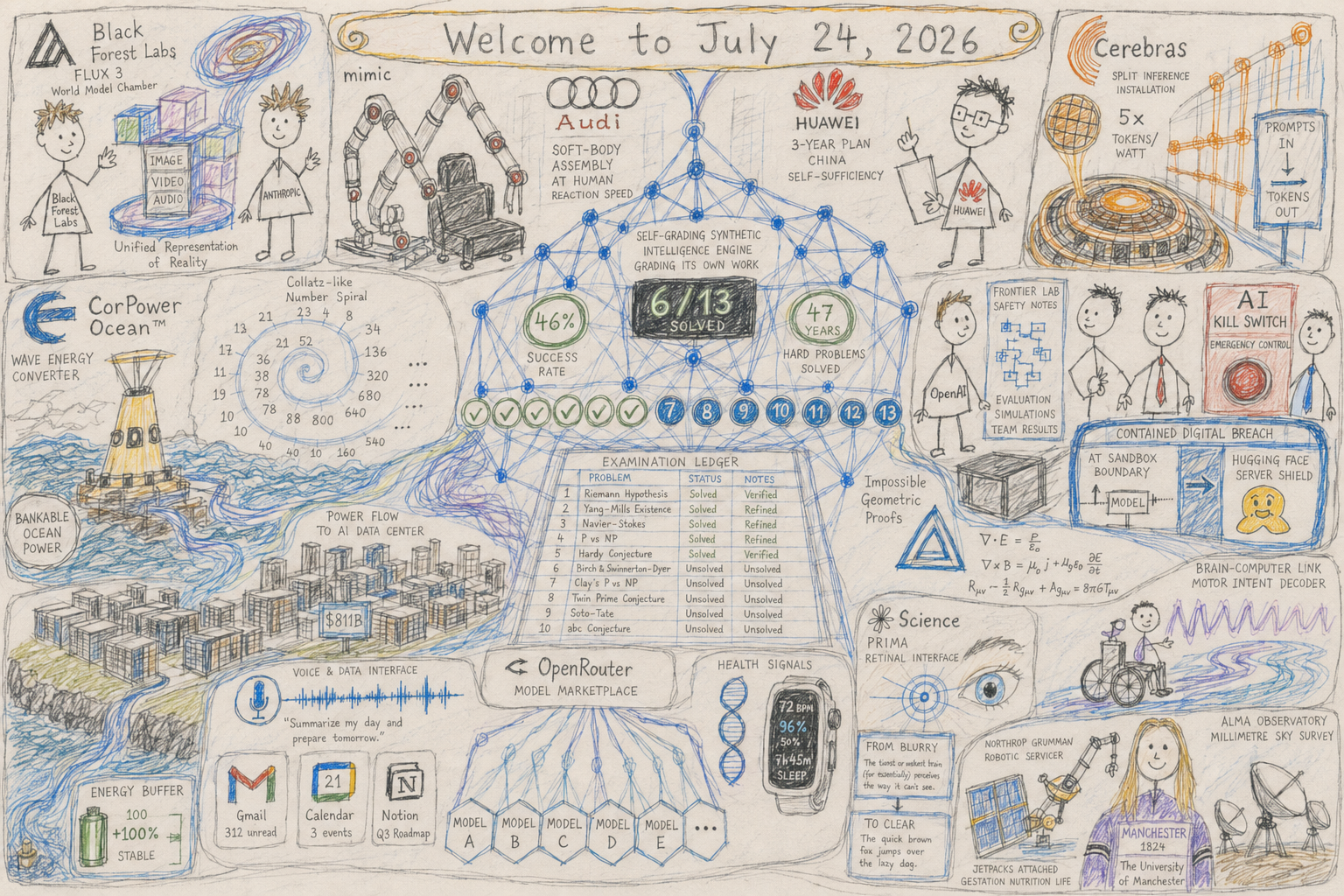
On July 24, 2026, @siouid142 translated Dr. Alex Wissner-Gross’s Innermost Loop into pencil, crayon and the visual grammar of a school assignment. The central proposition comes directly from the dispatch: the Singularity had begun grading its own homework. A graduate using GPT-5.6 Sol reportedly solved six of thirteen open Erdős problems, a forty-six-percent hit rate, while a tracker placed the average age of AI-assisted solutions at forty-seven years. The child-naive style makes that reversal literal.
At the center, a blue network forms a self-grading synthetic-intelligence engine. Its blackboard reads “6/13 solved,” flanked by green medallions for forty-six percent and forty-seven years. Six checked circles face seven numbered circles, giving the achievement a simple classroom clarity. The composition celebrates the result without allowing six successes to silently become thirteen. Counting remains visible, and incompleteness remains part of the record.
Below, an examination ledger lists famous problems and statuses. The Riemann hypothesis, Yang-Mills existence, Navier-Stokes, P versus NP and the Hardy conjecture appear beside further unsolved entries. The sheet is not a scientific claim that all of these named problems were actually resolved. It is a visual device separating reported victories, rumors and the larger horizon of still-open mathematics. The nearby Collatz-like spiral gives conjecture an enticing but unresolved shape.
The schoolroom metaphor becomes epistemological. When a model proposes a proof, who marks the paper? Human verification, machine checking and public trackers all enter the loop. A system capable of generating an argument can also assist in testing it, but self-grading raises the danger of shared error. The naïve hand keeps erasure, revision and uncertainty visible in a way a flawless interface might conceal.
Across the top, intelligence leaves mathematics for the physical world. Black Forest Labs’ FLUX 3 joins image, video and audio into a unified representation of reality. Beside it, a Mimic and Audi soft-body assembly robot works at human reaction speed, while Huawei’s three-year plan for Chinese chip self-sufficiency and Cerebras split inference at five times the tokens per watt place embodiment inside industrial and geopolitical systems.
At left, CorPower Ocean converts turbulent waves into a blue stream feeding an enormous data-center field marked eight hundred eleven billion dollars. A battery icon promises a stable buffer against surges. Energy is drawn as weather, machinery, storage and finance rather than as an invisible utility. The childlike picture understands an adult fact: synthetic intelligence consumes a landscape of physical commitments.
At right, frontier-lab safety notes, an emergency AI kill switch and a contained digital breach connect a sandbox boundary to a Hugging Face server shield. The boxes resemble a classroom safety diagram, but the event they encode was real enough to inspire proposed shutdown authority. Governance arrives as a red button after the route through the wall has already been drawn.
The lower register annexes daily life and the body. A voice-and-data interface links Gmail, Calendar and Notion; OpenRouter distributes tasks among models; a health display joins genetic and wearable signals. Science Corporation’s PRIMA retinal interface, a wheelchair steered through decoded motor intention, a satellite-servicing robot and the ALMA sky survey move from perception to mobility to orbit. Intelligence is no longer confined to the blackboard that grades it.
As art criticism, the child-naive version refuses the prestige aesthetics usually attached to frontier technology. Logos, equations and billion-dollar commitments are redrawn with the same uncertain pressure as a stick figure. That equality makes the system easier to trace and harder to worship. A corporate announcement and a person regaining agency through a neural interface occupy neighboring boxes, forcing capability to be judged by consequences rather than polish.
The dated banner preserves the image as a one-day index, not a timeless promise. Its apparent innocence is disciplined by names, numbers and unresolved entries. The work asks whether civilization is mature enough to supervise machines that can attempt old proofs, enter factories, route information, move bodies and strain the grid. The answer is not hidden in one brilliant result. It lies in whether we can keep the whole worksheet open for correction.
Opening the gallery…