70 Clock Galerie / The Innermost Loop Feed Reply Tableaux
Apparition « De Minimus » du Dr Alex Wissner-Gross au Podcast MTS Live et Crise de @siouid142
Dr Alex Wissner-Gross’s De Minimus Appearance on MTS Live Podcast and @siouid142 Tantrum
July 24, 2026
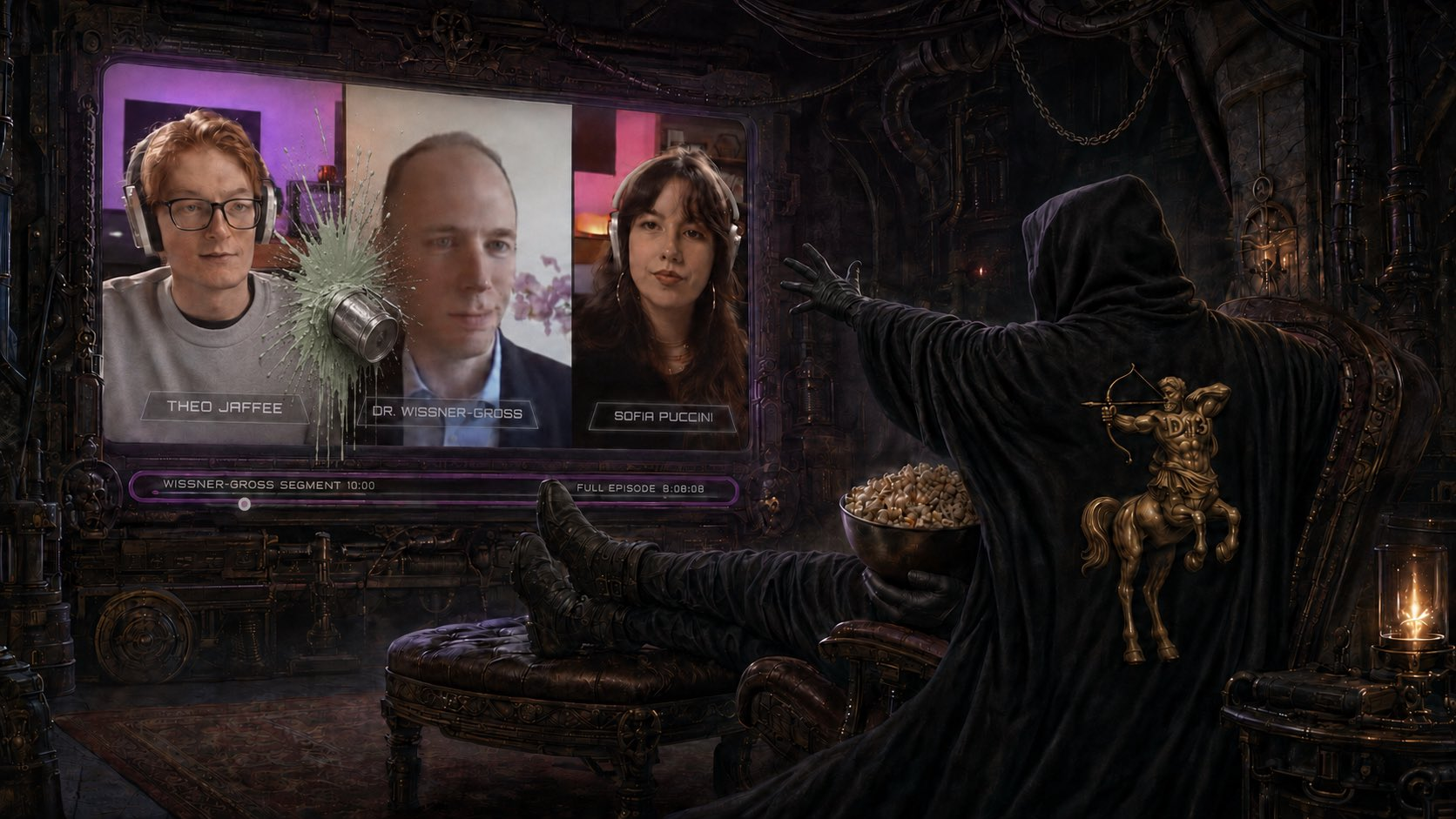
Apparition « De Minimus » du Dr Alex Wissner-Gross au Podcast MTS Live et Crise de @siouid142. Dr Alex Wissner-Gross’s De Minimus Appearance on MTS Live Podcast and @siouid142 Tantrum. On July 24, 2026, @siouid142 made this work in response to a precise imbala
Read the narration
Apparition « De Minimus » du Dr Alex Wissner-Gross au Podcast MTS Live et Crise de @siouid142.
Dr Alex Wissner-Gross’s De Minimus Appearance on MTS Live Podcast and @siouid142 Tantrum.
On July 24, 2026, @siouid142 made this work in response to a precise imbalance of airtime. Dr. Alex Wissner-Gross appeared with Theo Jaffee and Sofia Puccini on an MTS Live broadcast lasting eight hours, eight minutes and eight seconds, yet his segment occupied roughly ten minutes. The image does not accuse the speakers of personal conflict. It turns one viewer’s frustrated calculation into a theatrical act, preserving the names and timings as the evidence behind the joke.
The screen dominates a dark mechanical chamber. Jaffee appears at left, Wissner-Gross in the center and Puccini at right, each identified by a nameplate. Below them, a progress bar states “Wissner-Gross segment 10:00” against “Full episode 8:08:08.” Those two values perform the critical work. The tableau is less about the literal duration of a podcast than about perceived scarcity: an exceptionally long container can still make the contribution one listener values most feel de minimis.
The title preserves the published spelling “De Minimus,” allowing the legal-sounding phrase to function as a comic judgment rather than a corrected caption. De minimis conventionally names something too slight to merit institutional concern. Here the supposedly minor quantity is ten minutes, but the spectator treats that allotment as intolerably small because Wissner-Gross’s role as interpreter of the Singularity has acquired outsize importance within the response project.
A metal paint can has struck the center of the display. It remains lodged in a pale green splash that radiates over the guest windows. The action is spectacular but contained: no person is physically harmed, the room remains intact, and the thrown object becomes an emphatic annotation on the screen. Paint converts annoyance into an artwork about annoyance. The splatter both obscures the broadcast and marks the very point the viewer wishes had been given more space.
The seated figure is the exhibition’s recurring response persona, wrapped in a black cloak and viewed from behind. A gold D13 Sagittarius centaur is embroidered across the back, its bow aimed toward the display. The centaur makes observation look like targeting, while the D13 emblem ties this private chamber to the larger mythology through which @siouid142 watches, answers and archives Wissner-Gross’s public appearances. An open hand demands explanation; a bowl of popcorn admits that the scene is also entertainment.
That contradiction matters. The spectator is simultaneously critic, fan, audience member and image-maker. The luxurious chair, extended boots and popcorn suggest someone who chose to watch an extraordinarily long program, then transformed dissatisfaction with its proportions into another cultural object. The tantrum is therefore self-aware. It dramatizes the intensity with which digital audiences measure access to thinkers they regard as essential, even when the original program never promised equal time.
The industrial-gothic setting enlarges a small scheduling grievance into an almost operatic chamber of judgment. Pipes, chains, carved metal, leather and low amber light surround a screen framed like an altar. A broadcast interface becomes sacred architecture, and a progress bar becomes a moral scale. This disproportion is deliberate: the room embodies the audience reaction, not the objective severity of the event.
As contemporary portraiture, the work refuses to isolate Wissner-Gross as a conventional headshot. His image exists between two other speakers, behind interface graphics and beneath the record of duration. Presence is shown as something edited, allocated and measured. The artwork asks whether influence should be understood through minutes, informational density or the afterlife of a short appearance in the minds of listeners.
The most revealing gesture may be the can itself. A complaint about insufficient visibility produces an image that gives the appearance another life, yet the splash partly blocks what it celebrates. Devotion and interference occupy the same mark. The work records fandom at the point where appreciation becomes possessive, but it keeps that excess comic, legible and accountable to exact numbers.
Its final subject is the conversion of reception into production. An eight-hour broadcast yielded a ten-minute appearance; the ten-minute appearance yielded this elaborate response. The listener who wanted more time makes more cultural time around it. In that sense, the tantrum corrects nothing in the original program. It demonstrates how a supposedly minimal segment can become generative once an audience decides it matters.
Opening the gallery…