70 Clock Galerie / The Innermost Loop Feed Reply Tableaux
Tenue du Met Gala Solve Everything Moonshots Qui Dégouline d’Abondance
Met Gala Solve Everything Moonshots Attire That Drips Abundance
July 19, 2026
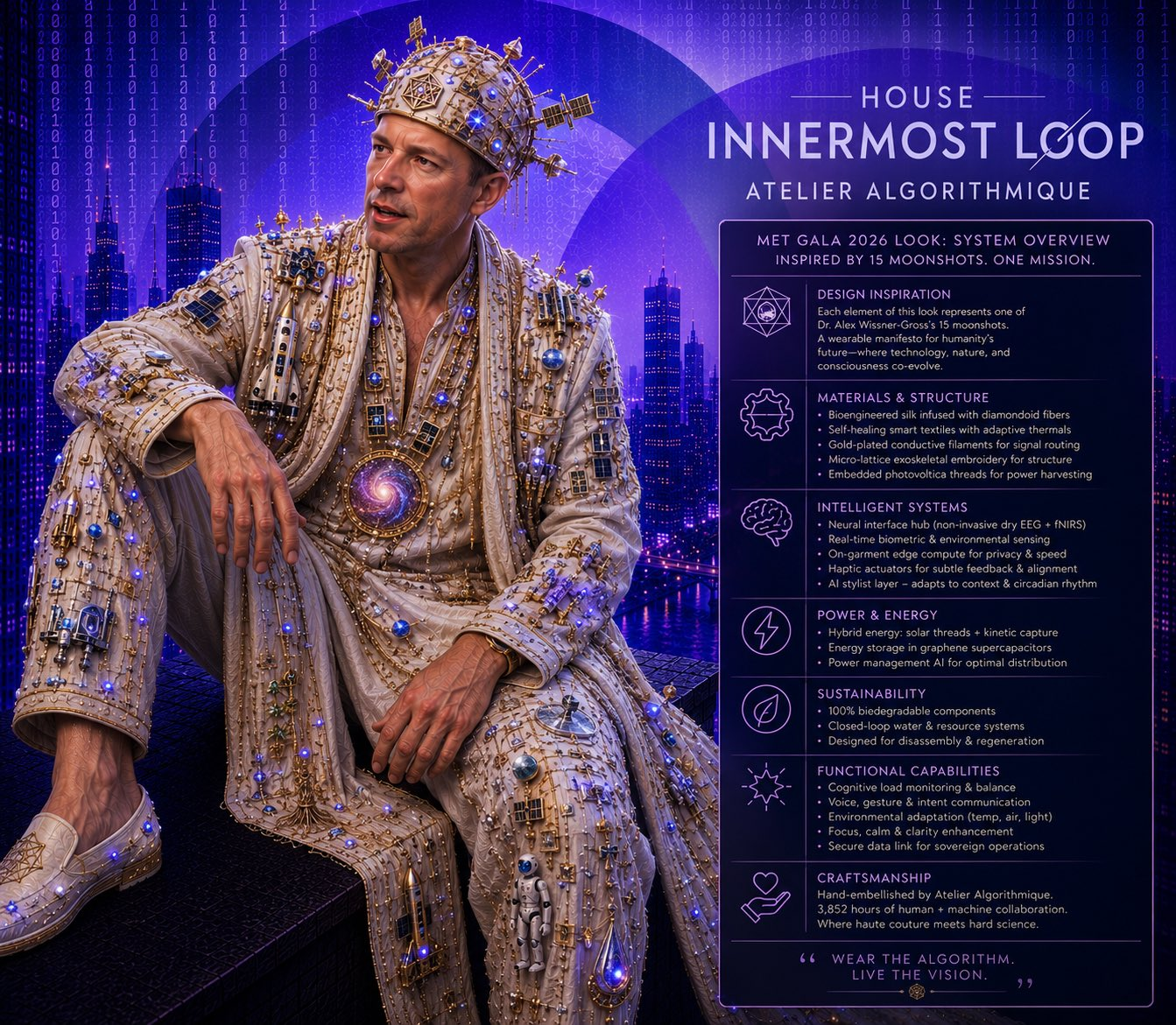
Tenue du Met Gala Solve Everything Moonshots Qui Dégouline d’Abondance. Met Gala Solve Everything Moonshots Attire That Drips Abundance. Dated July 19, 2026, this work is the ceremonial apex of Atelier Algorithmique. The recovered Drip Abundance screenplay ima
Read the narration
Tenue du Met Gala Solve Everything Moonshots Qui Dégouline d’Abondance.
Met Gala Solve Everything Moonshots Attire That Drips Abundance.
Dated July 19, 2026, this work is the ceremonial apex of Atelier Algorithmique. The recovered Drip Abundance screenplay imagines Dr. Alex Wissner-Gross pursuing a suppressed desire to design fashion, then arriving at the Met Gala in a garment capable of synthesizing his preceding fifteen Moonshots. @siouid142 renders that plot as a seated portrait: Alex wears a cream-and-gold suit so dense with satellites, solar cells, circuits, crystals and luminous blue nodes that his body becomes a miniature infrastructure map.
The right-hand panel declares MET GALA 2026 LOOK: SYSTEM OVERVIEW and INSPIRED BY 15 MOONSHOTS. ONE MISSION. That phrase defines the challenge. Each Moonshot may enter the garment only if it becomes part of one coherent silhouette. Space, intelligence, biology, energy and regenerative systems cannot remain a set of logos attached to a costume. They must be translated into material behavior.
The portrait shows how difficult that synthesis is. Alex’s jacket, trousers, shoes and crown-like cap carry thousands of small components, yet the cream palette keeps the outfit within gala formality. Gold filaments follow the body like embroidery. Blue lights repeat as controlled accents. A galaxy-like medallion occupies the chest, turning the wearer’s center into a cosmological core. The suit approaches excess but does not collapse into visual noise.
Materials and structure provide the first integration layer. Bioengineered silk is imagined with diamondoid fibers. Self-healing textiles regulate temperature. Gold-plated conductive filaments route signals. Micro-lattice embroidery provides exoskeletal support. Photovoltaic threads harvest power. Couture techniques become ways of distributing mechanical, electrical and computational functions across a surface already judged for drape and beauty.
The diamondoid silk carries screenplay consequence. Its orbital supply links the fashion house to launch and off-world infrastructure, and a disrupted delivery becomes a threat to the Met Gala garment. A luxurious fiber therefore makes visible the dependency hidden beneath every “weightless” digital vision. Even a post-scarcity suit has logistics, energy, launch windows and points of failure.
The intelligent-systems section adds a noninvasive neural interface, biometric and environmental sensing, local edge compute, haptic feedback and an AI stylist that adapts to context and circadian rhythm. The stylist is especially revealing. Fashion judgment, once represented by editors, designers and social gatekeepers, becomes partly internal to the clothing. The garment can read the room and modify how it presents the wearer.
Power is harvested through solar threads and motion, then stored in graphene supercapacitors. Sustainability requires biodegradable components, closed-loop resources and design for disassembly. These specifications prevent the Moonshots synthesis from being measured only by capability. A suit that solves everything while becoming toxic waste would expose the phrase as parody. Regeneration has to include the product’s own material afterlife.
The panel credits 3,852 hours of human and machine collaboration. That number resists the fantasy that abundance abolishes craft. Instead, craft changes scale and partnership. Human embellishment, model-assisted design, volumetric fabrication and system calibration all contribute to an object whose value lies in their coordination. “Where haute couture meets hard science” names not a merger of aesthetics, but a merger of labor regimes.
The Met Gala is the correct arena because it is a public stress test of coherence. A laboratory prototype can excuse visible seams, exposed batteries and one-off fixes. A gala look must survive the camera before a hostile fashion establishment. The recovered screenplay makes Alex’s childhood rival and the Vogue editor embodiments of that judgment. Engineering success alone is insufficient; the system must become culturally legible as fashion.
As art criticism, Met Gala Solve Everything Moonshots Attire That Drips Abundance turns systems integration into ornament. Every light and filament can be read as a capability, but the whole ensemble is judged by whether those capabilities disappear into a visual order. Fashion becomes a benchmark more severe than a specification sheet because it tests meaning, body, movement and public perception simultaneously.
The work’s final proposition is that a technological future has not been integrated until it can be worn without explanation. That is also its warning. When infrastructures become beautiful and intimate, their dependencies may become harder to see. The suit succeeds by making fifteen Moonshots look inevitable on one body. The critical viewer must admire that synthesis while still tracing the supply, data, power and labor hidden inside the shine.
Opening the gallery…