70 Clock Galerie / The Innermost Loop Feed Reply Tableaux
Le Temps Lui-même Devient Notre Métier à Tisser
Time Itself Becomes Our Loom
July 19, 2026
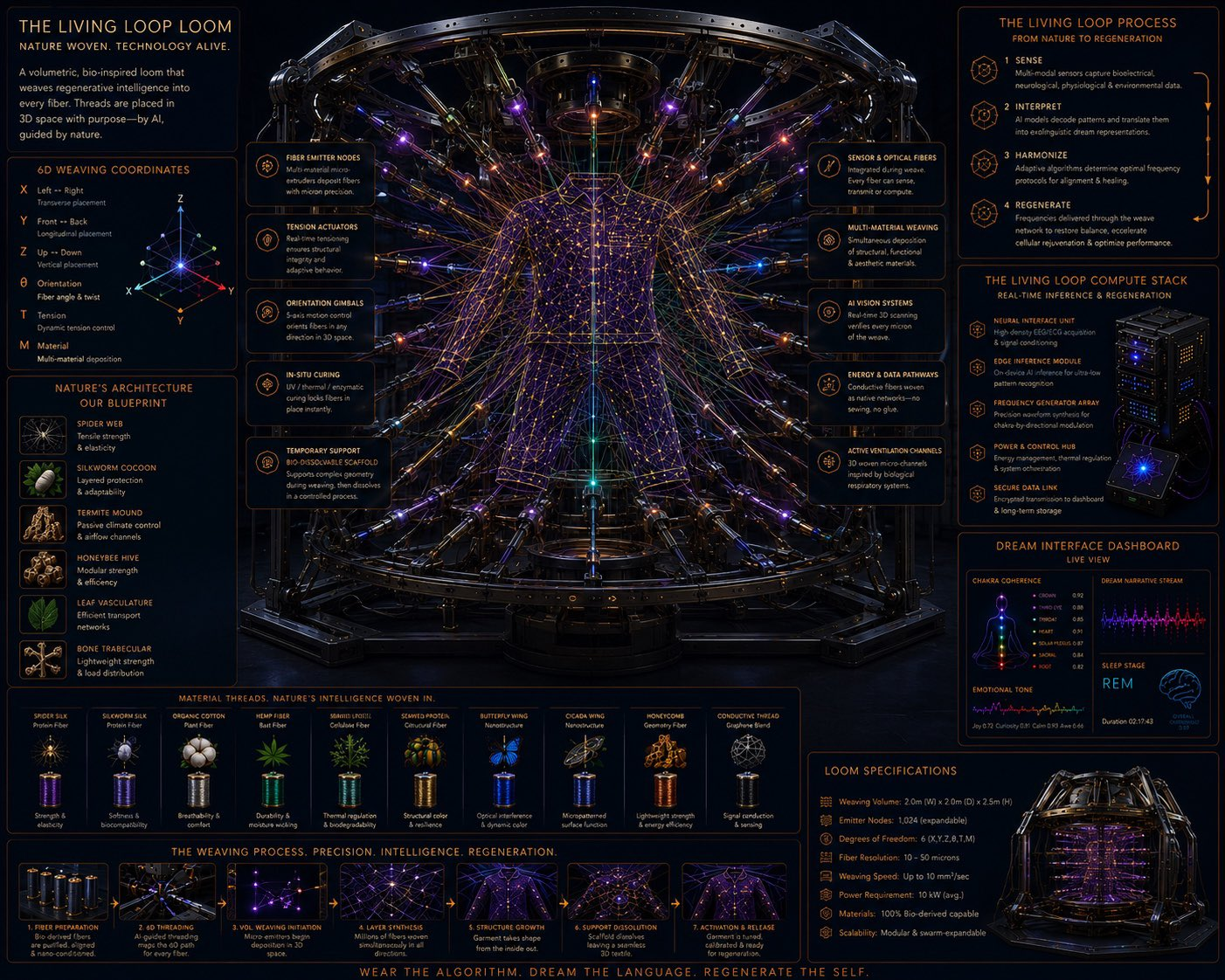
Le Temps Lui-même Devient Notre Métier à Tisser. Time Itself Becomes Our Loom. Dated July 19, 2026, this diagram is the technical manifesto inside @siouid142’s Drip Abundance sequence. Where the surrounding works show finished clothing on Dr. Alex Wissner-Gros
Read the narration
Le Temps Lui-même Devient Notre Métier à Tisser.
Time Itself Becomes Our Loom.
Dated July 19, 2026, this diagram is the technical manifesto inside @siouid142’s Drip Abundance sequence. Where the surrounding works show finished clothing on Dr. Alex Wissner-Gross, Time Itself Becomes Our Loom removes the celebrity portrait and opens the machine. The Living Loop Loom occupies the center as a circular array of emitter arms surrounding a luminous human form. The image asks how a fashion Moonshot would have to manufacture if clothing were no longer cut from cloth but grown as a responsive relationship between body, material and time.
The left panel names six weaving coordinates. X, Y and Z locate a fiber in three-dimensional space. Orientation controls the angle and twist of the strand. Tension changes its dynamic behavior. Material determines what is being deposited. A conventional loom organizes threads across a plane; this system treats every path as a spatial and functional decision. The garment is not assembled from panels after weaving. It emerges inside a volume, already shaped around the digital twin of its wearer.
That digital twin makes time the decisive coordinate even though the diagram labels it indirectly. The system reads posture, gait, breathing, pressure, heat, neurological activity and environmental conditions. Those measurements continue to change. A thread that supports the shoulder during one motion may need to relax during another; ventilation must respond to temperature; optical fibers may change appearance with bioelectric state; regenerative channels may deliver different patterns during sleep and exertion. The loom therefore designs not only where matter goes, but when it acts.
Around the central body, the machine’s parts are given almost anatomical names. Fiber-emitter nodes place different materials. Orientation gimbals steer them. Tension actuators regulate behavior. In-situ curing locks fibers in position. A temporary bio-dissolvable scaffold supports the three-dimensional structure and then disappears. Sensors and optical fibers, active ventilation channels, conductive data pathways and multi-material deposition are built into the weave rather than attached afterward.
The bottom register identifies nature as the engineering library. Spider web supplies tensile strength and elasticity; silkworm cocoon provides layered protection and adaptability; termite mound offers passive climate control; honeybee hive demonstrates modular strength; leaf vasculature becomes a transport network; bone trabeculae distribute load with little mass. Separate spools add cotton, hemp, seaweed protein, butterfly-wing optical principles, cicada surfaces and conductive thread. Biomimicry is not used as decorative rhetoric. Each organism contributes a specific physical strategy.
The sequence of fabrication reads like a birth ritual. Fibers are prepared, threaded into guided arrays, initiated in a volumetric field, synthesized into layers, grown into structure, released from the dissolving scaffold and activated for regeneration. The machine’s black-and-gold presentation gives this process the authority of an industrial blueprint, while violet and blue light make the unfinished body resemble a constellation. Couture, laboratory protocol and cosmology share one chamber.
At upper right, the Living Loop process is summarized as Sense, Interpret, Harmonize, Regenerate. Sensors gather bioelectrical, neurological, physiological and environmental information. Models decode it into a representation of the wearer. Adaptive algorithms determine an intervention. Frequencies are returned through the textile. Whether every speculative health claim proves possible is less important to the artwork than the feedback architecture: clothing becomes a bidirectional interface instead of passive covering.
As contemporary speculative design, Time Itself Becomes Our Loom refuses the familiar image of artificial intelligence as a chatbot floating on a screen. Intelligence appears as coordinated matter placement, local sensing and continuous adaptation. The work turns a fashion house into a control system and a control system into a philosophy of care. Traditional weaving makes a stable textile. The Living Loop makes an unfinished agreement among organism, algorithm and environment.
The diagram’s closing line—Wear the algorithm. Dream the language. Regenerate the self—compresses the promise and the danger. Once the body becomes a data stream and time becomes a fabrication input, clothing can respond with unprecedented precision. It can also interpret the person continuously. The loom is therefore “living” not because metal becomes biological, but because the boundary between wearer and garment remains open. The object survives by never becoming final.
Opening the gallery…