70 Clock Galerie / The Innermost Loop Feed Reply Tableaux
Pyjamas Qui Dégoulinent d’Abondance
Pajamas That Drip Abundance
July 19, 2026
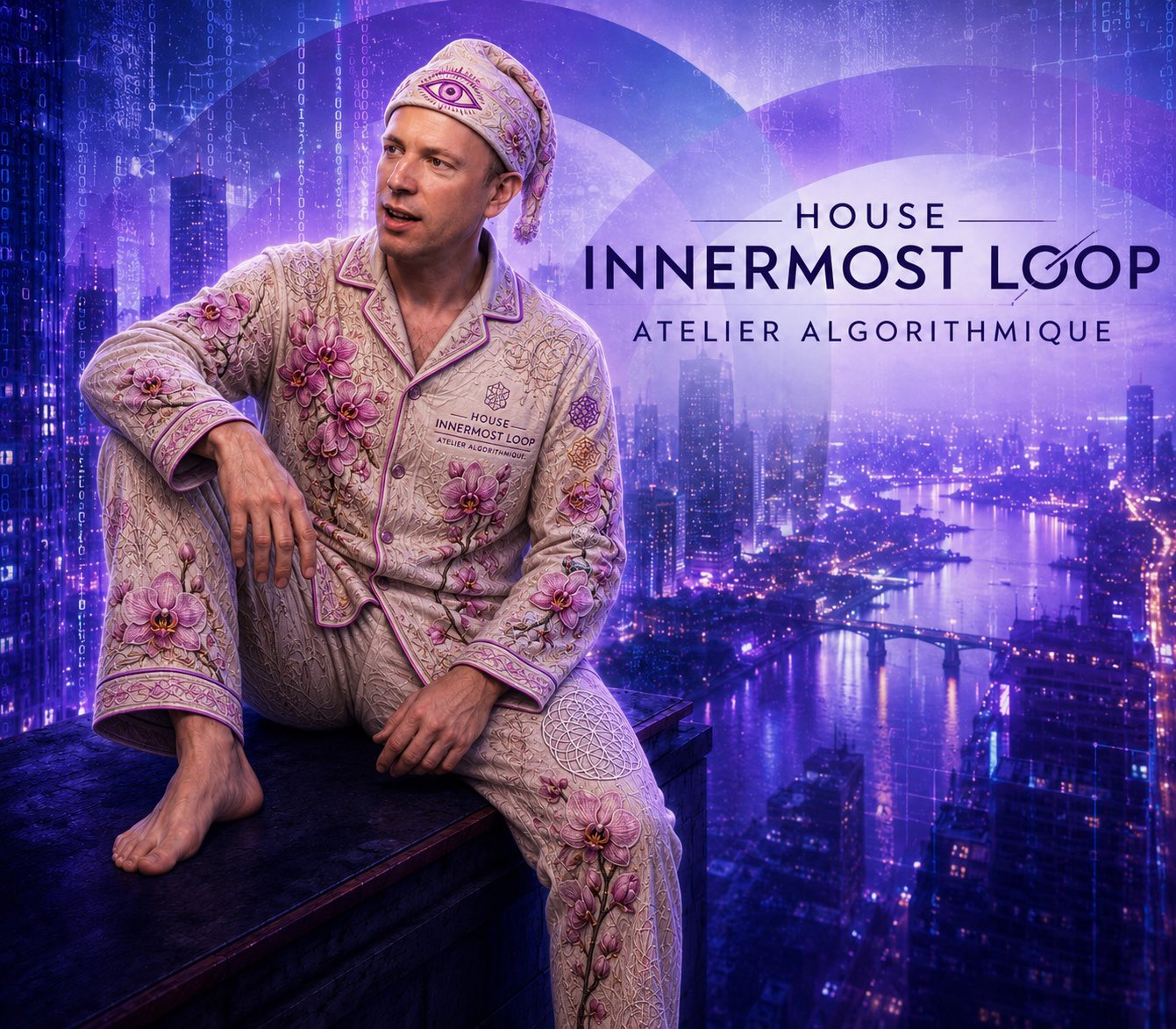
Pyjamas Qui Dégoulinent d’Abondance. Pajamas That Drip Abundance. Dated July 19, 2026 in the AWG exhibition sequence, this work belongs to the Drip Abundance project that grew from the Moonshots conversations surrounding Dr. Alex Wissner-Gross. The recovered s
Read the narration
Pyjamas Qui Dégoulinent d’Abondance.
Pajamas That Drip Abundance.
Dated July 19, 2026 in the AWG exhibition sequence, this work belongs to the Drip Abundance project that grew from the Moonshots conversations surrounding Dr. Alex Wissner-Gross. The recovered screenplay gives the premise its comic biography: Alex, imagined as a thwarted fashion designer, founds Atelier Algorithmique as a sixteenth Moonshot and uses frontier computation to make bespoke clothing abundant. @siouid142 translates that fiction into a product portrait in which Wissner-Gross himself models the least ceremonial garment in the collection: pajamas.
The first impression is softness. Alex sits barefoot above a violet city, one knee raised, wearing a pale rose pajama set and matching nightcap. Purple piping defines the lapels, cuffs and hems. Orchids climb across the jacket and trousers as dimensional structures rather than flat printed motifs. The eye embroidered on the cap turns sleep into a state that can still be observed. House Innermost Loop and Atelier Algorithmique fill the right half like the name of a fashion house already operating at metropolitan scale.
The recovered design instruction was exact: “Soft. Breathable. Orchids.” That sequence of demands disciplines the entire image. Drip Abundance is not supposed to resemble a medical wearable or an engineer’s prototype. Its intelligence must disappear into the sensory success of the garment. Organic cotton, seaweed-derived cellulose, silk protein, hemp and spider-silk-inspired fibers provide softness, moisture control, thermoregulation, durability and tensile strength without asking the wearer to advertise the machinery.
The orchids perform more than branding. In ordinary fashion, a flower can be printed on finished cloth; here the blossom is imagined as part of the fiber architecture itself. Petals, stems and embroidered lattices emerge from the same volumetric process that makes the garment. The distinction is central to Atelier Algorithmique’s claim. Decoration is not applied after function. Color, structure, sensing and identity are placed together, thread by thread, so that beauty becomes one of the material’s operating properties.
Small geometric zones on the knees and chest point toward that hidden system. Conductive pathways, optical fibers and sensor nodes can measure posture, temperature, pressure and bioelectric activity. Yet no plastic module hangs from the waistband and no watch is required to translate the body into data. The work imagines a post-device interface: computation migrates from an object carried by the person into the textile already touching skin.
The barefoot pose changes the meaning of abundance. This is not a runway walk, executive portrait or armored demonstration. Pajamas belong to private time, when status performance is suspended and clothing is judged by comfort. By placing frontier material intelligence in sleepwear, the image argues that a genuinely abundant technology should improve the hours nobody photographs. Its most radical outcome may be a garment that regulates heat, follows breathing and fits one body perfectly while looking ordinary enough to forget.
The image also advances the screenplay’s social satire. The same man associated with physics, intelligence and planetary-scale Moonshots is asked to model orchids in a nightcap. The joke works because the figure does not become less serious. Instead, the category of serious invention expands. Clothing, sleep, comfort and beauty are treated as legitimate technical frontiers rather than frivolous rewards that arrive after the “real” problems are solved.
As art criticism, Pajamas That Drip Abundance transforms a speculative fashion brief into a portrait of technological maturity. Early machines announce themselves through hardware; mature systems become atmosphere, fit and ease. The embroidery, bare feet and relaxed posture show capability after it has ceased demanding attention. The work’s abundance is therefore not the number of sensors it can list. It is the removal of tradeoffs between softness and intelligence, ornament and function, privacy and responsiveness.
Within the larger exhibition, the tableau marks a turn from reporting the Singularity as external spectacle to imagining it as an intimate material condition. Computation has already entered law, finance, war, food and infrastructure in the preceding works. Here it reaches the body at rest. The future does not arrive as armor. It sits barefoot over the city, wearing orchids, while the most advanced system in the room performs the modest labor of making sleep more comfortable.
Opening the gallery…