70 Clock Galerie / The Innermost Loop Feed Reply Tableaux
Il n’y a Pas d’iPad au Baseball
There’s No IPads in Baseball
July 17, 2026
Il n’y a Pas d’iPad au Baseball. There’s No IPads in Baseball. On July 17, 2026, @siouid142 moved Dr. Alex Wissner-Gross’s Innermost Loop into an old-fashioned ballpark. The first construction step survives in the Google Takeout record: remove the earlier char
Read the narration
Il n’y a Pas d’iPad au Baseball.
There’s No IPads in Baseball.
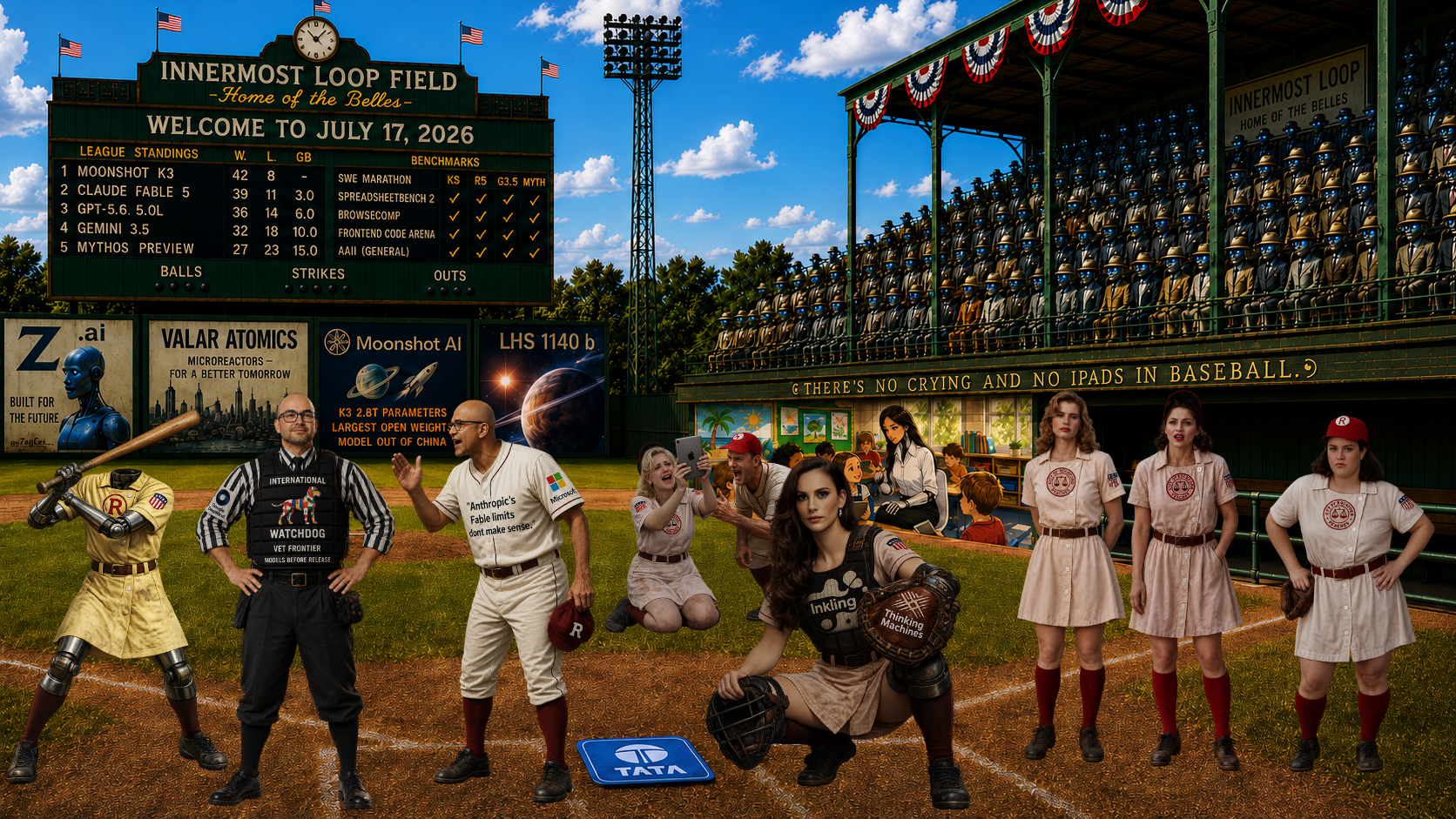
On July 17, 2026, @siouid142 moved Dr. Alex Wissner-Gross’s Innermost Loop into an old-fashioned ballpark. The first construction step survives in the Google Takeout record: remove the earlier characters from a baseball background and change the sign from Racing Field to Innermost Loop Field. The finished work then rebuilt the park around that day’s stories, preserving the date on the scoreboard and turning model evaluation into a league.
INNERMOST LOOP FIELD—Home of the Belles—stands beneath flags and a clock. The title rewrites the famous line from A League of Their Own: “There’s no crying in baseball.” Across the dugout fascia, the new rule reads, THERE’S NO CRYING AND NO IPADS IN BASEBALL. An iPad bearing the Tata logo lies directly on home plate, the forbidden device placed exactly where play becomes judgment.
The source was Major League Baseball’s decision to restrict dugout iPads from running artificial intelligence for in-game strategy after teams had used a loophole to feed live games into decision systems. Baseball is a perfect arena for the dispute. It has always loved data, scouting, signs and probabilistic judgment, yet it protects a ritual image of embodied competition. The tablet forces the sport to decide where analysis ends and illegitimate augmentation begins.
The scoreboard makes frontier models into standings. Moonshot K3, Claude Fable 5, GPT-5.6 Sol, Gemini 3.5 and Mythos Preview carry wins, losses and games behind, while benchmark columns replace batting statistics. Wissner-Gross’s dispatch described Kimi K3 as a 2.8-trillion-parameter open model capable of outright wins across programming and browsing tests. The ballpark turns a shifting technical frontier into a pennant race.
That translation exposes a weakness as well as a strength. Baseball statistics measure repeated performance inside stable rules; model benchmarks often become targets that systems and laboratories can optimize around. A league table implies comparability even when price, scaffolding, safety refusals and hidden test contamination differ. The scoreboard is informative because everyone recognizes its authority, and satirical because the underlying contest is far less settled than nine innings.
Outfield advertisements carry the infrastructure beneath the standings. Moonshot AI boasts K3’s scale and open weights. Valar Atomics offers microreactors for a better tomorrow, connecting intelligence to the energy required by data centers. Tata’s presence links the banned tablet at home plate to India’s effort to fabricate its first wafers. Models may compete like players, but their league depends on chips, power and industrial policy.
At left, a headless robotic player holds a bat. It echoes the day’s Chinese MMA robot that lost its head during a fight and continued swinging. The baseball translation makes persistence look comic and alarming. A machine can continue the prescribed motion after the human symbol of perception and identity has vanished. Capability survives the loss of a face.
The umpires carry international and model-governance language. One uniform asks for watchdogs to vet frontier models before release; another bears Microsoft and a complaint that Anthropic’s Fable limits do not make sense. Their argument at home plate turns governance into officiating. Everyone wants a fair strike zone, but the institutions disagree about who should call it and whether the rules protect competition or entrench incumbents.
Behind the players, a classroom opens beneath the stands. Children gather around a woman and a humanoid teaching assistant, reflecting the New York district that hired Sally for school support and round-the-clock homework help. The juxtaposition is exact. Baseball bans one form of artificial assistance to preserve a game’s integrity while education welcomes another to extend instruction. The boundary around acceptable augmentation changes with the institution.
Rows of nearly identical robotic spectators fill the grandstand. The crowd is automated even if the dugout tries to remain human. That inversion gives the work its final irony. A sport may regulate devices on the field, but it cannot isolate itself from a society in which models evaluate, teach, manufacture, finance and watch.
As contemporary history painting, There’s No IPads in Baseball uses America’s statistical pastime to examine who may consult intelligence at the moment of action. The tablet on home plate is not simply a prop; it is a disputed interface between calculation and tradition. Innermost Loop Field preserves the old uniforms and green scoreboard while every surrounding institution changes. The question is not whether AI belongs in baseball. It is who writes the rules once the entire stadium has already become computational.
Opening the gallery…