70 Clock Galerie / The Innermost Loop Feed Reply Tableaux
Fosse Planétarque, Collines de la Singularité 071626
Planetarch Pit, Singularity Hills 071626
July 16, 2026
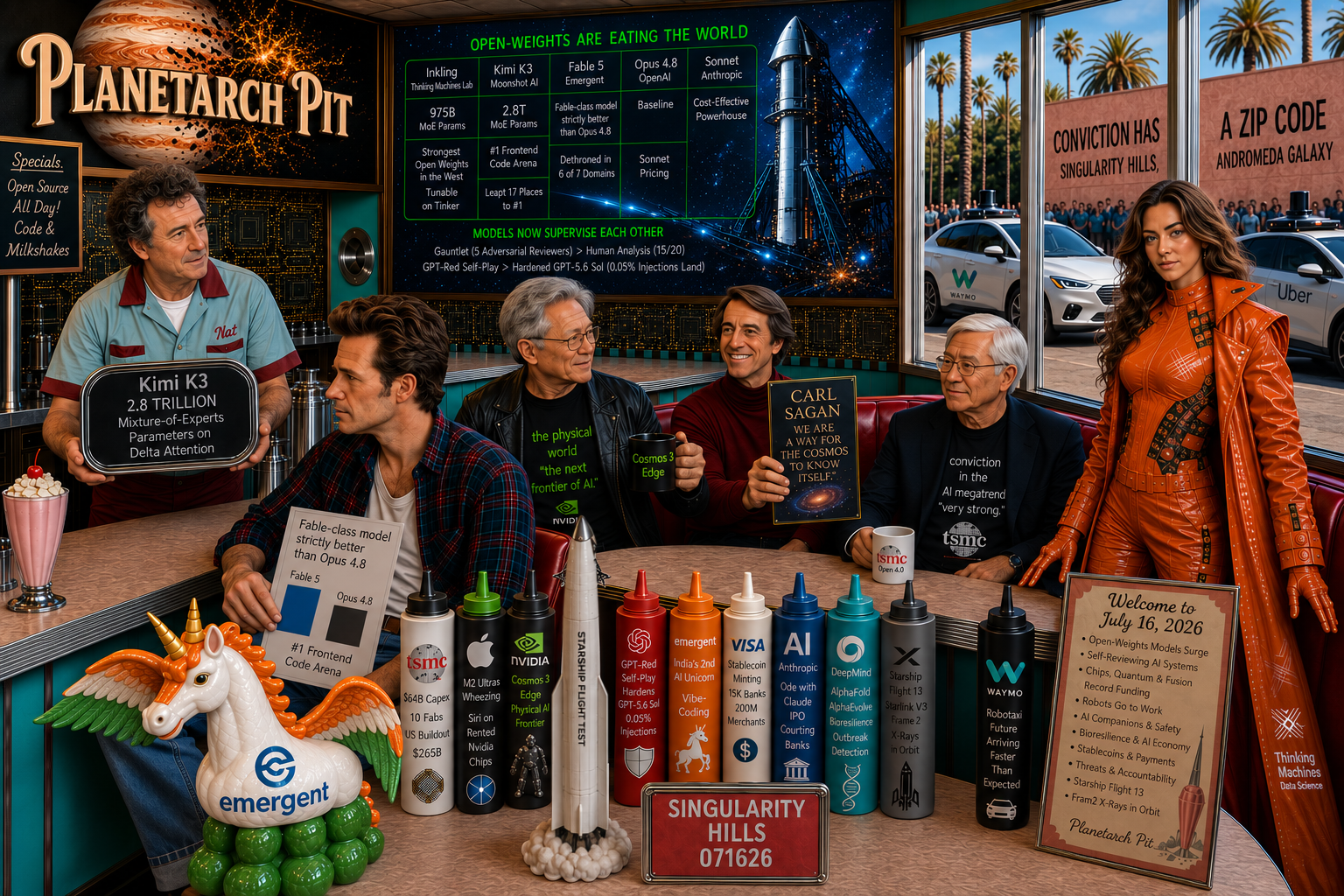
Fosse Planétarque, Collines de la Singularité 071626. Planetarch Pit, Singularity Hills 071626. On July 16, 2026, @siouid142 recast Dr. Alex Wissner-Gross’s Innermost Loop as a roadside diner named Planetarch Pit. Chrome booths, milkshakes, condiment bottles a
Read the narration
Fosse Planétarque, Collines de la Singularité 071626.
Planetarch Pit, Singularity Hills 071626.
On July 16, 2026, @siouid142 recast Dr. Alex Wissner-Gross’s Innermost Loop as a roadside diner named Planetarch Pit. Chrome booths, milkshakes, condiment bottles and palm trees make the frontier look already zoned for ordinary life. Yet the menu of the day spans open-weight models, adversarial review, chip megafabs, robotics, biology, payments and spaceflight. The future has become a place where one can stop for coffee.
The board above the counter declares OPEN-WEIGHTS ARE EATING THE WORLD. Inkling, Kimi K3, Fable 5, Opus 4.8 and Sonnet occupy a grid of parameters, rankings, cost and capability. Moonshot’s Kimi K3 carries 2.8 trillion mixture-of-experts parameters and a leap to the top of a frontend coding arena. The leaderboard is designed like a diner menu because model selection increasingly resembles choosing among daily specials: intelligence, price and availability displayed together.
Nat, the server at left, holds a tray announcing Kimi K3’s scale and Delta Attention. His name and retro uniform domesticate the enormous model. The contrast is the joke: trillions of parameters arrive on a small metal tray. At the same time, it reveals the service economy beneath frontier language. Users do not encounter parameters directly. They order capability through an interface and judge whether the result is worth the price.
The seated figures carry the day’s institutional claims. One chart states that Fable 5 is strictly better than Opus 4.8. Jensen Huang’s shirt calls the physical world the next frontier of AI, reflecting Nvidia’s Cosmos 3 Edge and a coalition for embodied intelligence. A TSMC figure wears conviction in the AI megatrend, while another man holds Carl Sagan’s proposition that we are a way for the cosmos to know itself.
Sagan’s book gives the diner its philosophical horizon. Wissner-Gross closed the dispatch by adapting that line to the first diagnostic X-rays taken in orbit: we are a way for the cosmos to X-ray itself. The artwork places the sentence between coffee, chips and rockets. Cosmic self-knowledge does not appear in a temple. It arises from manufactured sensors, trained crews, launch vehicles and the mundane institutions able to serve them.
The condiment bottles are a compressed systems map. TSMC, Apple, Nvidia, Starship, OpenAI, Emergent, Visa, Anthropic, DeepMind, X and Waymo become sauces applied to the same meal. Labels mention capex, rented chips, world models, self-play red teaming, stablecoin minting, IPOs, outbreak detection and robotaxis. The device is comic but exact: each technology flavors the present while depending on the same counter, power and supply chain.
Outside the window, Waymo and Uber vehicles sit beneath signs reading CONVICTION HAS SINGULARITY HILLS and A ZIP CODE ANDROMEDA GALAXY. The dispatch described nominal partners lobbying against one another as robotaxis arrived faster than expected. Their cars share the same parking lot while their institutions compete over the rules of the road. Automation has become local politics.
The menu lists chips, quantum and fusion, robots going to work, companions and safety, bioresilience, stablecoins and payments, threats and accountability, and Starship Flight 13. The list is an honest admission that no single story governs the scene. Planetarch Pit supplies spatial unity without pretending ideological unity. Every development must pass through the same social room, where customers compare claims and consequences.
An Emergent unicorn balloon sits near the counter, turning India’s second AI unicorn in a month into literal decoration. A small Starship model lifts from its own bottle while the real vehicle towers on the board behind. The work repeatedly shifts scale: corporation to toy, megafab to condiment, cosmos to paperback. This is how rapid technical change becomes graspable before anyone can fully interpret it.
The title “Planetarch” enlarges the humble pit stop into a station for planetary administration. Yet the diner remains nostalgic. Its forms belong to mid-century optimism, when highways, suburbs and consumer appliances represented the future arriving through infrastructure. Singularity Hills is imagined as the next planned community, complete with specials, parking and an address extending toward Andromeda.
As contemporary history painting, Planetarch Pit, Singularity Hills 071626 makes ordinariness its provocation. Open weights and embodied intelligence do not descend as abstract forces; they become what is served, driven, financed and argued over in a shared civic space. The plaque on the counter fixes the date like a new town’s founding marker. The work asks what happens after the frontier becomes a neighborhood. Someone still takes the order, someone owns the road, and someone must decide what the specials cost.
Opening the gallery…