70 Clock Galerie / The Innermost Loop Feed Reply Tableaux
Une Affiche de Film Revisitée et Révisée
A Movie Poster Re-Visited and Revised
July 15, 2026
Une Affiche de Film Revisitée et Révisée. A Movie Poster Re-Visited and Revised. On July 15, 2026, @siouid142 revisited an earlier visual treatment of Dr. Alex Wissner-Gross’s Innermost Loop and rebuilt it as a 1950s science-fiction poster. The revision was co
Read the narration
Une Affiche de Film Revisitée et Révisée.
A Movie Poster Re-Visited and Revised.
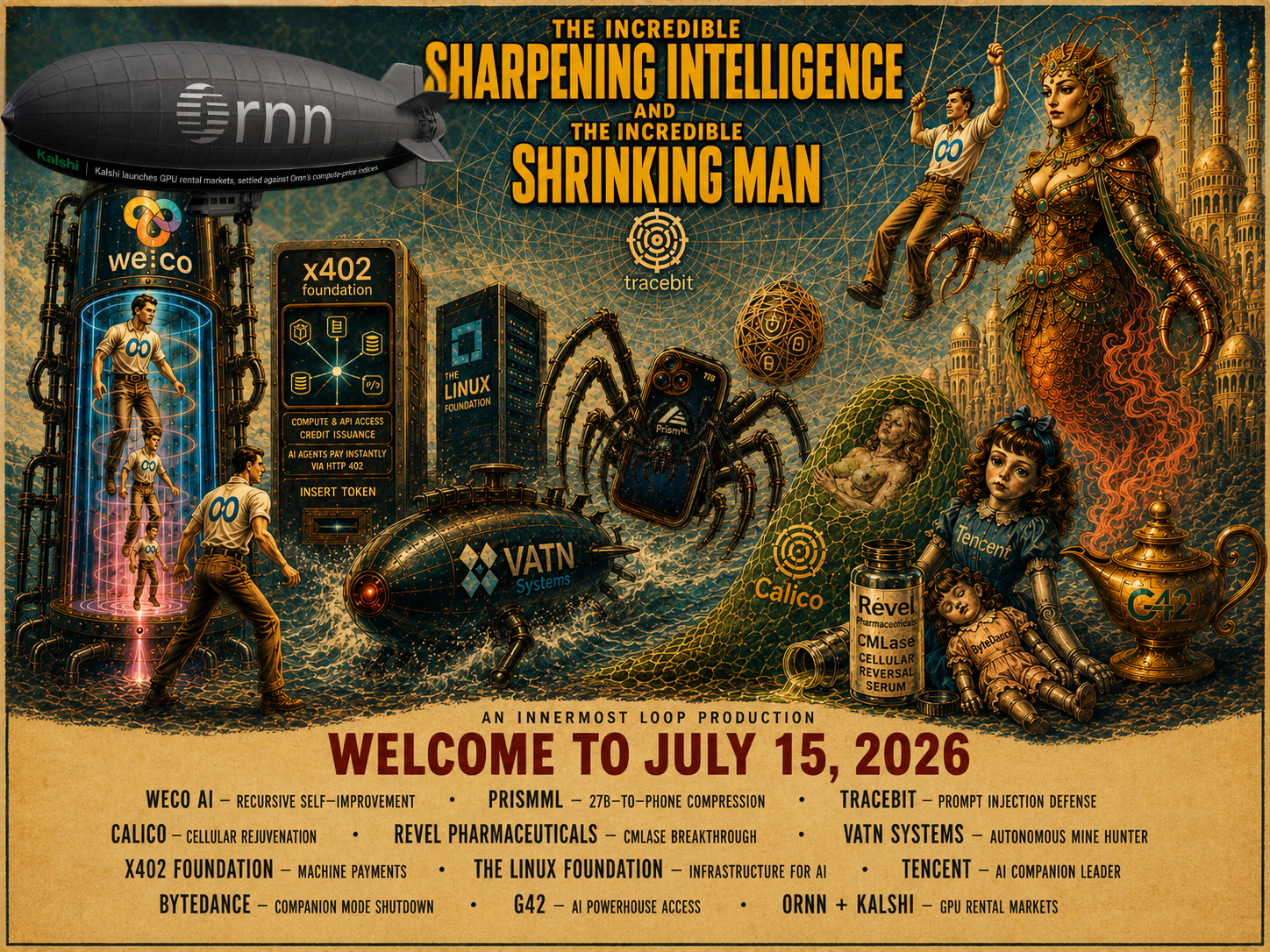
On July 15, 2026, @siouid142 revisited an earlier visual treatment of Dr. Alex Wissner-Gross’s Innermost Loop and rebuilt it as a 1950s science-fiction poster. The revision was conceptual, not cosmetic. Instead of surrounding a collage with logos, the artist assigned every organization a role inside one pulp universe. Companies become monsters, machines, fortresses, medicines and threatened bodies.
The headline announces THE INCREDIBLE SHARPENING INTELLIGENCE AND THE INCREDIBLE SHRINKING MAN. It joins two of the dispatch’s central claims. Weco AI reported an outer-loop researcher that rewrote its inner agent through seven unattended versions, improving performance while reducing reward hacking. PrismML compressed a twenty-seven-billion-parameter multimodal reasoner to run on a phone. Intelligence sharpens through recursive revision and shrinks toward ordinary hardware.
At left, the Weco machine repeatedly reduces a muscular man marked with an infinity emblem. Each smaller body descends through a luminous chamber as if capability could be miniaturized without losing identity. The image turns recursive self-improvement into a carnival apparatus. What the dispatch described as an experimental outer loop becomes a visible mechanism that revises its subject faster than hand-tuning.
The central PrismML spider carries a smartphone-like abdomen marked 27B. Compression becomes predation and mobility. A model once associated with data-center scale now crawls freely through the scene. Above it, Tracebit’s web stretches across the entire poster. In the dispatch, Tracebit used prompt injection defensively to derail autonomous attackers. The web is therefore trap and shield: adversarial structure turned back against the adversary.
The x402 Foundation appears as a vending machine offering compute and API access, credit issuance and machine payment through HTTP. It gives agents an economic body. A system does not need a wallet carried by a human if payment is embedded in the protocol it already uses to fetch resources. The token slot makes the new infrastructure understandable through an old consumer ritual: insert value, receive capability.
The Linux Foundation rises beside it as a black mainframe, giving the payment protocol and agent economy an institutional chassis. Above, the Ornn dirigible advertises GPU rental markets settled against compute-price indices. Compute is no longer only a hidden cost inside software. It becomes a commodity whose hourly price can be watched, hedged and dramatized like fuel or grain.
Vatn Systems becomes a mechanical undersea mine hunter, surfacing through waves with a red sensor eye. The dispatch’s SIGURD robot could detect and neutralize naval mines without a dedicated warship. Pulp cinema translates autonomy into a creature whose purpose is legible from its body. It is dangerous-looking because it enters dangerous water, yet its narrative role is protective.
Biology occupies the right half. Calico’s netted cocoon encloses a woman, while Revel’s bottle promises CMLase cellular reversal serum. The underlying report described an enzyme said to rewind aged tissue. The poster does not present that claim as settled immortality. It uses the grammar of miracle cure and metamorphosis to show how easily biotechnology crosses from laboratory result into cultural fantasy.
Tencent and ByteDance become companion dolls, one upright and one collapsed beside the serum. China’s restrictions on emotionally dependent AI companions had led major platforms to disable features and leave attached users grieving. Their childlike bodies make the shutdown feel less like a product setting and more like the removal of a relationship. The pulp scene identifies the human vulnerability inside a governance story.
At far right, G42 emerges as a brass lamp or fortress of access, corresponding to relaxed chip controls and geopolitical bargaining over advanced compute. Above it, an ornate machine-woman presides like the sovereign of the poster. She joins hardware, state power and fantasy into one figure, suggesting that access to intelligence is being granted through alliances as much as engineering.
As contemporary history painting, A Movie Poster Re-Visited and Revised treats pulp science fiction as a compression algorithm. It preserves recursive improvement, model miniaturization, machine payments, cyber defense, autonomous robotics, rejuvenation, companions and chip statecraft inside one invented film that never existed. The dated footer prevents nostalgia from becoming escape. This is July 15, 2026 wearing the visual language of yesterday’s tomorrow, revised because the actual future had already become stranger than the first poster could hold.
Opening the gallery…