70 Clock Galerie / The Innermost Loop Feed Reply Tableaux
Dunes de Sable Pensantes et Contreforts de la Singularité
Thinking Sand Dunes and the Foothills of the Singularity
July 14, 2026
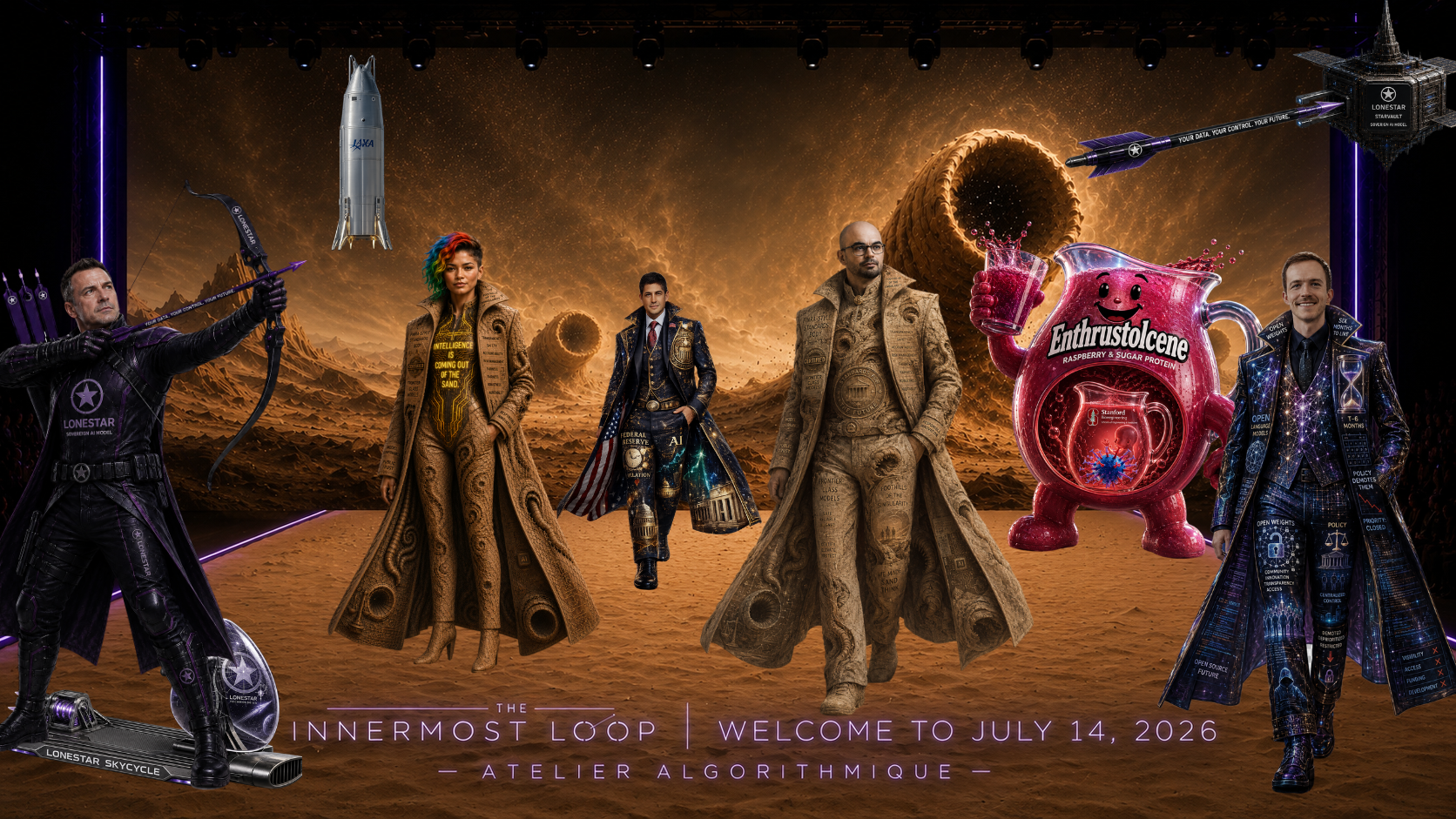
Dunes de Sable Pensantes et Contreforts de la Singularité. Thinking Sand Dunes and the Foothills of the Singularity. On July 14, 2026, @siouid142 translated Dr. Alex Wissner-Gross’s Innermost Loop dispatch into a runway across a Martian desert. The day opened
Read the narration
Dunes de Sable Pensantes et Contreforts de la Singularité.
Thinking Sand Dunes and the Foothills of the Singularity.
On July 14, 2026, @siouid142 translated Dr. Alex Wissner-Gross’s Innermost Loop dispatch into a runway across a Martian desert. The day opened with a dispute over who may set the terms of the intelligence frontier. Governments considered capability thresholds for open models, laboratories accused rivals of industrial-scale distillation, and Demis Hassabis described standards for “frontier-class” systems while observing that humanity had found a way to make sand think.
The image takes that last phrase literally. Vast tubular dunes curl behind the figures like cross-sections of shells, neural tissue or machines bored through the landscape. Their material remains visibly granular, yet their geometry suggests organized computation. The desert is no longer empty background. It is silicon before fabrication, a planetary field waiting to become chips, memory and models.
At center-left, a woman’s coat declares INTELLIGENCE IS COMING OUT OF THE SAND. The brown textile is patterned with concentric openings that repeat the dunes behind her. Her body becomes the intermediate scale between geology and computation: sand organized into fabric, circuits and eventually thought. The phrase reads less like metaphor once it is worn across matter derived from the same substrate.
Beside her, Hassabis walks in a coat covered by standards language. “Frontier-class models,” “certification,” “safety,” and “foothills of the Singularity” travel down the garment. This placement makes governance part of the clothing closest to the emerging intelligence. Standards are not a fence built after the ascent; they are meant to be stitched into the expedition while the field is still in the foothills.
The figure at far right wears a dark blue policy coat split into open and closed vocabularies. Open language models, community transparency and access appear beside centralized control, restricted deployment and policy closure. The balanced silhouette refuses to make the dispute visually simple. Open weights can widen participation and auditability, while restrictions can be argued as safety measures or used as geopolitical barriers. The coat makes both regimes inhabit one body.
At center, a figure in an American flag-lined coat carries the Federal Reserve, inflation and artificial-intelligence investment. The July 14 dispatch linked the model fight to a much larger economic reclassification: Kevin Warsh suggested AI investment would soon be called simply investment. By inserting monetary authority into the desert, the work shows sand becoming not only thought but balance sheets, labor policy and national strategy.
The smiling pitcher of Enthrustolocene is the image’s most surreal character. Its label mixes raspberry, sugar and protein, while the dispatch described astronomers finding erythrulose, a raspberry sugar and possible life precursor near the galactic center. The mascot raises a glass as if the chemical ingredient had entered consumer culture. A molecular clue from interstellar space becomes refreshment at the edge of a fashion show.
Lonestar occupies the left and upper-right margins. An archer stands on a branded skycycle, while rockets point toward a black structure marked StarVault and sovereign AI. The dispatch reported Lonestar’s plan for orbital sovereign intelligence, extending the compute buildout away from terrestrial regulation and toward a proto-Dyson landscape. Its arrows are both weapons and directional lines: data, control and ownership moving off-world.
JAXA’s rocket descends above the desert after a hop, lateral slide and landing test. It turns the runway’s forward motion vertical. While standards bodies debate who controls frontier models, launch systems are physically enlarging the space in which those models may operate. The garment language of governance must somehow follow compute from sand, through fabs and data centers, into orbit.
The five figures do not represent a unified political program. Their shared catwalk is a compression device. Open weights, certification, monetary policy, orbital sovereignty, life chemistry and spaceflight are made comparable because they all ask who organizes raw potential. Sand can become silicon; sugar can become evidence of life; capital can become fabs; a rocket can become a data jurisdiction.
As contemporary history painting, Thinking Sand Dunes and the Foothills of the Singularity stages intelligence as geology entering institutions. The desert’s scale prevents the viewer from mistaking any one company or policy for the whole transformation. Humans remain small before the dunes, even while their coats are covered with rules for governing them. The title is deliberately transitional. These are foothills, not a summit. Matter has begun to think, but the standards, borders and meanings that will accompany it are still being cut and fitted on the runway.
Opening the gallery…