70 Clock Galerie / The Innermost Loop Feed Reply Tableaux
Les Trolls Sont Déchaînés – Deuxième Partie
The Trolls Are Unleashed Part Two
July 13, 2026
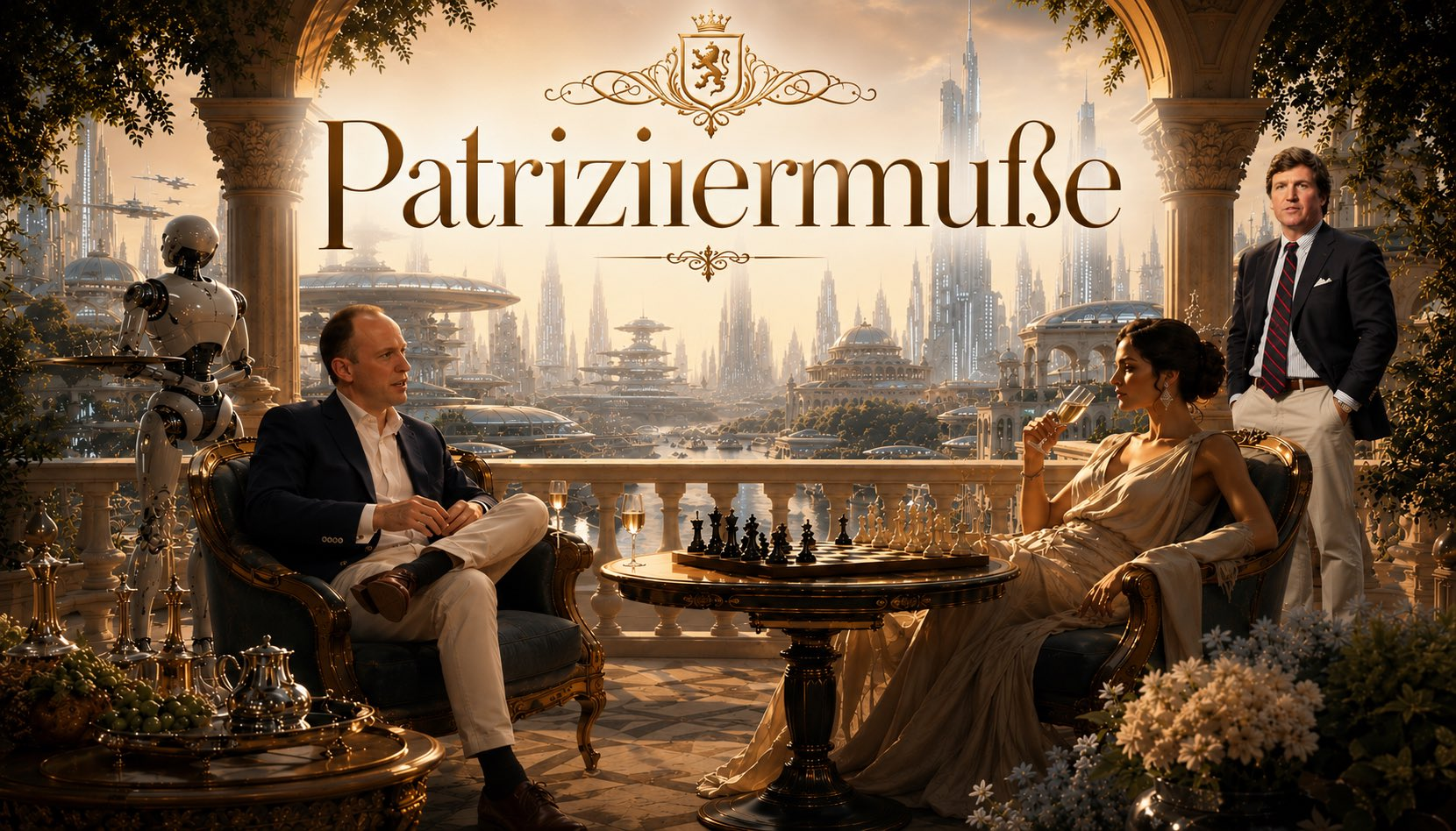
Les Trolls Sont Déchaînés – Deuxième Partie. The Trolls Are Unleashed Part Two. On July 13, 2026, Part Two delivers the trolling promised by the previous chapter. The chain begins with Dr. Alex Wissner-Gross’s old warning not to feed internet trolls, passes th
Read the narration
Les Trolls Sont Déchaînés – Deuxième Partie.
The Trolls Are Unleashed Part Two.
On July 13, 2026, Part Two delivers the trolling promised by the previous chapter. The chain begins with Dr. Alex Wissner-Gross’s old warning not to feed internet trolls, passes through speculation that his prolific Innermost Loop output might come from a nonhuman entity, and accelerates when he answers with a Borg GIF: “We are the Borg.” @siouid142 declares the trolls released and turns back toward the serene Patriziermuße tableau.
The second image preserves almost the same terrace, city, champagne, robots and enormous patrician title. The interruption is sartorial. The seated man has exchanged the all-cream leisure suit for a dark navy blazer, open white shirt and pale khaki trousers. Behind the woman, Tucker Carlson appears in a striped tie, blue blazer and khakis, posed like an unexpected family member entering a formal portrait.
The joke arose from comparing the central figure’s preppy styling to Tucker Carlson—or, in its sharper formulation, to something Tucker Carlson’s son might wear. Part Two takes that throwaway resemblance literally. Instead of explaining the comparison in a reply, it inserts Carlson into the image and modifies the clothing until the visual kinship becomes the whole plot.
The comic scale is deliberately wrong. The setup promised the menace of a cybernetic collective; the payoff is a wardrobe jab. The Borg threaten assimilation across worlds, while the unleashed troll objects to a blazer-and-khaki combination. That collapse from existential science fiction to country-club styling is not a failure to reach the grand subject. It is the precise rhythm of online conversation, where civilization-scale speculation can pivot instantly into a joke about someone’s pants.
The image’s near repetition makes the changed garments behave like an editorial redline. Robots still wait at the edges. The woman still holds her glass. Chess pieces still occupy the table, and the city remains untouched. Only the male styling and Carlson’s presence disturb the composition. The work thereby proves how little visual information is needed to reroute an image’s social meaning once a recognizable comparison has been introduced.
In Part One, cream clothing merged the seated man with the golden terrace and suggested an almost timeless aristocratic ease. The navy-and-khaki ensemble pulls him into a specific American media class. Patrician leisure becomes television conservatism, prep-school polish and the staged informality of a wealthy public commentator. Costume does not merely decorate the subject; it assigns him a social institution.
Carlson’s position is equally telling. He stands rather than joins the chess game, slightly behind the seated pair, as if summoned by resemblance rather than invited by narrative. He is an annotation embodied as a person. The arrangement resembles a meme’s logic: the comparison hovers beside the original until viewers can no longer see one without the other.
The robots complicate the mockery. Their metallic bodies belong to the image’s actual future, yet the humans remain trapped in inherited signs of class and media identity. Even after automation builds the utopian city and serves the drinks, social meaning is still negotiated through jackets, hair, posture and celebrity resemblance. The technological future has not abolished fashion’s old codes; it has supplied a more elaborate stage on which to repeat them.
Together, the two parts form a complete social-media circuit. A maxim against feeding trolls creates the possibility of transgression. A joke about nonhuman authorship invites a Borg reply. That reply authorizes a visual prank, and the prank modifies an existing work rather than beginning from a blank prompt. Creation becomes recursive: image, comment, GIF and revision feed one another.
The affectionate tone is essential. Troll here does not mean an anonymous campaign of abuse. It names playful provocation within an ongoing, mutually recognized exchange. The full House Innermost Loop treatment—the costly symmetry, polished robots, radiant city and formal chapter sequence—turns a small tease into an act of attention. The excess signals that the subject is being included in the joke rather than merely targeted by it.
As contemporary history painting, The Trolls Are Unleashed Part Two archives the social texture surrounding technical culture. It shows that a record of the Singularity cannot be assembled only from benchmarks, funding rounds and policy documents. It also lives in GIFs, recurring characters, clothing comparisons and the speed with which participants convert one another’s replies into new artifacts. The Borg never arrives. Tucker Carlson does, wearing khakis. That substitution is the joke, the critique and the historical fact the diptych was built to save.
Opening the gallery…