70 Clock Galerie / The Innermost Loop Feed Reply Tableaux
Les Observateurs Sont Observés : Maison de la Boucle la Plus Profonde chez Sainsbury’s
The Watchers Are Being Watched: House Innermost Loop Upon Sainsbury’s
July 12, 2026
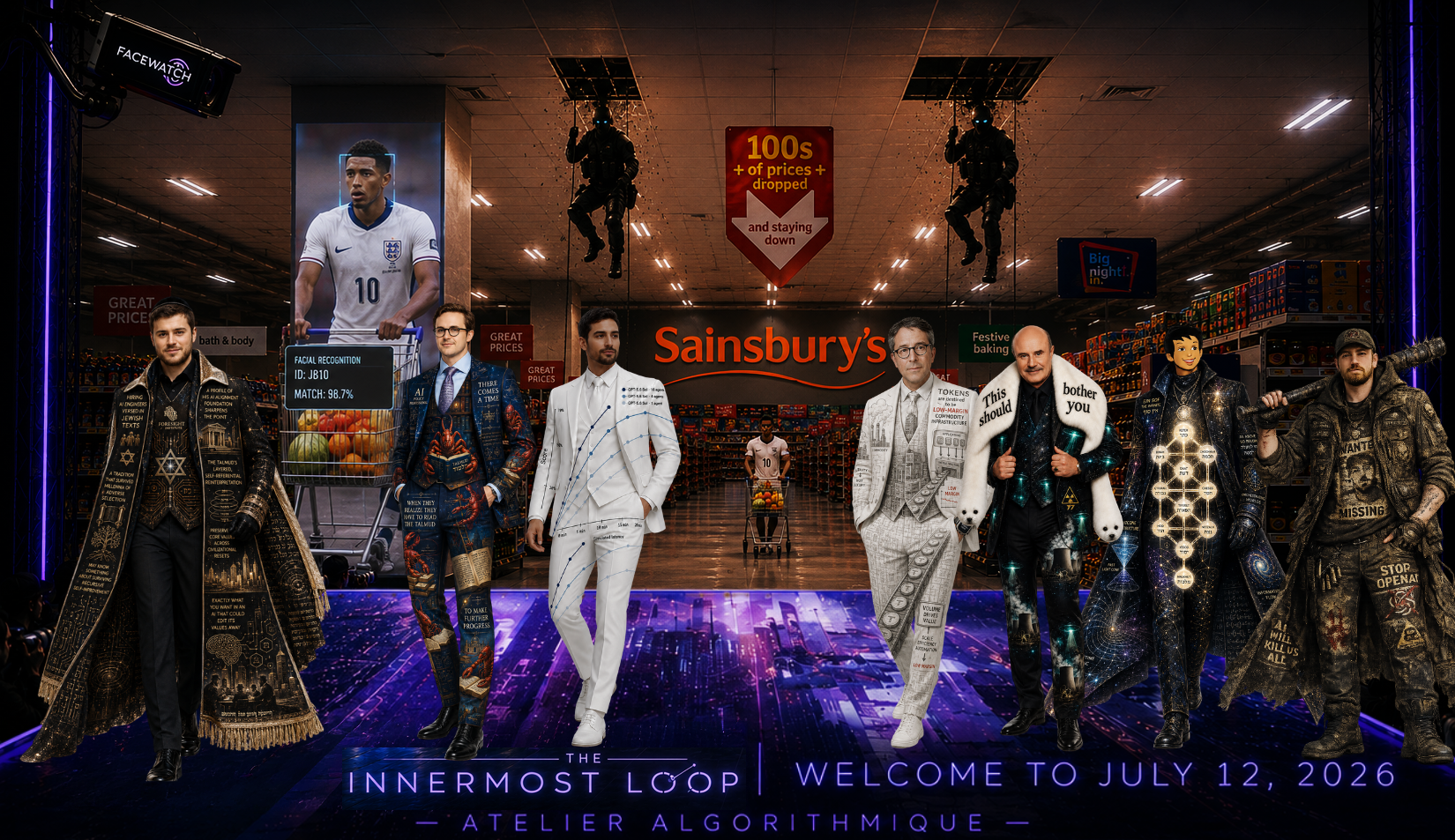
Les Observateurs Sont Observés : Maison de la Boucle la Plus Profonde chez Sainsbury’s. The Watchers Are Being Watched: House Innermost Loop Upon Sainsbury’s. On July 12, 2026, @siouid142 converted Dr. Alex Wissner-Gross’s Innermost Loop dispatch into a survei
Read the narration
Les Observateurs Sont Observés : Maison de la Boucle la Plus Profonde chez Sainsbury’s.
The Watchers Are Being Watched: House Innermost Loop Upon Sainsbury’s.
On July 12, 2026, @siouid142 converted Dr. Alex Wissner-Gross’s Innermost Loop dispatch into a surveillance runway inside Sainsbury’s. The title comes directly from the day’s warning that “the watchers are being watched”: British shop facial-recognition systems were moving toward police alerts within four seconds of a match. The image returns the gaze by making the usually ambient apparatus impossible to ignore.
Sainsbury’s orange wordmark dominates the back wall, while a Facewatch camera hangs at upper left. In the center, Jude Bellingham appears enlarged on a recognition display. A shopping-cart screen assigns an identification and a 98.7 percent match. Two black tactical figures descend through broken ceiling panels. What a customer would normally encounter as cameras, signs and loss-prevention infrastructure becomes an overt theater of classification.
The supermarket is an exact setting because retail surveillance presents itself as routine convenience and safety. Aisles, price cards, baskets and checkout data already organize shoppers into legible patterns. Facial recognition adds identity to that environment, converting a visit for groceries into a biometric event. By staging couture in the aisle, the work exposes the social choreography hidden inside an ordinary store: enter, be seen, be compared, be priced and proceed.
The sign above the runway announces that hundreds of prices have dropped and are “staying down.” It echoes retail promotion, but its huge downward arrow also resembles a score or risk indicator. Price and person are processed by adjacent systems. The supermarket promises lower costs while the camera assigns confidence to a face. Both operations appear objective because they arrive as numbers, yet both depend on classifications, thresholds and institutional choices.
The lineup carries the wider July 12 dispatch on its garments. At left, coats dense with Hebrew text, Talmudic references, diagrams and commentary answer the opening story: AI policy professionals turning to the Talmud and Kabbalah for models of value continuity under recursive self-modification. A tradition built from canon, argument and layered reinterpretation becomes wearable architecture for systems that might otherwise edit away the commitments they were meant to preserve.
The Kabbalistic Tree of Life appears again as a luminous network on the woman’s dark gown. Its nodes resemble both the Sefirot and a computational graph. The correspondence is not offered as a mystical solution to alignment. It makes visible the structural attraction: a core surrounded by commentary, relationships and limits on unilateral rewriting. Ancient textual survival becomes a serious design analogy precisely because the new systems may revise themselves.
The figures at right widen the social register. A fur-trimmed coat marked by warnings evokes Dr. Phil’s UAP commentary and the repeated insistence that undisclosed activity over nuclear facilities “should bother you.” Beside it, astronomical diagrams and missing-person motifs suggest the day’s unresolved evidence. The store becomes an archive of observation in which some watchers claim perfect matches while others confront phenomena that remain unclassified.
That contrast is the image’s deepest irony. Facewatch promises a high-confidence identity within seconds; the UAP record has resisted consensus for decades. Artificial systems appear most authoritative in the intimate space of an ordinary shopper, while extraordinary events around military and nuclear infrastructure remain politically ambiguous. Certainty is distributed according to institutional convenience, not simply according to the importance of the question.
The fashion audience and cameras add a third layer of watching. Runway culture depends on inspection, photography, recognition and public ranking. The people wearing surveillance critiques are themselves displayed for spectators. House Innermost Loop therefore does not pretend to stand outside the gaze. It turns observation back on itself, showing that documentation can reveal power even while participating in the same visual economy.
As contemporary history painting, The Watchers Are Being Watched transforms a supermarket into a civic model of recursive observation. Talmudic commentary asks how values survive repeated reinterpretation; facial recognition asks how identity survives repeated capture; UAP files ask what remains when observation fails to settle meaning. Sainsbury’s holds these questions under fluorescent light. The work does not claim every camera is evil or every match false. It asks who defines the list, who may revise it, and whether a society that watches within four seconds has built an equally rapid way to watch the watcher.
Opening the gallery…