70 Clock Galerie / The Innermost Loop Feed Reply Tableaux
Superlatif de la Singularité : Le Plus Susceptible de Devenir M. Fusion
Singularity Superlative: Most Likely to Be Mr. Fusion
July 11, 2026
Superlatif de la Singularité : Le Plus Susceptible de Devenir M. Fusion. Singularity Superlative: Most Likely to Be Mr. Fusion. Dated July 11, 2026, this work grows from a Moonshots exchange involving Dr. Alex Wissner-Gross rather than from the main July 11 In
Read the narration
Superlatif de la Singularité : Le Plus Susceptible de Devenir M. Fusion.
Singularity Superlative: Most Likely to Be Mr. Fusion.
Dated July 11, 2026, this work grows from a Moonshots exchange involving Dr. Alex Wissner-Gross rather than from the main July 11 Innermost Loop tableau. Wissner-Gross had returned to the proposition that reactors are critical to the intelligence buildout. @siouid142 answered by reviving an earlier running comparison: among fusion companies, Helion was the one most likely to become a real-world Mr. Fusion, the compact power appliance from Back to the Future.
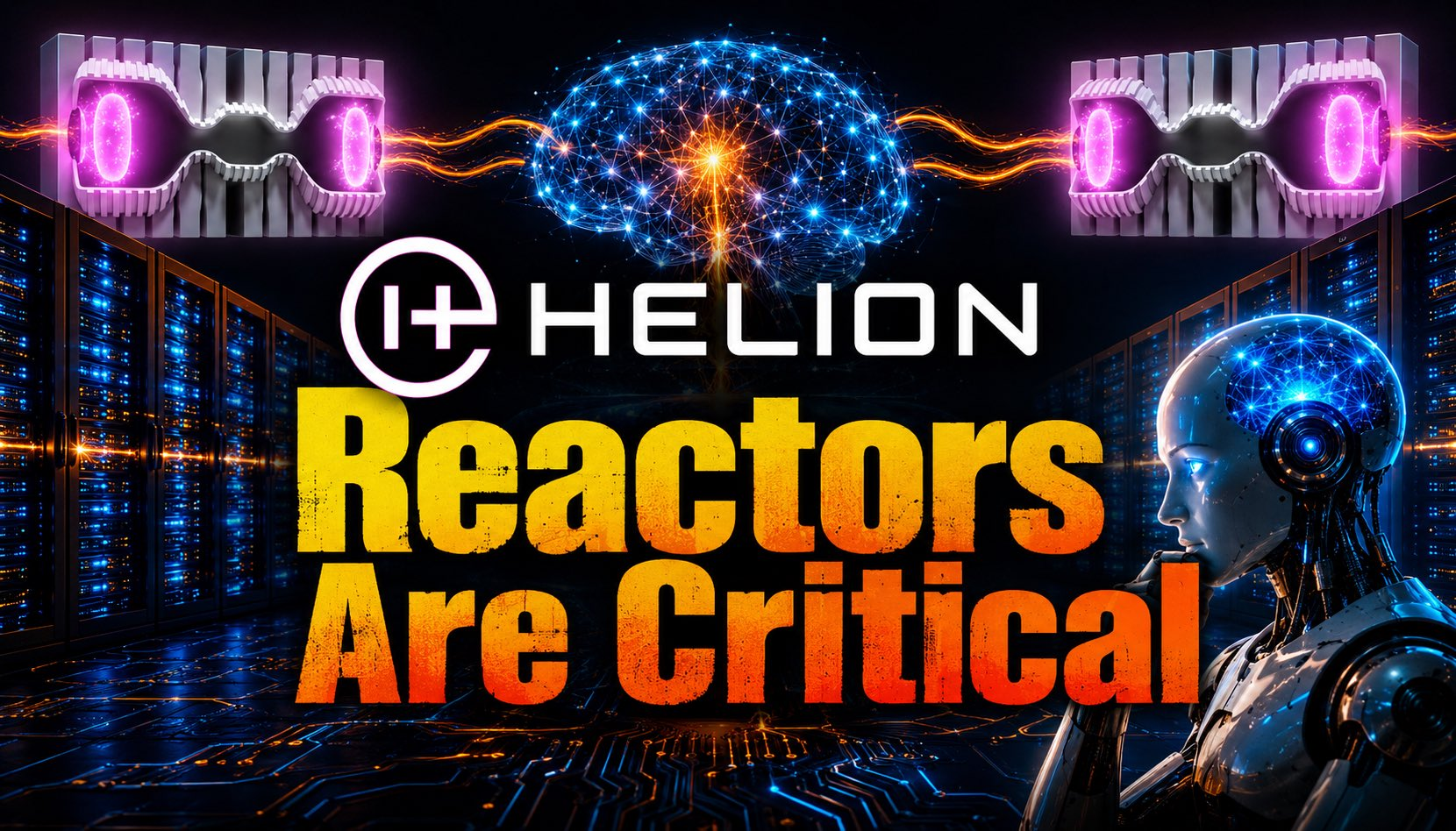
The image is not the yearbook scene its title might first suggest. It is a severe Helion advertisement set inside a data center. The enormous HELION wordmark occupies the upper field like the name of a graduating institution. Beneath it, two luminous fusion-reactor forms flank a bright neural sphere. A robotic head and long corridors of server racks make the destination of the energy explicit. The school superlative has become an industrial campaign poster.
Across the bottom, REACTORS ARE CRITICAL appears in immense yellow-orange letters. Critical carries two meanings. Reactors are indispensable to an economy whose demand for computation keeps expanding, and a fission or fusion system reaches criticality when its physical process becomes self-sustaining. The typography turns a technical threshold and an infrastructure judgment into one emphatic sentence.
The Mr. Fusion reference provides the work’s historical hinge. In Back to the Future, a fantastical household machine converts refuse into enough energy for impossible travel. Its charm lies in making an immense engineering problem look casual: lift the lid, feed it scraps, and continue into the future. Helion’s devices are not countertop appliances, and the portrait makes no claim that commercial fusion is already solved. The comparison names the desired cultural end state—abundant power becoming ordinary enough to disappear into use.
The yearbook formula, “most likely to be,” protects that distinction. A superlative is a prediction made before the later life is known. It recognizes promise, personality and reputation while preserving uncertainty. Helion receives the title because the earlier conversation made it the most vivid candidate for this pop-cultural role, not because the artwork grants it a completed reactor or guaranteed economic victory.
The paired reactor forms are therefore trophies and questions at once. Their radiant centers suggest controlled stars, but their polished symmetry resembles products already ready for a showroom. Between them, the neural globe converts power into mind. The composition makes the intelligence boom look less like software floating in a cloud and more like a physical circuit: reactor, electricity, servers, model, machine intelligence.
The robot head at lower center reinforces this material chain. It does not dream independently of infrastructure. Its face emerges only after racks, cooling, chips and energy have been assembled around it. By placing the head beneath the glowing sphere, the work treats artificial intelligence as an effect of organized matter rather than an ethereal visitor. The future depends on watts before it can produce words.
That is why the image belongs beside the much denser July 11 cosmic garden without being mistaken for it. The companion tableau surveys models, memory, chips, robotaxis, orbital mirrors and UAP history. This work isolates the prior condition beneath all of them. If reactors are critical, then energy technology is not one news item among many. It is the load-bearing substrate that determines which visions can persist after the demonstration.
The clean corporate palette also deserves attention. Black space, electric blue and solar orange strip away the nostalgic clutter normally associated with Back to the Future. Only the title preserves the film reference; the image itself speaks the language of venture-scale infrastructure. The collision lets popular memory serve as a mnemonic while allowing the engineering ambition to appear in its contemporary form.
As contemporary history painting, Singularity Superlative: Most Likely to Be Mr. Fusion records how technical communities narrate unfinished infrastructure through jokes that carry real evaluative force. A movie prop, a Moonshots callback and a fusion company become one compact judgment about the energy future. The poster does not prove Helion will win. It preserves the more historically revealing fact that, at this moment, abundant compact power could still be imagined through Mr. Fusion—and that the servers waiting in the dark had already made the need feel critical.
Opening the gallery…