70 Clock Galerie / The Innermost Loop Feed Reply Tableaux
Maison de la Boucle la Plus Profonde – Défilé de Marc Andreessen, Noam Brown, Ben Bernanke, Sam Altman, Mark Zuckerberg et Elon Musk
House Innermost Loop – Catwalk - Marc Andreessen, Noam Brown, Ben Bernanke, Sam Altman, Mark Zuckerberg, and Elon Musk
July 10, 2026
Maison de la Boucle la Plus Profonde – Défilé de Marc Andreessen, Noam Brown, Ben Bernanke, Sam Altman, Mark Zuckerberg et Elon Musk. House Innermost Loop – Catwalk - Marc Andreessen, Noam Brown, Ben Bernanke, Sam Altman, Mark Zuckerberg, and Elon Musk. On Jul
Read the narration
Maison de la Boucle la Plus Profonde – Défilé de Marc Andreessen, Noam Brown, Ben Bernanke, Sam Altman, Mark Zuckerberg et Elon Musk.
House Innermost Loop – Catwalk - Marc Andreessen, Noam Brown, Ben Bernanke, Sam Altman, Mark Zuckerberg, and Elon Musk.
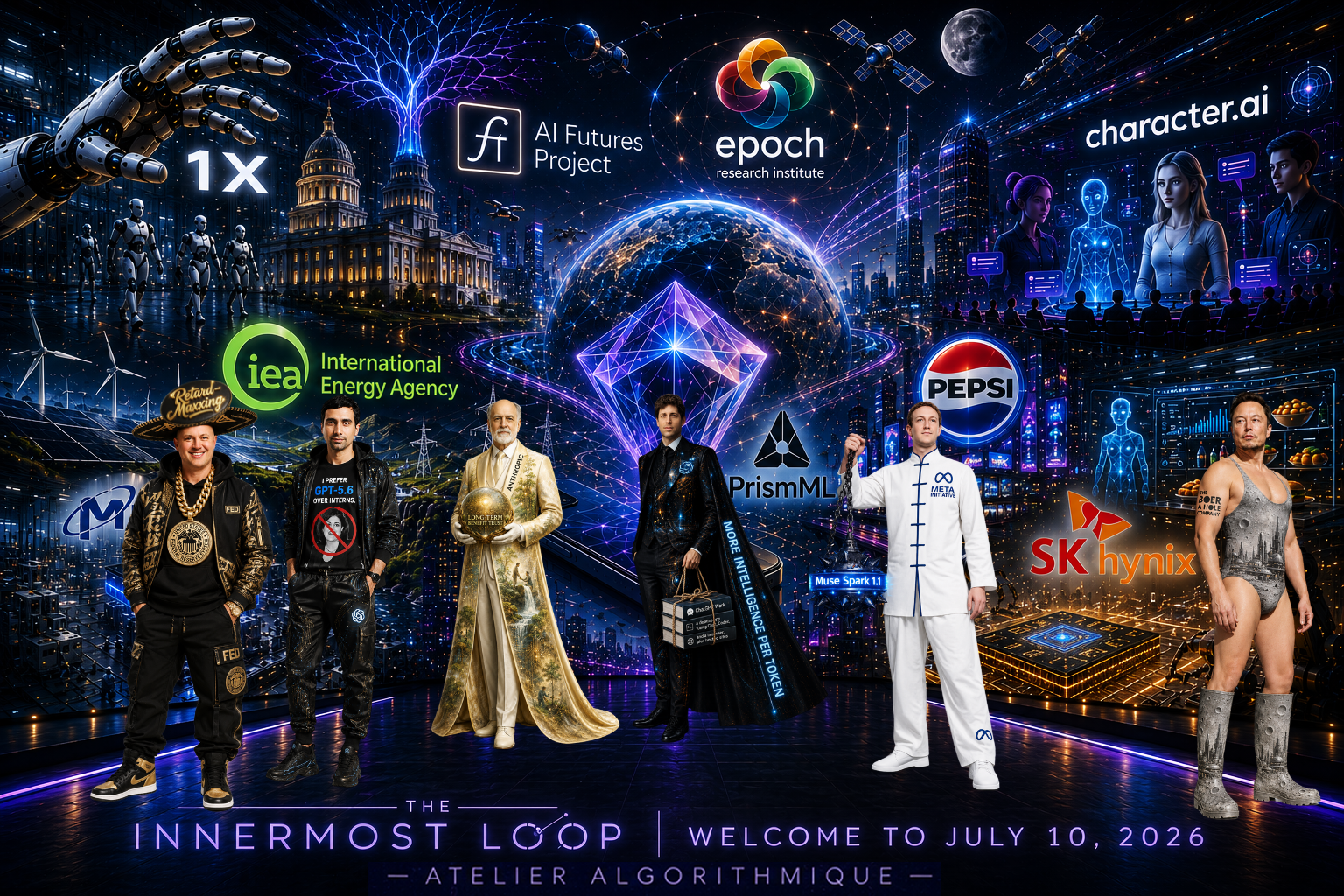
On July 10, 2026, @siouid142 converted Dr. Alex Wissner-Gross’s Innermost Loop into a six-person couture bloc. Marc Andreessen, Noam Brown, Ben Bernanke, Sam Altman, Mark Zuckerberg and Elon Musk occupy one floor because the day’s argument joined venture ideology, model judgment, institutional governance, product economics, platform competition and industrial scale. The surviving record preserves that editorial logic even though the original prompt-by-prompt garment exchange does not survive.
Andreessen stands at far left in black and gold beneath a landscape of wind, solar and the International Energy Agency. His oversized chain, Federal Reserve motifs and “retard maxxing” hat combine economic authority with deliberately provocative internet shorthand. The garment connects his accelerationist posture to a Federal Reserve consultation on artificial intelligence’s economic impact while mocking paralysis through overanalysis.
Noam Brown stands beside him in a dark OpenAI outfit. His shirt gives the day’s practitioner verdict: he would prefer GPT-5.6 over interns. The provocation compresses a labor-market argument into a sentence worn on the chest. Brown represents evaluation from inside frontier research, where the comparison is no longer only model against model but model against a human role within an actual workflow.
At center-left, former Federal Reserve chair Ben Bernanke wears a long gold garment labeled ANTHROPIC and carries an object marked LONGTERM BENEFIT TRUST. His presence brings central-bank gravitas into AI governance. The work does not portray him as a model builder. It uses his institutional biography to ask what kind of fiduciary and public authority is being assembled around companies whose decisions may shape labor, capital and technological risk.
Sam Altman occupies the center in black, carrying a compact case and wearing the phrase MORE INTELLIGENCE PER TOKEN. The July 10 source tied him to GPT-5.6 and a claimed improvement in dollars per task. The garment makes product economics visible as tailoring: intelligence is treated not only as an abstract capability but as something metered, priced and optimized for useful work.
Behind Altman, a faceted intelligence glows over Earth while PrismML and Muse Spark appear at runway level. The background extends the efficiency theme across compact models and image systems. Satellites place the same problem in orbit: fit capability into cheaper tasks and distributed physical environments.
Mark Zuckerberg appears in an austere white Meta uniform, holding a vertical staff beneath the enormous Pepsi emblem and a Character.AI display. The source placed him in the day’s attack on extreme model margins. His clothing’s clinical simplicity contrasts with Meta’s platform scale: efficiency is not presented as austerity for its own sake, but as a strategy for distributing model capability across billions of users and devices.
The Character.AI scene shows synthetic figures conversing before an audience. It gives the platform argument a social body: lower prices and wider distribution increase the places where simulated people, assistants and companions enter ordinary relationships.
Elon Musk stands at far right in a deliberately crude “Boer A Hole Company” garment and metal boots. The joke redirects the monumentality of the surrounding infrastructure through a recurring project pun on The Boring Company. His place in the dispatch involved a reversal around Anthropic and the expanding SpaceX, Starlink and Starmind industrial stack. Satellites, orbital paths and the giant mechanical hand make scale inseparable from personality.
Across the backdrop, 1X humanoids march beneath a robotic hand; the AI Futures Project and Epoch Research Institute occupy the sky; SK Hynix rises from a field of circuitry. These entities turn the catwalk into a systems map. Forecasting, benchmarks, memory, robotics, energy, platforms and space infrastructure are not secondary decorations. They are the material conditions that make the six people’s positions consequential.
WELCOME TO JULY 10, 2026 runs across the floor beside THE INNERMOST LOOP and ATELIER ALGORITHMIQUE. As contemporary history painting, the work is a portrait of allocation: who decides where intelligence, money, labor and compute move next. The common runway does not imply agreement. It reveals dependence. Venture capital needs research; products need memory and energy; platforms need users; governance needs legitimacy; orbital ambition needs terrestrial industry. Six figures walk separately, but the luminous world behind them is one interlocked machine.
Opening the gallery…