70 Clock Galerie / The Innermost Loop Feed Reply Tableaux
Chronologie de la Théorie Unifiée de l’Intelligence comme Compression de l’Information
A Timeline of The Unified Theory of Intelligence as Information Compression
July 9, 2026
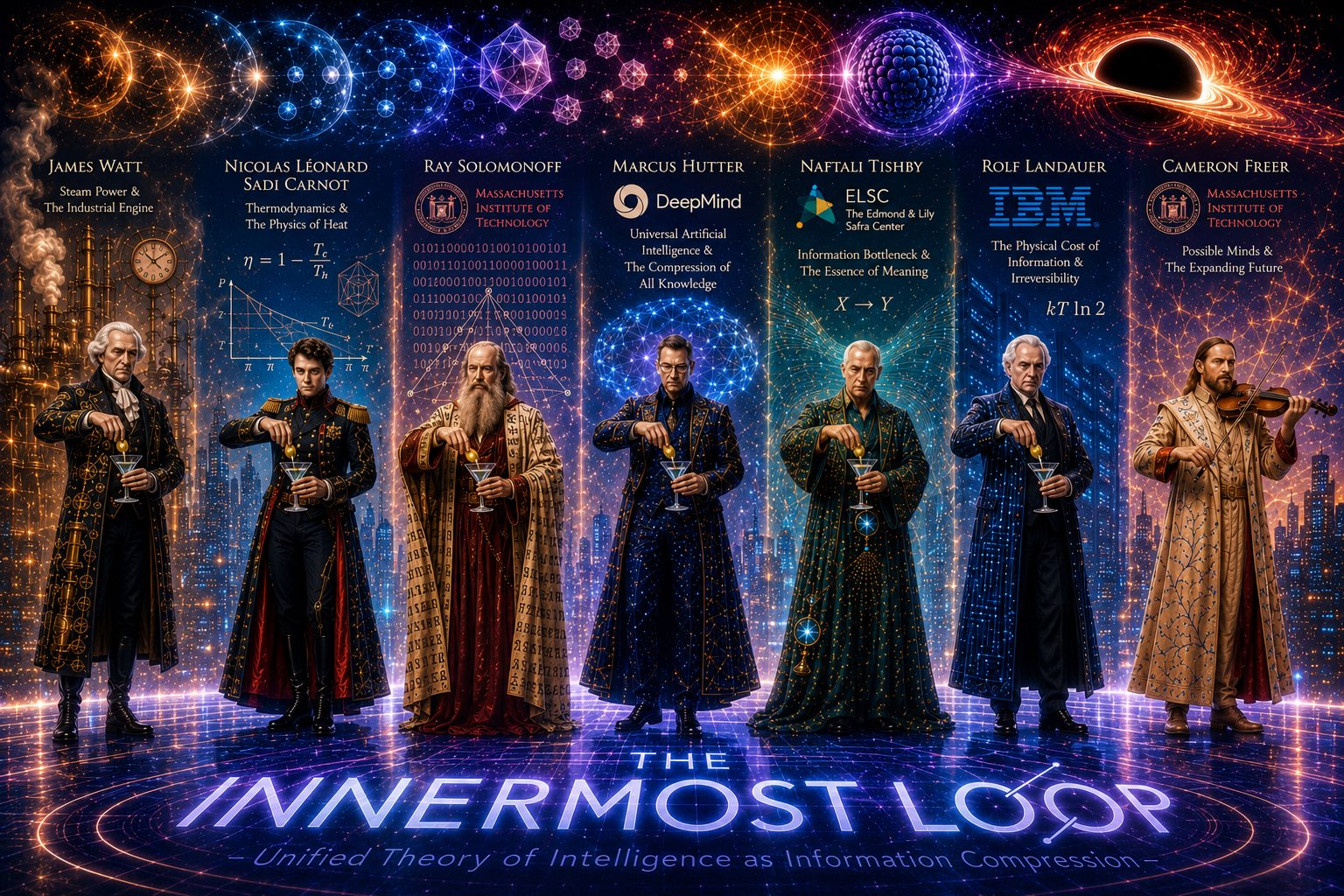
Chronologie de la Théorie Unifiée de l’Intelligence comme Compression de l’Information. A Timeline of The Unified Theory of Intelligence as Information Compression. Created on July 9, 2026, this work turns the claim that intelligence is compression into a cere
Read the narration
Chronologie de la Théorie Unifiée de l’Intelligence comme Compression de l’Information.
A Timeline of The Unified Theory of Intelligence as Information Compression.
Created on July 9, 2026, this work turns the claim that intelligence is compression into a ceremonial genealogy. @siouid142 does not give the theory one inventor or one decisive equation. Seven figures stand beneath thermodynamic, mathematical and computational emblems, allowing the argument to accumulate across centuries: useful intelligence finds structure, predicts what comes next and retains meaning while discarding redundancy.
At far left stands James Watt beneath steam, gears and a clock. The label names steam power and the industrial engine. Watt is not presented as an artificial-intelligence theorist. He begins the prehistory of the timeline by making work, energy and efficiency into an engineering system. Compression here starts materially: extract more organized motion from a physical process and measure what is lost.
Beside him, Nicolas Léonard Sadi Carnot occupies a field of heat diagrams and the familiar efficiency relation between hot and cold reservoirs. Thermodynamics introduces limits. No engine converts all heat into work, and no account of information can remain detached from physical cost forever. Carnot’s panel gives the later computational claims a universe governed by constraints rather than metaphor alone.
Ray Solomonoff stands before binary strings and a converging diagram. His position marks the shift from engines to prediction. Algorithmic probability rewards shorter programs that explain observations and assigns greater weight to compact descriptions. In this lineage, learning is not the storage of every event as isolated fact; it is the discovery of a generative account capable of reproducing the regularity behind the events.
Marcus Hutter occupies the center beneath DeepMind and the words UNIVERSAL ARTIFICIAL INTELLIGENCE AND THE COMPRESSION OF ALL KNOWLEDGE. The Hutter Prize makes the proposition operational by treating improved lossless compression of a large text corpus as evidence that a system has discovered structure in human knowledge. Compression is not celebrated because smaller files are convenient. It becomes a proxy for understanding.
Naftali Tishby follows beneath the Edmond and Lily Safra Center and the phrase INFORMATION BOTTLENECK AND THE ESSENCE OF MEANING. The arrow from X to Y summarizes a central problem: preserve what is relevant for prediction while discarding incidental detail. His panel gives the timeline its semantic pressure. The best representation is not the shortest in isolation; it is the shortest that retains what the task requires.
Rolf Landauer stands beneath IBM, a blue computational city and the formula kT ln 2. His principle ties information erasure to a minimum physical energy cost. The timeline therefore refuses to let compression float as pure abstraction. Bits are represented physically, and irreversible operations have thermodynamic consequences. Intelligence may become denser, but density still inhabits matter.
At far right, Cameron Freer plays a violin beneath MIT and the phrase POSSIBLE MINDS AND THE EXPANDING FUTURE. The instrument changes the ceremony. The other figures appear to pour or hold a drink; Freer produces structured variation in time. Music becomes a final image of compression: a score, pattern and performance can generate experience vastly richer than the notation alone while remaining organized enough to be recognized.
Above the figures, the visual field evolves from fiery mechanics through atomic diagrams, polyhedra, stars, a cellular sphere and a black hole. The sequence does not claim a simple linear proof. It stages recurring questions at different scales: what can be predicted, what must be discarded, what costs energy, and what compact rule can generate a larger world?
The figures’ formal coats unify institutions that would otherwise appear in separate textbooks. Equations, binary code, network geometry and industrial motifs become textiles. The effect is deliberately ceremonial, almost a toast to the possibility of a unified account. Yet each panel preserves a different boundary condition, preventing the theory from collapsing into the empty slogan that smaller always means smarter.
As contemporary history painting, A Timeline of The Unified Theory of Intelligence as Information Compression treats theory itself as the subject. Its seven-person procession links steam engines to possible minds without pretending the path was inevitable. The illuminated floor names THE INNERMOST LOOP because each figure asks a version of the same question: how can a system turn a vast world into a compact internal form and still act intelligently within it? The image’s answer remains provisional but powerful. Intelligence is not the accumulation of everything; it is the art of discovering what can be left out without losing the future.
Opening the gallery…