70 Clock Galerie / The Innermost Loop Feed Reply Tableaux
Jerry Tworek Défile pour la Maison de la Boucle la Plus Profonde
Jerry Tworek Walks for House Innermost Loop
July 8, 2026
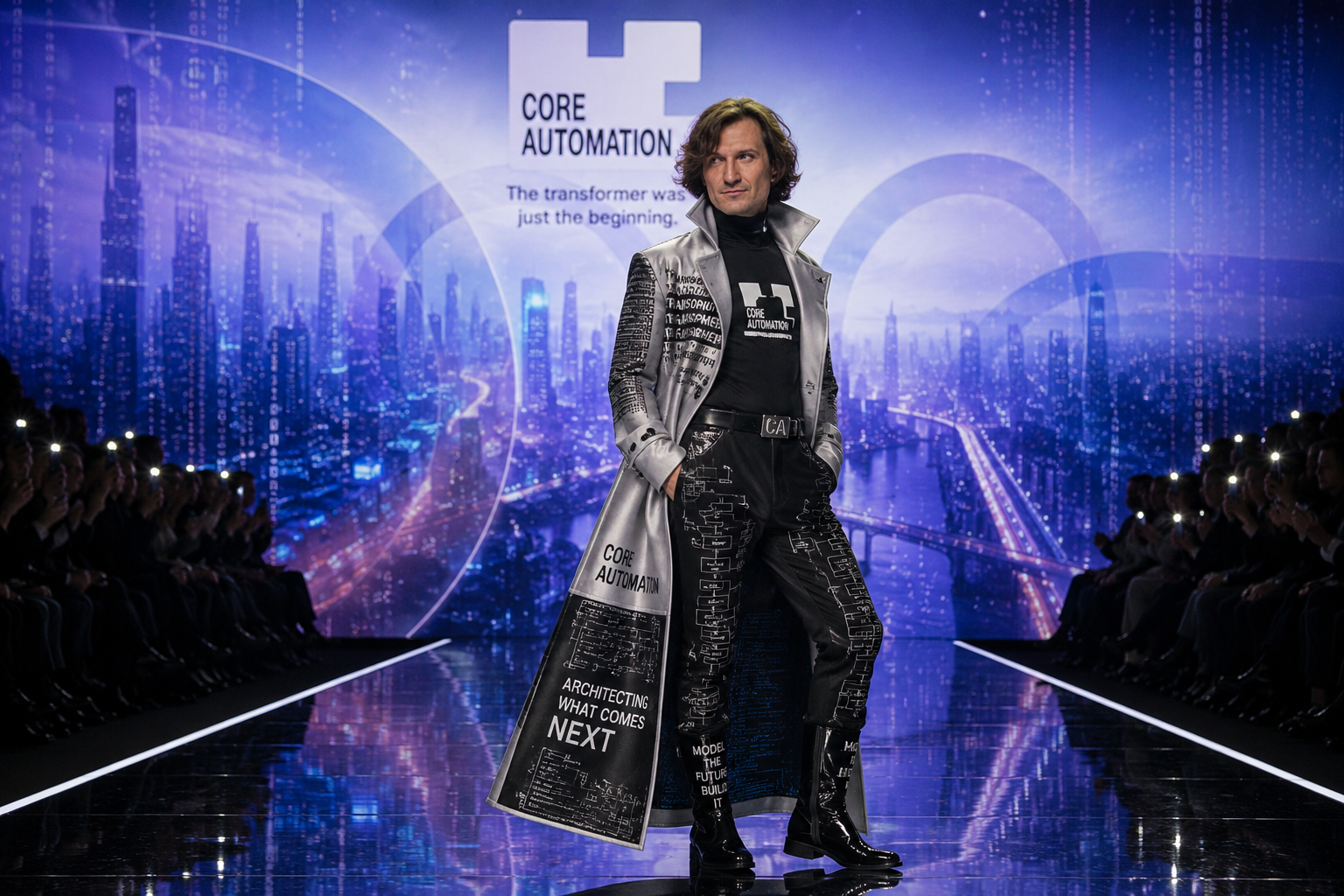
Jerry Tworek Défile pour la Maison de la Boucle la Plus Profonde. Jerry Tworek Walks for House Innermost Loop. On July 8, 2026, Jerry Tworek entered Dr. Alex Wissner-Gross’s Innermost Loop through an architectural eulogy. The transformer had defined the modern
Read the narration
Jerry Tworek Défile pour la Maison de la Boucle la Plus Profonde.
Jerry Tworek Walks for House Innermost Loop.
On July 8, 2026, Jerry Tworek entered Dr. Alex Wissner-Gross’s Innermost Loop through an architectural eulogy. The transformer had defined the modern language-model era, yet Tworek was already speaking of it as the prelude to a successor. @siouid142 turns that paradox into runway fashion: a technology still powering the present is honored at the very moment its designers begin walking toward what follows it.
Tworek stands beneath CORE AUTOMATION and the phrase THE TRANSFORMER WAS JUST THE BEGINNING. The background’s pale emblem resembles both an industrial component and a monumental letterform. It gives the runway the atmosphere of a product unveiling, but the black-and-silver palette makes the event feel equally like a memorial.
His coat and trousers are covered with code, flow diagrams, stacked boxes and technical traces. The patterns evoke model architecture without claiming to reproduce a literal transformer schematic. Their repetition matters. Attention layers gained power through repeated structure, and the garment transforms that repetition into texture—an architecture so successful that it became the default surface of an era.
Across the long front panel appear the words ARCHITECTING WHAT COMES NEXT. Lower inscriptions urge the viewer to model the future and build it. The language shifts the portrait from obituary to design brief. Tworek is not mourning an extinct object. He is marking the point when familiarity with one system becomes the foundation for inventing another.
Fashion supplies an exact temporal metaphor. A dominant silhouette can remain commercially everywhere while designers already regard it as last season’s form. The same can happen in computation. The transformer may continue to scale, train and serve enormous workloads even as research attention moves toward architectures that promise different memory, reasoning, efficiency or learning behavior.
The portrait therefore avoids the blunt image of a tombstone or discarded chip. Obsolescence is not represented as disappearance. Tworek wears the transformer across his body and carries it forward. The coat is tribute, working archive and transitional skin. Its open front shows a darker inner layer, suggesting that the successor is not yet fully visible but is already reorganizing the silhouette.
His stance reinforces this in-between state. One foot advances while the body turns slightly toward the audience. He is both leaving and presenting. The runway makes architecture public as a sequence of choices rather than an invisible technical foundation. Viewers witness the field deciding that its most successful form may not be its final form.
Within the wider July 8 group, Tworek supplies the structural layer beneath every other story. Procedural kingdoms, agentic evaluations, simulation arguments and executive cognition all depend on computational forms capable of representing, predicting and acting. His individual portrait closes the sequence by moving from what systems do back to what systems are built from.
CORE AUTOMATION gives that structural role an industrial name. “Core” suggests the deep mechanism beneath applications, while “automation” describes the transfer of increasingly complex sequences from human procedure into machine execution. The words meet on his chest as a compact mandate: architecture matters because it determines which loops can run, remember and improve without constant intervention.
The silver exterior catches runway light like a machine casing, while black fabric beneath it absorbs the glow. That opposition gives the garment a temporal depth. The visible system is polished and legible; the next architecture remains dark, not because it is ominous, but because its decisive form has not yet been selected. Tworek wears certainty about transition without pretending certainty about the destination.
The surrounding city is threaded with arcs and falling digits. It looks continuous, but the garment’s diagrams reveal the constructed mechanisms beneath that continuity. This contrast is important to the project’s art criticism. Artificial intelligence often reaches the public as a smooth interface; the coat restores the layered architecture and human decisions that make the interface possible.
As contemporary history painting, Jerry Tworek Walks for House Innermost Loop records a frontier culture that eulogizes its foundations before they have stopped expanding. The work does not name or illustrate a verified successor, and it does not pretend the transformer has ended. It captures the more historically revealing mood: confidence that another architecture must come next. Tworek walks in a coat made from the reigning paradigm while its inscriptions point beyond it. The transformer remains everywhere, but the runway has already begun changing seasons.
Opening the gallery…