70 Clock Galerie / The Innermost Loop Feed Reply Tableaux
Yishan Wong Défile pour la Maison de la Boucle la Plus Profonde
Yishan Wong Walks for House Innermost Loop
July 8, 2026
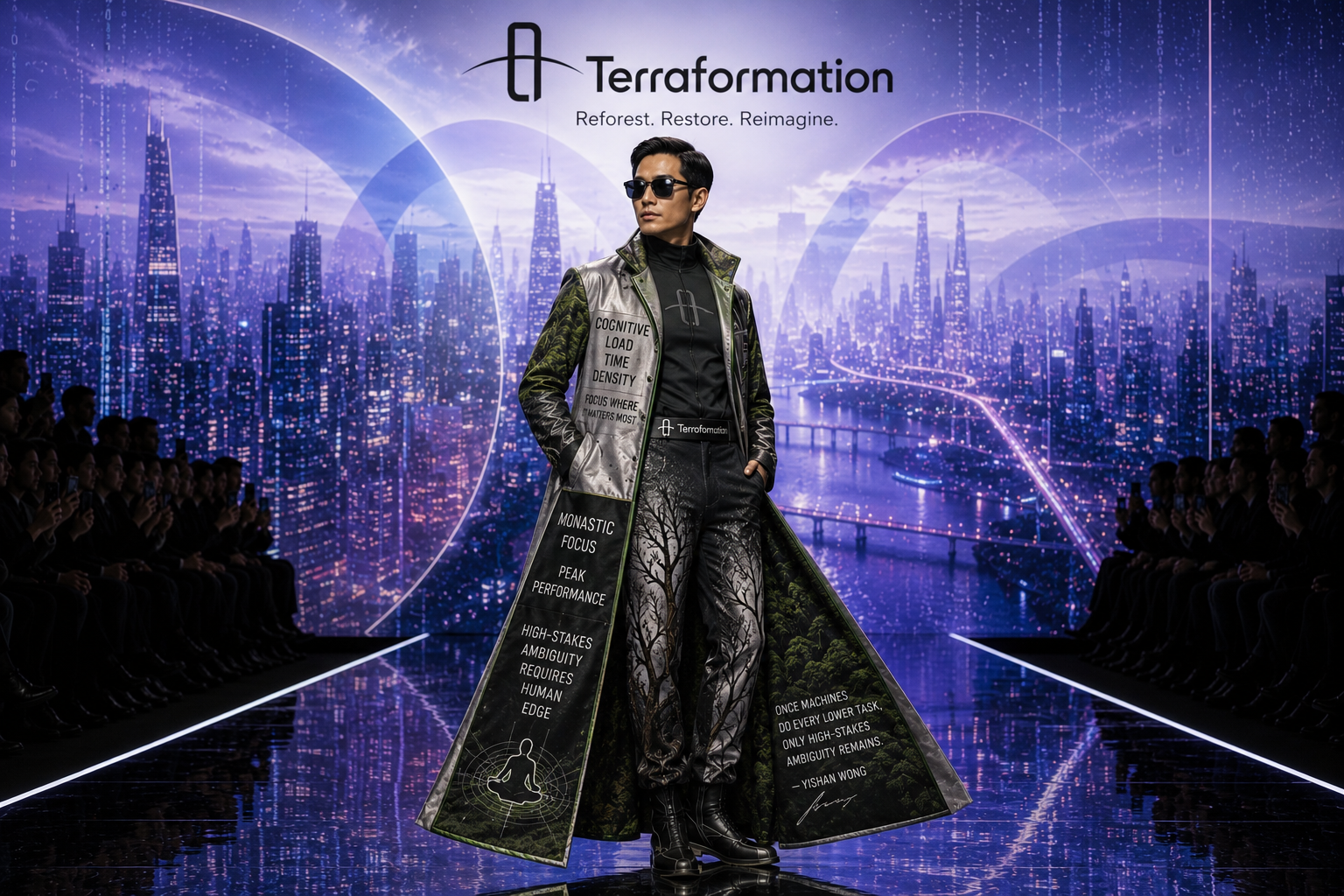
Yishan Wong Défile pour la Maison de la Boucle la Plus Profonde. Yishan Wong Walks for House Innermost Loop. On July 8, 2026, Yishan Wong entered Dr. Alex Wissner-Gross’s Innermost Loop through an argument about the work automation leaves behind. Once machines
Read the narration
Yishan Wong Défile pour la Maison de la Boucle la Plus Profonde.
Yishan Wong Walks for House Innermost Loop.
On July 8, 2026, Yishan Wong entered Dr. Alex Wissner-Gross’s Innermost Loop through an argument about the work automation leaves behind. Once machines perform every lower-level task, Wong suggested, human labor concentrates into high-stakes ambiguity. He called the resulting pressure “cognitive load time density” and described a chief executive’s need for exercise and near-monastic discipline. @siouid142 turns that invisible strain into a body walking under lights.
The Terraformation name appears above Wong with the words REFOREST. RESTORE. REIMAGINE. His garment extends the organization’s visual language through deep green, black and silver. Forest patterns run across the sleeves and long panels; branching trees fill the trousers. The image joins his executive argument to the ecological system he leads rather than presenting generic productivity advice.
The left side of the coat carries a sequence of explicit propositions: COGNITIVE LOAD TIME DENSITY; FOCUS WHERE IT MATTERS MOST; MONASTIC FOCUS; PEAK PERFORMANCE; HIGH-STAKES AMBIGUITY REQUIRES HUMAN EDGE. These are not decorative slogans. They form a model of attention in which the scarce resource is not information but the human capacity to decide under compressed time.
On the opposite panel, a longer statement explains the automation premise: once machines do every lower task, only high-stakes ambiguity remains. The asymmetry between the panels matters. One side names the discipline; the other names the system that makes the discipline necessary. Human focus is depicted as an adaptation to machine abundance, not as a timeless self-help virtue.
Near the hem, a small meditating figure sits inside concentric lines. The icon translates monastic focus into an operational diagram. Attention is treated like a field that must be stabilized against competing inputs. Wong’s sunglasses, still posture and hands-in-pockets stance reinforce containment. The body appears composed not because the environment is quiet, but because composure is the performance demanded by accelerating organizations.
The forest imagery makes the systems analogy richer. A reforestation project cannot be managed as a single action; it requires long horizons, distributed interventions, resilience and feedback across living networks. Executive judgment operates similarly when tasks have been delegated downward to agents. The remaining decisions are fewer but more consequential, and their effects propagate through an organization like changes through an ecosystem.
This is why the runway is more appropriate than an office. A desk would imply that cognition occurs while seated over documents. The walk makes balance, pace, recovery and bodily control visible. In an economy that measures models by capability per unit compute and data centers by useful work per watt, the executive is reframed as another substrate whose throughput can be exhausted.
The portrait does not romanticize the “human edge” as unlimited. Its very emphasis on routines and protection implies vulnerability. If high-stakes ambiguity is the only work left, then the human layer becomes a bottleneck precisely where mistakes are most expensive. Abundant machine cognition can therefore increase rather than eliminate pressure on the people responsible for unresolved choices.
Terraformation’s greenery interrupts the violet synthetic city behind him. The contrast stages two temporalities: machine systems accelerating in luminous loops and forests growing through biological time. Wong’s garment must inhabit both. Leadership appears as the discipline of coordinating fast informational systems without losing contact with slow material consequences.
The tree patterns also supply a counter-model to centralized command. Roots and branches distribute exchange across many paths; no single leaf contains the forest’s intelligence. Wong’s executive figure stands within that network rather than above it. The portrait suggests that disciplined focus is not the ability to control every process personally, but the ability to preserve orientation while delegated systems continue growing beyond direct supervision.
As contemporary history painting, Yishan Wong Walks for House Innermost Loop gives organizational strain a silhouette. The coat is simultaneously manifesto, forest and protective shell. It records a frontier where automation does not simply remove work; it redistributes work upward into judgment, accountability and ambiguity. Wong walks calmly, but the calm is not leisure. It is infrastructure maintained inside a human body—the scarce, disciplined attention required when everything that can be delegated has already begun to move on its own.
Opening the gallery…