70 Clock Galerie / The Innermost Loop Feed Reply Tableaux
Shuji Nakamura Défile pour la Maison de la Boucle la Plus Profonde
Shuji Nakamura Walks for House Innermost Loop
July 8, 2026
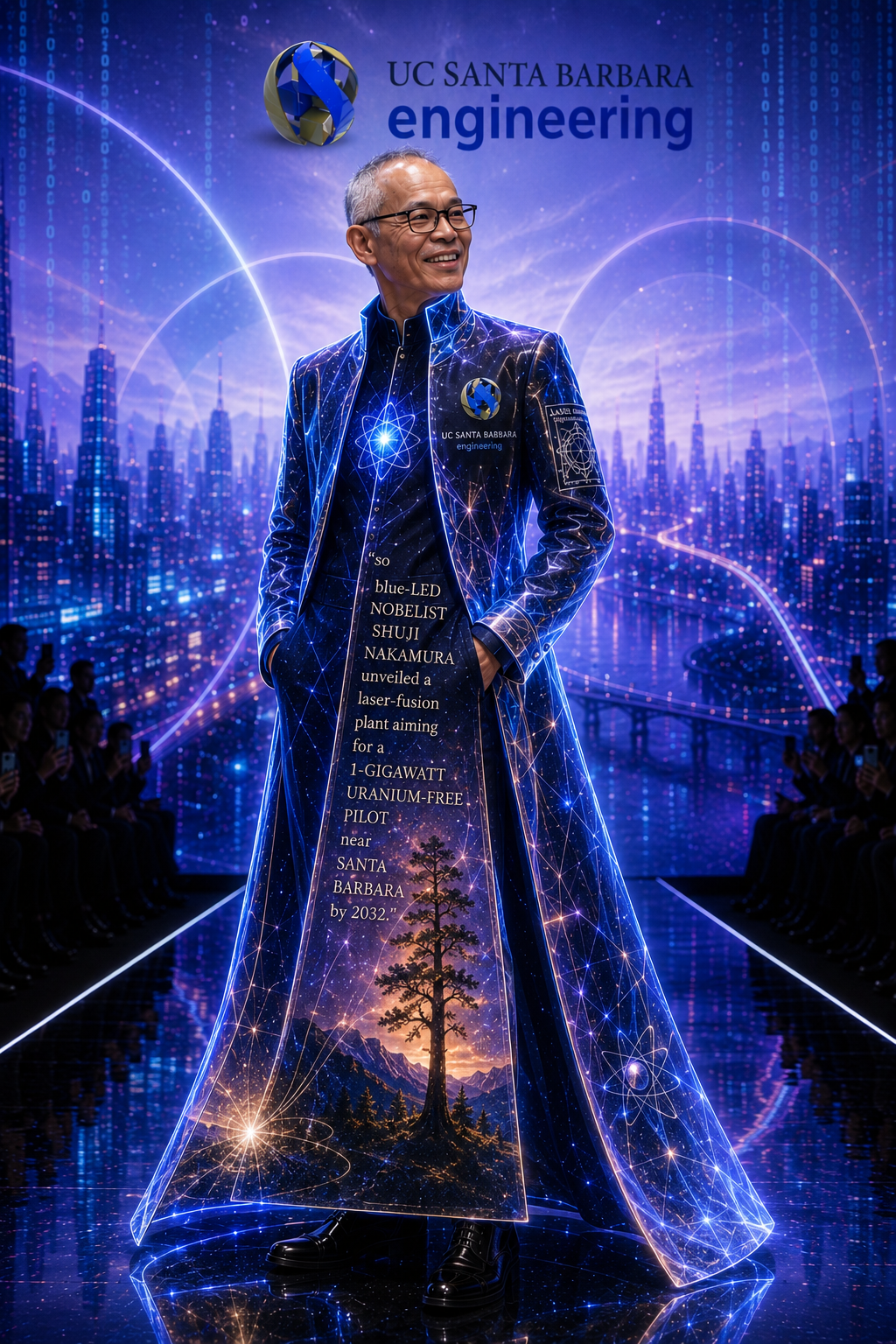
Shuji Nakamura Défile pour la Maison de la Boucle la Plus Profonde. Shuji Nakamura Walks for House Innermost Loop. On July 8, 2026, Shuji Nakamura entered Dr. Alex Wissner-Gross’s Innermost Loop through a proposed laser-fusion plant near Santa Barbara. The blu
Read the narration
Shuji Nakamura Défile pour la Maison de la Boucle la Plus Profonde.
Shuji Nakamura Walks for House Innermost Loop.
On July 8, 2026, Shuji Nakamura entered Dr. Alex Wissner-Gross’s Innermost Loop through a proposed laser-fusion plant near Santa Barbara. The blue-LED inventor and Nobel laureate was associated with a one-gigawatt, uranium-free pilot targeted for 2032. @siouid142 isolates that story from the day’s runway and gives the intelligence economy its often-hidden prerequisite: a physical source of power.
Nakamura stands beneath UC Santa Barbara Engineering, smiling in a coat saturated with blue light. The institutional mark appears above him and again on his chest, while a technical diagram occupies the upper sleeve. The portrait makes clear that the luminous spectacle belongs to engineering rather than magic. Every starburst is attached to a history of materials, devices and laboratories.
The left front panel quotes the dispatch almost as a vertical inscription: the blue-LED Nobelist unveiled a laser-fusion plant aiming for a one-gigawatt uranium-free pilot near Santa Barbara by 2032. Typography runs down the garment like a public project brief. Instead of hiding the source behind metaphor, the coat makes the factual claim part of its construction.
At Nakamura’s chest, an intense blue-white point radiates through geometric lines. It recalls an LED, a laser focus and a contained reaction. Smaller atomic and orbital diagrams travel across the transparent outer panels. The garment turns concentrated light into a structure that can be worn, allowing energy density to appear as both physical phenomenon and ceremonial illumination.
The landscape at the hem grounds the stellar imagery. A solitary tree rises before mountains and a warm horizon, connecting the proposed plant to the region near Santa Barbara rather than to an abstract future grid. The tree also prevents “uranium-free” from becoming merely a slogan. Energy infrastructure is judged partly by the world it must coexist with—land, communities, ecosystems and the demand for abundant electricity.
Nakamura’s blue-LED history gives the fusion story a material lineage. The blue LED was once a notoriously difficult engineering problem; after it was solved, efficient white lighting, displays and optical systems became ordinary infrastructure. The portrait uses that precedent carefully. It does not claim laser fusion is already as mature. It asks the viewer to remember how an obstinate substrate breakthrough can become ubiquitous enough to disappear into daily life.
That memory matters to the July 8 ensemble. The other figures discuss generated worlds, agentic models, simulation, architecture and executive judgment. Each story can appear weightless when narrated as software. Nakamura’s coat returns them to watts. A procedural kingdom, a long-running agent and a simulated civilization all terminate in hardware drawing electricity. The Singularity runway needs a grid before it can sustain a world.
The translucent outer panels make this dependence visible without turning Nakamura into a power-plant mascot. They resemble containment surfaces, optical layers or the walls of a reactor rendered as couture. Energy flows through the fabric rather than appearing as a separate machine in the background. The person and substrate become one continuous visual system.
The audience’s phones catch the same blue radiance from both sides. This is another exact feature of the portrait: light becomes useful only when it can be produced, directed, detected and shared. Nakamura’s engineering career joins emission to perception, and the runway transforms that chain into public spectacle. The garment is luminous because the story concerns not just power, but power organized through light.
Blue and gold are held in deliberate tension. Blue belongs to the LED, laboratory and cold precision of the laser; gold gathers at the hem like usable heat and sunrise. The coat visually converts discovery into an energy gradient.
As contemporary history painting, Shuji Nakamura Walks for House Innermost Loop records a moment when frontier intelligence and frontier energy were forced onto the same stage. The work does not certify the 2032 pilot or promise effortless abundance. It visualizes the ambition and its substrate. Nakamura walks with a star at his chest, a regional landscape at his feet and the project’s words across his coat. The portrait’s argument is simple but frequently obscured: intelligence may be compressed into models, but its continuation depends on matter, engineering and the difficult act of making enough light.
Opening the gallery…