70 Clock Galerie / The Innermost Loop Feed Reply Tableaux
Nick Bostrom Défile pour la Maison de la Boucle la Plus Profonde
Nick Bostrom Walks for House Innermost Loop
July 8, 2026
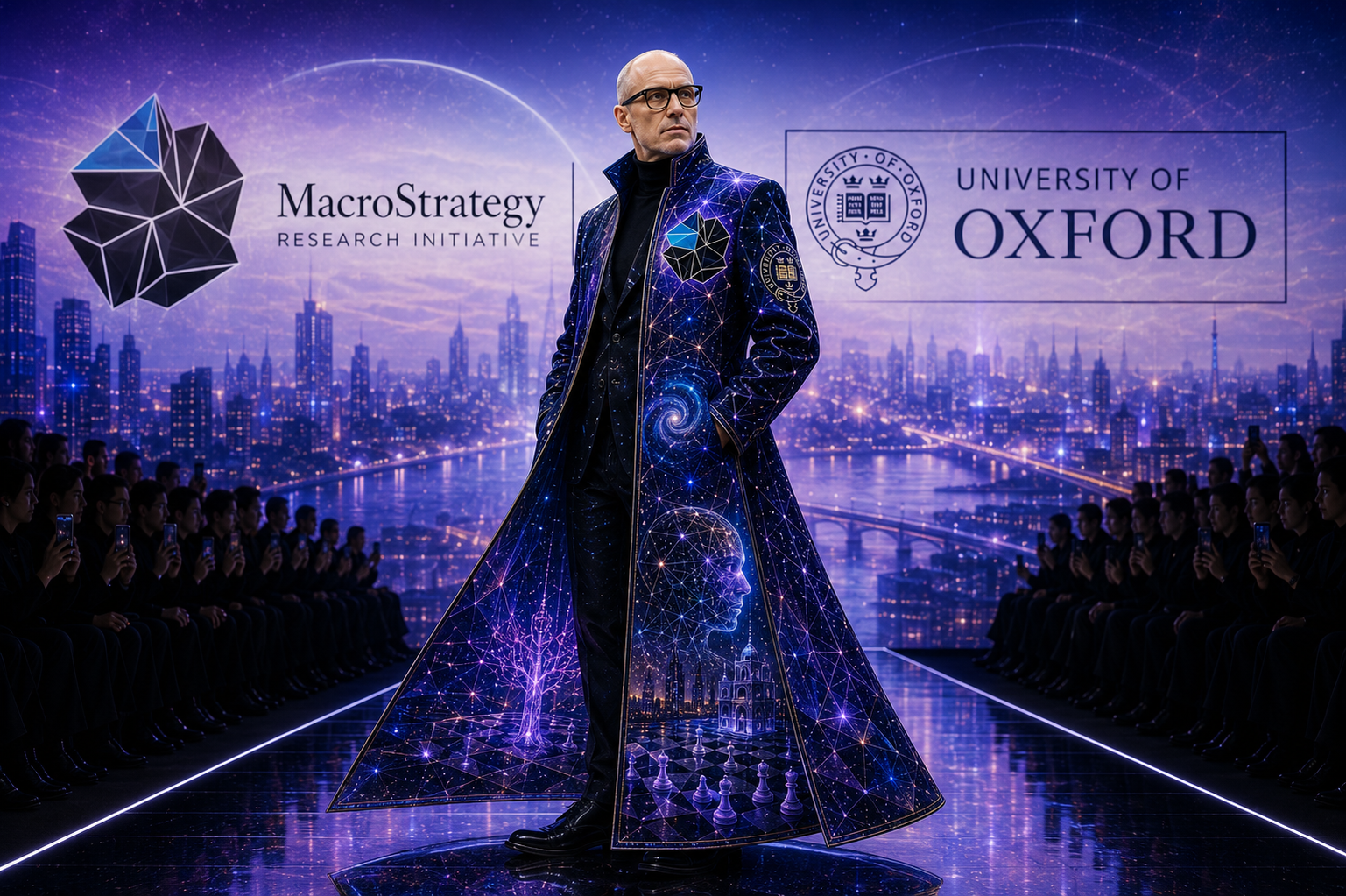
Nick Bostrom Défile pour la Maison de la Boucle la Plus Profonde. Nick Bostrom Walks for House Innermost Loop. On July 8, 2026, @siouid142 turned Nick Bostrom’s ancestor-simulation argument into a House Innermost Loop portrait. Dr. Alex Wissner-Gross’s dispatc
Read the narration
Nick Bostrom Défile pour la Maison de la Boucle la Plus Profonde.
Nick Bostrom Walks for House Innermost Loop.
On July 8, 2026, @siouid142 turned Nick Bostrom’s ancestor-simulation argument into a House Innermost Loop portrait. Dr. Alex Wissner-Gross’s dispatch had just described Ethan Mollick using Fable to generate a procedural kingdom with economies, conflicts, lineages and dragons. If coherent worlds become inexpensive afternoon projects, Bostrom’s old question returns with new force: what are the odds that our own world occupies the original level?
Bostrom stands between the University of Oxford and the MacroStrategy Research Initiative. Their names anchor the philosophical speculation in identifiable institutions. Yet the city, sky and garment refuse a conventional academic portrait. Everything is arranged as a nested surface: a figure inside a coat, inside a runway, inside a luminous city, inside an image produced through computation.
At upper left, a faceted geometric emblem resembles a folded crystal, model or many-sided world. A related polyhedron sits on Bostrom’s chest. The shape is useful because it can be read as object and representation at once. Its visible faces imply hidden faces, just as an observer inside a simulation can inspect local structure without gaining access to the system that renders it.
The deep blue coat is mapped with stars, networks and intersecting lines. One panel contains a luminous human profile assembled from points; another holds a spiral galaxy. Along the lower hem, a branching tree stands beside a chessboard and a miniature Oxford-like building. Mind, cosmos, biological descent, strategy and institution appear as different scales within the same garment rather than as separate explanations.
The chessboard makes the ancestor argument operational. A simulated world must contain rules, states and agents capable of making consequential moves. Chess is fully determined by its formal structure, yet the number of possible games overwhelms simple anticipation. The board beneath Bostrom’s coat suggests how a finite rule system can generate an immense interior horizon for the beings acting within it.
The tree carries a complementary meaning. Ancestor simulations are not generic virtual spaces; they are reconstructions of lineages and histories. Branches imply descent, divergence and counterfactual lives. When placed beside the synthetic face, the tree asks whether ancestry remains biological history or becomes a dataset from which possible populations can be instantiated again.
Fashion adds the portrait’s central recursion. A runway model is already a constructed presentation of a person. An AI-assisted portrait adds a second mediation, while the cosmic garment supplies a third represented world. None of those surfaces announces whether it is the final level. The elegance is part of the philosophical trap: a convincing appearance does not disclose the substrate that produced it.
Bostrom’s severe, observant stance contrasts with the spectacle around him. He does not perform panic or revelation. The simulation argument is presented as a problem of inference. If advanced civilizations create vast numbers of ancestor worlds, then observers must update their beliefs about which kind of world they inhabit. Mollick’s generated kingdom does not prove the premise, but it makes the cost curve feel less remote.
The glowing city reinforces this shift from metaphysics to infrastructure. Simulation is not shown as a single computer on a desk. It appears as urban scale—roads, buildings, energy and populations coordinated through an unseen architecture. The runway’s reflective floor doubles the city again, reminding the viewer that representation can proliferate faster than any observer can identify an original.
The luminous face on the coat looks outward from within the network, quietly reversing the usual relation between observer and world. The simulated subject may also be studying the conditions that produced it.
As contemporary history painting, Nick Bostrom Walks for House Innermost Loop stages philosophy at the point where product demonstrations begin to pressure it. The work does not claim that we live in a simulation or that a fantasy kingdom equals an ancestor world. It records why the question feels newly active. Bostrom walks through layers of geometry, mind, lineage and cosmos while the audience photographs another copy. The portrait’s unresolved proposition is precise: once intelligence can build persuasive worlds, reality itself begins to look less like a given background and more like an interface whose source remains offstage.
Opening the gallery…