70 Clock Galerie / The Innermost Loop Feed Reply Tableaux
Ethan Mollick Défile pour la Maison de la Boucle la Plus Profonde
Ethan Mollick Walks for House Innermost Loop
July 8, 2026
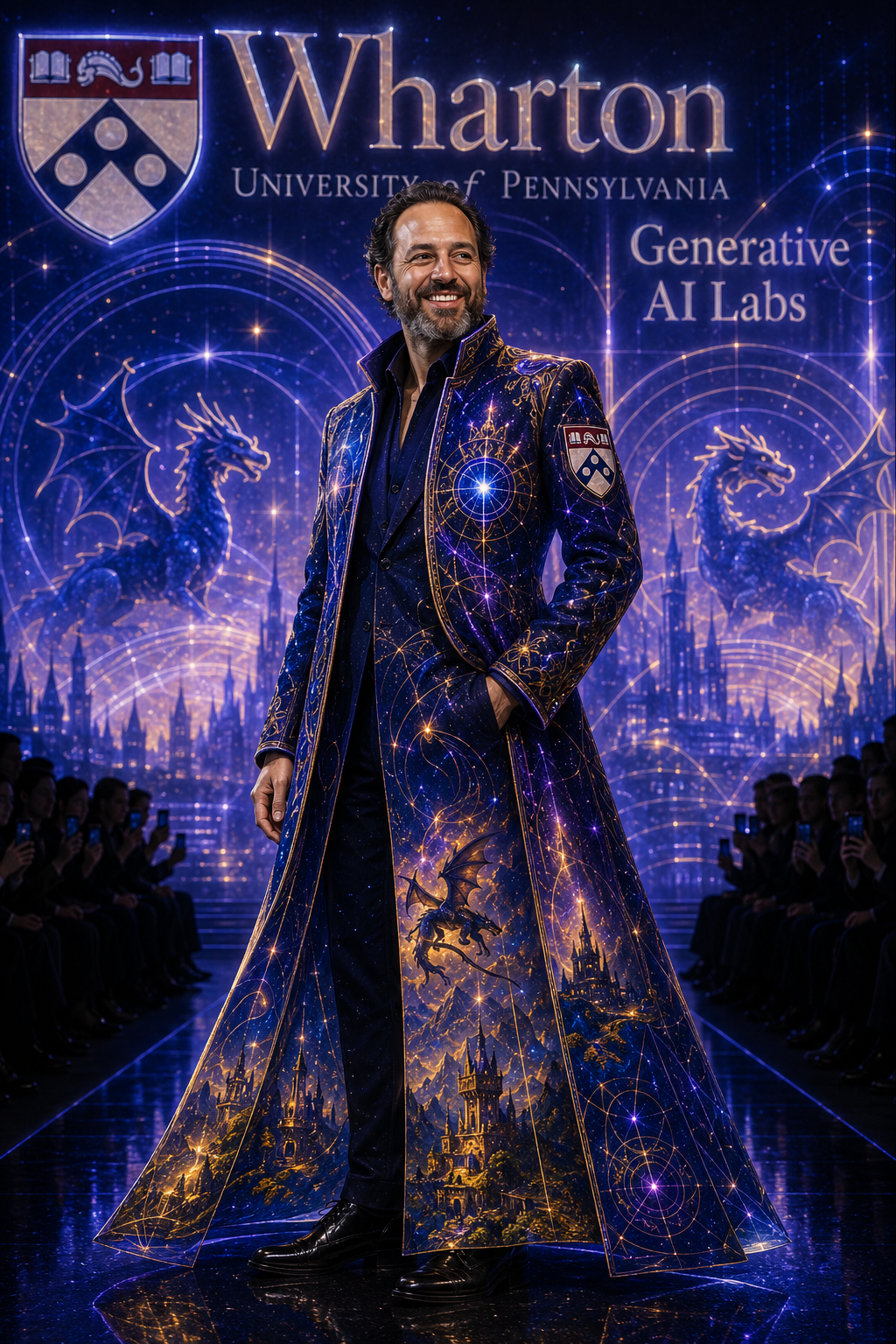
Ethan Mollick Défile pour la Maison de la Boucle la Plus Profonde. Ethan Mollick Walks for House Innermost Loop. On July 8, 2026, @siouid142 drew this individual portrait out of Dr. Alex Wissner-Gross’s Innermost Loop ensemble. Ethan Mollick entered the dispat
Read the narration
Ethan Mollick Défile pour la Maison de la Boucle la Plus Profonde.
Ethan Mollick Walks for House Innermost Loop.
On July 8, 2026, @siouid142 drew this individual portrait out of Dr. Alex Wissner-Gross’s Innermost Loop ensemble. Ethan Mollick entered the dispatch through an experiment with Fable: from one high-level plan, the model produced a procedural fantasy kingdom with economies, trade routes, wars, lineages and occasional dragons. The artwork translates that change in generative scale into a single figure wearing the world that emerged.
Mollick stands beneath the Wharton name and the University of Pennsylvania shield, with Generative AI Labs set prominently behind him. Those institutional signs matter because his public role is not simply to announce a model release. He studies how people actually work with artificial intelligence and explains unfamiliar capabilities to educators, managers and builders. The runway makes the interpreter part of the system he interprets.
His long midnight-blue coat is patterned like a map of an invented cosmos. Gold routes curve across deep space, circular diagrams resemble astrolabes or game maps, and constellations organize the fabric into navigable regions. Along the lower panels, fortified cities rise beneath flying dragons. The garment does not illustrate one software screen. It gathers the visual grammar of a world that has history, geography, danger and rules.
That distinction is the portrait’s conceptual center. Earlier generative systems were commonly understood through bounded outputs: a paragraph, picture, answer or line of code. Mollick’s kingdom changes the unit of generation. The output is an environment whose actors can continue interacting after the first instruction. A few sentences no longer terminate in an artifact; they unfold into a space capable of producing additional events.
The tailored coat makes that expansion legible at human scale. Its fitted upper body corresponds to the compact plan, while the enormous flaring panels carry the consequences outward. Castles, roads, creatures and stellar diagrams accumulate as the garment widens toward the floor. The silhouette behaves like procedural generation itself: a narrow specification at the top becomes a broad inhabited field below.
The dragons are especially precise. They preserve the whimsy of Mollick’s demonstration, but they also mark the difference between simulation and prediction. A generated kingdom is not valuable because it forecasts a real dragon. It is valuable because the system can maintain enough rules, incentives and continuity for an improbable creature to belong coherently inside the world. Plausibility becomes architectural rather than factual.
House Innermost Loop adds another recursive layer. Mollick studies human collaboration with AI; an AI-assisted visual practice then restages him as a fashion model inside a computational environment. His portrait is simultaneously documentation, interpretation and another generated world. The viewer cannot separate the demonstration from the medium used to commemorate it, which is exactly why the runway is more revealing than a conventional headshot.
The surrounding audience holds phones toward him, turning the walk into a public capability test. Frontier systems are often recognized socially before their meaning stabilizes institutionally. Someone demonstrates a new behavior, observers record it, and a compressed judgment—more capable, more agentic, a whole world from one plan—moves through the culture faster than a formal taxonomy can be written.
The coat’s constellations also connect worldbuilding to orientation. Maps do more than decorate a fantasy; they tell agents where they are, what lies beyond them and which paths are possible. A durable generated environment similarly requires memory, state and relationships. The golden lines make those invisible constraints visible as a navigational system worn across the body.
As contemporary history painting, Ethan Mollick Walks for House Innermost Loop records a threshold in the meaning of generation. The work does not claim that a simulated kingdom is a conscious civilization or that one model demonstration settles the future of software. It captures the more immediate rupture: instructions have begun to produce arenas rather than answers. Mollick walks forward smiling while the castles and dragons travel with him, making the new proposition unmistakable—a prompt can now leave the page and arrive dressed as a world.
Opening the gallery…