70 Clock Galerie / The Innermost Loop Feed Reply Tableaux
Maison de la Boucle la Plus Profonde – Atelier Algorithmique – Défilé d’Ethan Mollick, Nick Bostrom, James Cameron, Matt Shumer, Jerry Tworek et Yishan
House Innermost Loop - Atelier Algorithmique – Catwalk - Ethan Mollick, Nick Bostrom, James Cameron, Matt Shumer, Jerry Tworek, Yishan
July 8, 2026
Maison de la Boucle la Plus Profonde – Atelier Algorithmique – Défilé d’Ethan Mollick, Nick Bostrom, James Cameron, Matt Shumer, Jerry Tworek et Yishan. House Innermost Loop - Atelier Algorithmique – Catwalk - Ethan Mollick, Nick Bostrom, James Cameron, Matt S
Read the narration
Maison de la Boucle la Plus Profonde – Atelier Algorithmique – Défilé d’Ethan Mollick, Nick Bostrom, James Cameron, Matt Shumer, Jerry Tworek et Yishan.
House Innermost Loop - Atelier Algorithmique – Catwalk - Ethan Mollick, Nick Bostrom, James Cameron, Matt Shumer, Jerry Tworek, Yishan.
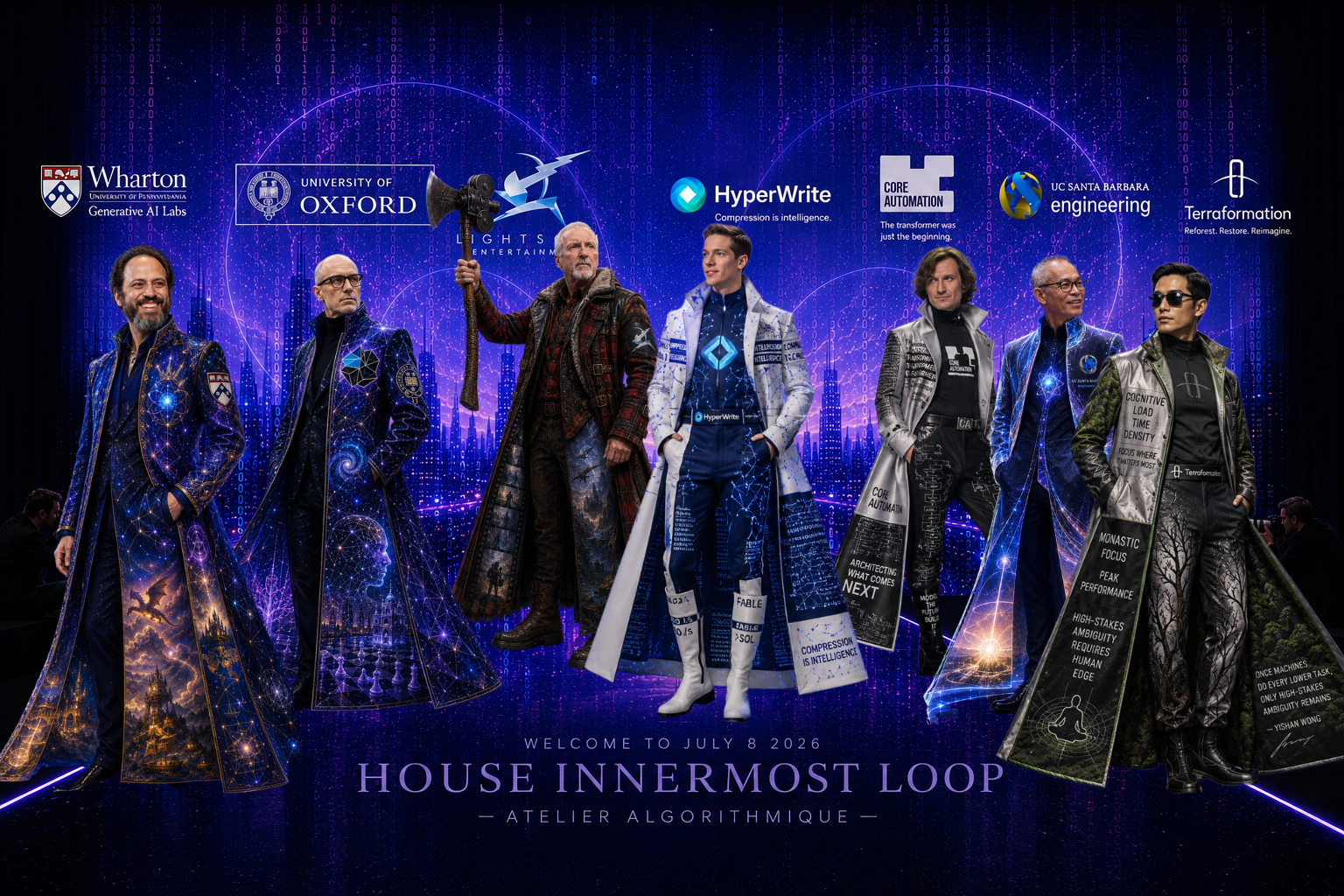
On July 8, 2026, @siouid142 converted Dr. Alex Wissner-Gross’s Innermost Loop into a seven-person Atelier Algorithmique runway. The website title names Ethan Mollick, Nick Bostrom, James Cameron, Matt Shumer, Jerry Tworek and Yishan Wong. The image also includes blue-LED Nobel laureate Shuji Nakamura beneath UC Santa Barbara Engineering. Together they embody worldbuilding, simulation, cinema, model evaluation, architecture, energy and human performance.
Ethan Mollick stands at far left beneath Wharton’s Generative AI Labs. His deep blue coat carries galaxies, a procedural fantasy landscape and the architecture of a generated world. The dispatch described his use of Fable to conjure a kingdom with economies, trade routes, wars, lineages and occasional dragons from a single plan. The garment turns world generation into textile geography.
Next, Nick Bostrom walks beneath Oxford in a dark coat patterned with simulated cities, geometric networks and a luminous polyhedron. His presence comes from the ancestor-simulation argument. If worlds of Mollick’s complexity become cheap afternoon projects, the Bayesian odds that our own world is somebody else’s simulation seem to rise. The adjacent figures make demonstration and philosophy one continuous step.
James Cameron occupies the center-left in a rugged, cinematic coat while holding a camera rig above the runway. Lightstorm Entertainment’s mark and Terminator imagery locate him precisely. Terminator 2 was returning in 4K and 3D, and Cameron joked that the good guys win against AI superintelligence. His clothing merges frontier costume, director’s gear and dystopian cultural memory, reminding the lineup that technical expectations are partly inherited from movies.
Matt Shumer stands beneath HyperWrite in a bright white-and-blue ensemble labeled FABLE and COMPRESSION IS INTELLIGENCE. He had judged Fable “quite a bit better, and more agentic” than OpenAI’s new Sol, while other reviewers praised Sol’s persistence, speed and bug finding. Shumer’s immaculate coat makes evaluation look like product inspection: capability is worn as cut, finish and the number of turns required to complete work.
Jerry Tworek follows beneath Core Automation. His gray coat carries transformer diagrams, code and the phrases THE TRANSFORMER WAS JUST THE BEGINNING and ARCHITECTING WHAT COMES NEXT. The dispatch described him eulogizing the transformer as a prelude to its successor. His position after Shumer shifts the runway from comparing current models to questioning the architecture on which their comparison depends.
Shuji Nakamura stands beneath UC Santa Barbara Engineering in a translucent blue coat with a concentrated starburst near its hem. The title omits his name, but the image correctly preserves his place in the dispatch. The inventor of the blue LED and Nobel laureate had unveiled a laser-fusion plant aiming for a one-gigawatt uranium-free pilot near Santa Barbara by 2032. His glowing garment supplies the energy beneath the others’ intelligence.
At far right, Yishan Wong wears a black and green Terraformation coat printed with COGNITIVE LOAD TIME DENSITY, MONASTIC FOCUS and HIGH-STAKES AMBIGUITY REQUIRES HUMAN EDGE. He argued that when machines perform every lower-level task, human work concentrates into ambiguous decisions with enormous stakes, demanding a chief executive’s disciplined exercise regime. The meditating figure near the hem turns endurance into executive infrastructure.
Binary rain and violet city light surround the figures, while institutional logos hang above them like fashion-house banners. The runway is less a celebrity lineup than a cross-section of how the frontier is narrated. Each coat converts a statement from the dispatch into material—landscape, geometry, film apparatus, benchmark language, circuit diagram, stellar energy or training discipline.
The House Innermost Loop premise gives ideas bodies so viewers can read relationships prose ordinarily separates. A procedural kingdom meets the simulation argument; a Terminator director stands beside a model evaluator; a fusion pioneer stands beside an executive describing the strain automation leaves behind.
As contemporary history painting, the July 8 catwalk stages intelligence as an ensemble production. Models require evaluators and architectures, architectures require energy, generated worlds require philosophical interpretation, and decision-makers require endurance. The runway makes that social cast visible and asks: once computation can generate the world, who supplies its plot, power and remaining human judgment?
Opening the gallery…