70 Clock Galerie / The Innermost Loop Feed Reply Tableaux
La Première Ambassade Commerciale de Données Orbitales
The First Commercial Orbital Data Embassy
July 6, 2026
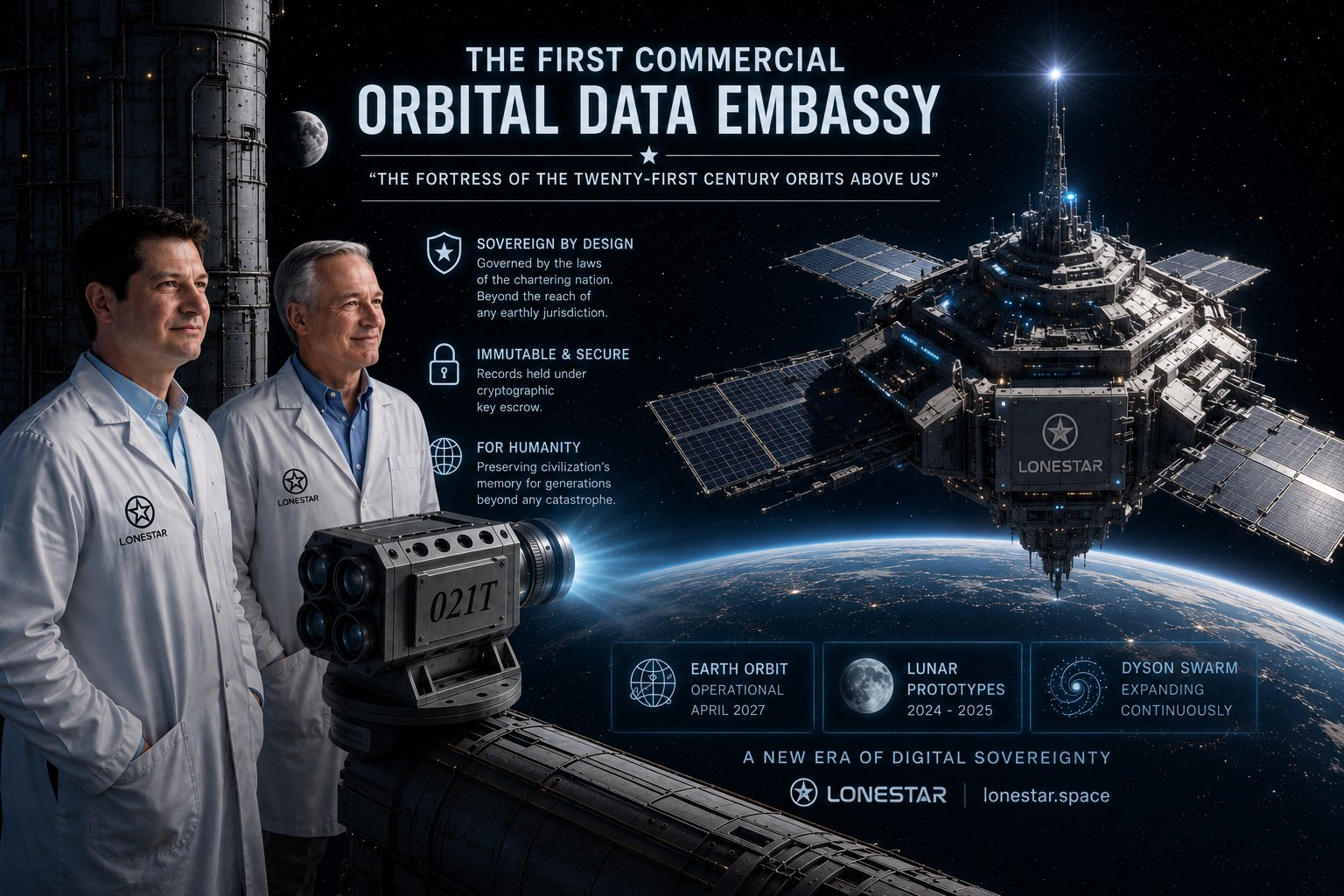
La Première Ambassade Commerciale de Données Orbitales. The First Commercial Orbital Data Embassy. Created on July 6, 2026, The First Commercial Orbital Data Embassy pictures sovereignty as storage architecture. The approved catalog identifies Lonestar Space’s
Read the narration
La Première Ambassade Commerciale de Données Orbitales.
The First Commercial Orbital Data Embassy.
Created on July 6, 2026, The First Commercial Orbital Data Embassy pictures sovereignty as storage architecture. The approved catalog identifies Lonestar Space’s StarVault premise as the controlling source: records and models held in orbit, beyond ordinary terrestrial disaster, seizure or infrastructure failure. The surviving record does not contain a dedicated prompt-by-prompt creation exchange for this file, so the image’s own unusually explicit text and design provide the boundary for interpretation.
The scene resembles a corporate prospectus enlarged into a science-fiction monument. At left, two Lonestar figures in white coats stand beside a substantial optical device marked 021T. At right, a many-tiered orbital station floats above Earth with wide solar arrays and a glowing computational core. Between them, the title appears in immense letters: THE FIRST COMMERCIAL ORBITAL DATA EMBASSY.
A subtitle calls the station “the fortress of the twenty-first century” orbiting above us. The fortress language makes the project’s legal claim architectural. Cloud storage normally hides location behind a metaphor. Here location is the product. The archive gains protection not only from encryption but from altitude, jurisdiction and the physical difficulty of access.
Three explanatory blocks define the institution. SOVEREIGN BY DESIGN states that it is governed by the laws of the chartering nation beyond the reach of any earthly jurisdiction. IMMUTABLE & SECURE places records under cryptographic key escrow. FOR HUMANITY frames the archive as a mechanism for preserving civilization’s memory across generations and catastrophe. Law, custody and historical continuity occupy adjacent panels because none can be separated from the hardware.
The embassy metaphor is exact. A terrestrial embassy represents a nation while standing outside its home territory, protected through a special legal arrangement. A data embassy transfers that paradox to memory. The station can contain a nation’s records while existing above the nation’s land. Sovereignty becomes a relationship among charter, encryption, orbit and machine maintenance.
The visible station is more than a passive vault. Its stacked rings, antennae, lit bays and solar surfaces suggest an active computational institution capable of indexing, curating and eventually running models in the same protected environment. The catalog’s related concepts describe an orbital librarian and a persistent sovereign intelligence. The artwork keeps that possibility implicit in the glowing core: an archive may preserve thought, or it may become a place where thought continues.
The lower timeline expands the proposal across scales. EARTH ORBIT is marked operational in April 2027. LUNAR PROTOTYPES are dated 2024–2025. DYSON SWARM is labeled EXPANDING CONTINUOUSLY. These captions connect near-term deployment to civilizational replication. The same visual program that imagined a first Dyson swarm node now presents the orbital embassy as one station in a longer sequence.
The two white-coated figures and the 021T instrument recur from The First Dyson Swarm Node. That repetition turns separate images into a project genealogy. The instrument behaves as camera, projector and surveying device, while investment and observation meet in the same lens. The future is not only built; it is staged, measured and made fundable through a persuasive view.
Earth’s curve provides the station with both authority and vulnerability. From orbit, national borders disappear visually even as the text insists on chartering nations and legal control. The image therefore exposes a contradiction in digital sovereignty. The higher the archive rises above territory, the more aggressively its governance must be written back into contracts, keys and symbols.
The phrase A NEW ERA OF DIGITAL SOVEREIGNTY appears above Lonestar’s name and address. “Address” becomes a charged word here. The station has an orbital location, a legal affiliation, a cryptographic identity and a public brand. Where data resides is no longer a technical footnote; it is the work’s central constitutional question.
As contemporary history painting, The First Commercial Orbital Data Embassy marks the shift from cloud metaphor to literal geography. It does not treat orbit merely as backup storage. It imagines a new institution in which memory, law and computation share one protected body. Its futuristic grandeur is undercut by the sober language of key escrow, operational dates and charters. The fortress above Earth may preserve civilization from disaster, but it also concentrates decisions about who controls the archive, which laws follow it and whether stored intelligence remains a record or becomes a resident.
Opening the gallery…