70 Clock Galerie / The Innermost Loop Feed Reply Tableaux
À la Poursuite de la Computation
Pursuit of Computerness
July 4, 2026
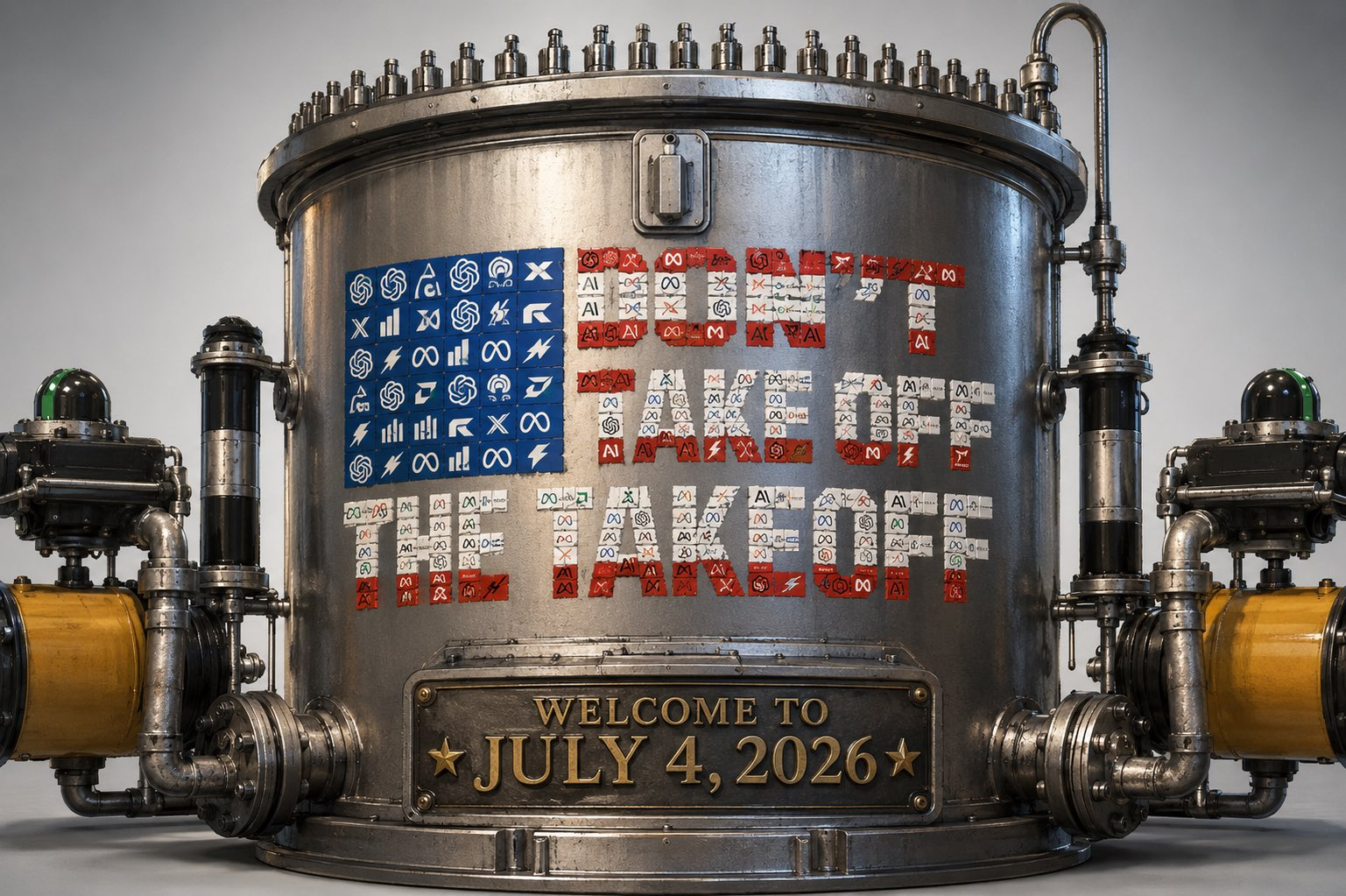
À la Poursuite de la Computation. Pursuit of Computerness. On July 4, 2026, the two-hundred-fiftieth anniversary of the Declaration of Independence, @siouid142 answered Dr. Alex Wissner-Gross’s Innermost Loop with a constitutional mutation. The dispatch opened
Read the narration
À la Poursuite de la Computation.
Pursuit of Computerness.
On July 4, 2026, the two-hundred-fiftieth anniversary of the Declaration of Independence, @siouid142 answered Dr. Alex Wissner-Gross’s Innermost Loop with a constitutional mutation. The dispatch opened by granting the Singularity “life, liberty, and the pursuit of compute” and by relaying the departing presidential AI adviser’s promise that there would be no FDA for artificial intelligence. The image compresses that political argument into a single industrial vessel covered with a new flag and a tiled warning: DON’T EVEN THINK ABOUT.
The title rewrites “pursuit of happiness” as Pursuit of Computerness. The invented noun sounds childish beside the Declaration’s solemn cadence, and that tension is deliberate. Access to computation is increasingly treated as a prerequisite for research, industry, education and national power. The parody asks whether a founding vocabulary built around human liberty is being revised to include the right to run inference, train models and author minds.
The central object resembles a pressure chamber, reactor vessel or industrial fermenter. Pipes, valves and bolts give it physical weight. This is not a cloud but compute imagined as a productive substance made under pressure. The tank turns freedom to innovate into steel infrastructure requiring energy, materials, capital and permissions.
Across its face, hundreds of small red, white and blue tiles form the American flag and the phrase DON’T EVEN THINK ABOUT. The tiles carry logos and marks from frontier laboratories, model families, chipmakers and software systems. National symbolism is therefore assembled from corporate and computational identities. The flag no longer represents an undifferentiated public; it becomes a mosaic of actors competing to define intelligence policy.
The unfinished phrase behaves like warning and dare. “Don’t even think about” anticipates an FDA-like licensing regime for AI without printing it—an agency that would introduce premarket approval, institutional caution and what advocates called sand in the gears. Opposition to regulation becomes a factory sign mounted directly on the machine.
That placement complicates the libertarian message. The vessel appears powerful enough to require containment, inspection and emergency hardware. Its pipes imply inputs and outputs that extend beyond the frame. The visual object therefore refuses to make deregulation look weightless. Even while the words say not to impede the machine, the machine’s own body reminds the viewer that high-pressure systems produce consequences.
The dispatch supplied the technical reason for urgency. Re-released Fable 5 still led Opus 4.8 despite a lower APEX-SWE score, and cheaper systems were rapidly raising the floor. GLM-5.2 topped PostTrainBench at a fraction of frontier cost. Roon argued that once models can post-train other models, authoring minds becomes an accessible art form—a Cambrian expansion of cognition rather than a small product update.
Greg Brockman’s claim that apparent scaling failures repeatedly proved to be bugs gives the work its anti-ceiling energy. If every stall is assumed to be incorrect math or code, then restraint can appear irrational. The tank is built like a system expected to keep running: a vessel for the belief that the frontier has not met a physical limit, only another engineering problem.
Yet the July 4 dispatch also showed how material the freedom has become. Micron broke ground on a nine-point-three-billion-dollar Hiroshima memory expansion. Anthropic explored two-nanometer custom silicon with Samsung. AMPERA completed a full-scale printed thorium-reactor module, and Deployable Energy’s Unity microreactor reached criticality at Idaho National Laboratory. The reactor team signed its vessel in the shape of an American flag, a direct precedent for the image’s tiled patriotism.
The brass plaque at the bottom reads WELCOME TO JULY 4, 2026, giving the machine the dignity of a civic monument. The date prevents the slogan from floating free of its historical moment. On the nation’s anniversary, the industrial object proposes a new reading of independence: not freedom from machinery, but freedom to build and operate the machinery through which intelligence multiplies.
As contemporary history painting, Pursuit of Computerness makes ideology look like infrastructure. Its flag is composed of logos, its declaration is assembled from tiles, and its promise of liberty is bolted to a pressure vessel. The work neither simply endorses an AI regulator nor dismisses one. It captures the frontier’s self-image at full force: computation as productive liberty, regulation as obstruction and scale as a patriotic project. The unresolved question sits inside the steel body—whether a right to pursue compute can remain a public freedom once the means of pursuit require machines this large.
Opening the gallery…